

Concepts: Mechanism of breathing and respiratory volumes
Breathing and Exchange of Gases24 min readLesson 2 of 6
2.1 Two pumps and one pressure difference
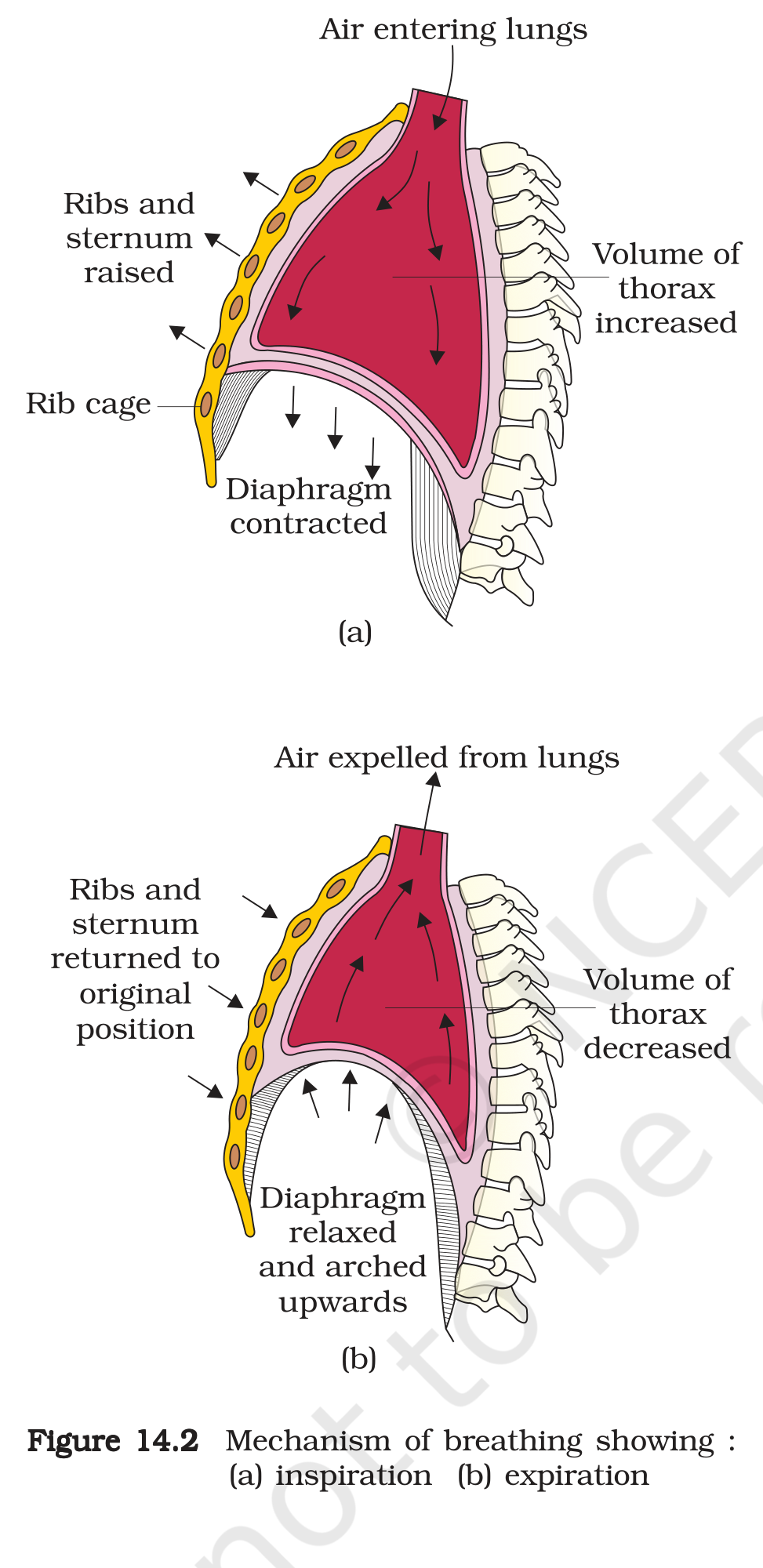
Air moves into the lungs when the pressure inside the lungs falls below the atmospheric pressure and moves out when the pulmonary pressure rises above it. Breathing therefore works by changing the volume of the chest cavity, because pressure and volume move in opposite directions in a closed space. Inspiration is an active process. The diaphragm contracts and flattens, and the external intercostal muscles lift the ribs and the sternum up and out. Both actions increase the volume of the thoracic cavity, which increases the volume of the lungs, and the pressure inside the lungs falls below the atmospheric pressure. Air then flows in from outside until the pressures equalise. Expiration at rest is passive: the diaphragm relaxes and becomes dome shaped again, the ribs and sternum return to their resting positions, the thoracic volume falls and the pressure inside the lungs rises slightly above atmospheric pressure, so air is pushed out. Forced expiration uses the abdominal muscles and the internal intercostals. A healthy adult breathes about 12 to 16 times per minute at rest. Figure 14.2 shows the two phases: in the inspiration panel the ribs and sternum are raised, the diaphragm is contracted and the volume of the thorax is increased; in the expiration panel the ribs and sternum have returned and the diaphragm is relaxed and arched upward.
2.1.1 Volumes and capacities
A spirometer measures the volume of air moved in and out, and the readings define the standard lung volumes. Tidal volume is the amount of air moved in or out when a person breathes normally, which is about 500 mL. Inspiratory reserve volume is the extra volume that can be inspired by a forcible inspiration, about 2500 to 3000 mL. Expiratory reserve volume is the extra volume that can be expired by a forcible expiration, about 1000 to 1100 mL. Residual volume is the air still left in the lungs after the person has breathed out as hard as possible; it is about 1100 to 1200 mL and a simple spirometer cannot measure it. Capacities are sums of two or more volumes. Inspiratory capacity is tidal volume plus inspiratory reserve volume. Expiratory capacity is tidal volume plus expiratory reserve volume. Functional residual capacity is expiratory reserve volume plus residual volume. Vital capacity is the maximum air expired after a maximum inspiration, and it is the sum of expiratory reserve volume, tidal volume and inspiratory reserve volume. Total lung capacity is the total air the lungs can hold, which is vital capacity plus residual volume.
| Measurement | What it means | Typical adult value |
|---|---|---|
| Tidal volume | Air moved in a normal breath | About 500 mL |
| Inspiratory reserve volume | Extra air after a forcible inspiration | 2500 to 3000 mL |
| Expiratory reserve volume | Extra air after a forcible expiration | 1000 to 1100 mL |
| Residual volume | Air left after forcible expiration | 1100 to 1200 mL |
| Vital capacity | Maximum air expired after maximum inspiration | About 3500 to 4500 mL |
| Total lung capacity | All air the lungs can hold | About 5000 to 6000 mL |
2.1.2 Reading the spirometer trace
A spirometer records the movement of a light drum or a digital sensor as the person breathes through a mouthpiece, and the trace shows the tidal breaths as a series of small waves. A deep breath in makes a tall upward wave, and the extra volume above the tidal level is the inspiratory reserve volume. A forced breath out after a normal expiration gives the downward wave whose height is the expiratory reserve volume. The residual volume cannot be read from the trace because it never leaves the lungs, so it is measured by other methods and then added to the tracings to get the total lung capacity.
2.1.3 Why the values are ranges
The printed values are averages, and a healthy person's values depend on age, sex, body size and training. A trained athlete may have a vital capacity well above the typical range, while an older person or a person with a restrictive lung disease may have a much smaller one. This is why the clinical question usually asks whether a value is inside the expected range for that person, and why a single reading is compared with the person's predicted value rather than with a fixed number.
2.1.4 Keeping the sums straight
The capacities are built from the four volumes, so a quick check is to ask which volumes make up the capacity named in the question. Inspiratory capacity is tidal volume plus inspiratory reserve volume, and it is the largest breath a person can take in from a normal resting level. Expiratory capacity is tidal volume plus expiratory reserve volume, and it is the most a person can breathe out from a normal resting level. Functional residual capacity is the air left after a normal breath, because the expiratory reserve volume cannot be called on in quiet breathing, so the lungs keep the residual volume plus the expiratory reserve volume. Vital capacity is the largest possible breath out after a largest possible breath in, and total lung capacity adds the residual volume to the vital capacity. Learning the two master sums, vital capacity and total lung capacity, makes every other capacity easy to derive in the exam.
Exam
The breathing question wants four links in order: muscle action, change in thoracic volume, change in pulmonary pressure, movement of air. For inspiration the muscles are the diaphragm and external intercostals, the volume rises and the pressure falls. For normal expiration the muscles relax, the volume falls and the pressure rises. For the volumes, memorise the two master sums: vital capacity is ERV plus TV plus IRV, and total lung capacity is vital capacity plus residual volume.
Common mistake
Do not say that normal expiration is active. At rest expiration is passive and happens when the inspiratory muscles relax, and only forced expiration uses the abdominal muscles. Do not add residual volume to vital capacity to get total lung capacity and then claim the residual volume can be measured by a spirometer, because it cannot. Do not confuse inspiratory capacity with inspiratory reserve volume: capacity includes the tidal volume, reserve volume does not.
2.1.5 Practice from the NCERT exercises, questions 1, 2, 6, 13 and 14
Exercise 1. Vital capacity is the largest volume a person can expel after taking the fullest possible breath. It shows how much air the lungs can actually move, and the clinic uses it to judge restrictive lung disease.
Exercise 2. After a normal breath the air still in the lungs is the functional residual capacity, which is the sum of expiratory reserve volume and residual volume, about 2100 to 2300 mL. The residual volume alone is the air left after the hardest possible expiration, about 1100 to 1200 mL.
Exercise 6. Normal inspiration begins when the diaphragm contracts and flattens and the external intercostal muscles lift the ribs and sternum. Thoracic volume rises, the lungs expand, the pressure inside the lungs falls below atmospheric pressure and air flows in. The phase ends when the muscles relax and the pressures equalise.
Exercise 13. IRV is the extra air taken in after a normal inspiration, 2500 to 3000 mL, while ERV is the extra air pushed out after a normal expiration, 1000 to 1100 mL. Inspiratory capacity is tidal volume plus IRV, and expiratory capacity is tidal volume plus ERV. Vital capacity is the maximum air exchanged after a maximum inspiration, and total lung capacity is vital capacity plus residual volume.
Exercise 14. Tidal volume is the air moved in a normal breath, about 500 mL. At 12 to 16 breaths per minute the air moved in an hour works out to about 360 to 480 litres, which is the figure a healthy person reaches over that time.