

Concepts: Excretory products and the human urinary system
Excretory Products and their Elimination24 min readLesson 1 of 6
1.1 Wastes that must leave the body
Metabolism produces substances that cannot be used again and would become harmful if they accumulated. The main ones are the nitrogenous wastes ammonia, urea and uric acid, together with carbon dioxide, water and various ions. Removing these substances is called excretion, and it is different from egestion, which is the removal of undigested food from the gut.
The form in which an animal excretes nitrogen depends largely on how much water is available to it. Ammonia is very soluble but highly toxic, so an animal that excretes ammonia must have plenty of water to dilute it and flush it out. This habit is called ammonotelism, and it is seen in bony fishes, aquatic amphibians and aquatic insects. Urea is much less toxic than ammonia and needs less water to be carried away, so many mammals and amphibians, and also marine fishes, convert ammonia to urea in the liver and excrete urea; such animals are called ureotelic. Uric acid is the least soluble of the three and can be excreted as a semi-solid paste or as pellets of crystals, which saves a great deal of water. Birds, reptiles and land snails are uricotelic, and the white part of bird droppings is the uric acid.
1.2 Excretory structures across animals
The organ used for excretion differs across groups. Flatworms have a network of protonephridia whose ends carry flame cells, and these structures are mainly concerned with ionic and fluid volume regulation, that is osmoregulation. Earthworms have nephridia, which are tubular structures that remove nitrogenous wastes and keep the fluid and ionic balance. Insects such as cockroaches have Malpighian tubules, which pour nitrogenous wastes into the gut so that they leave with the faeces and also help in osmoregulation. Crustaceans such as prawns have antennal glands or green glands that perform the excretory function. Chordates, including humans, have kidneys.
1.3 The human urinary system
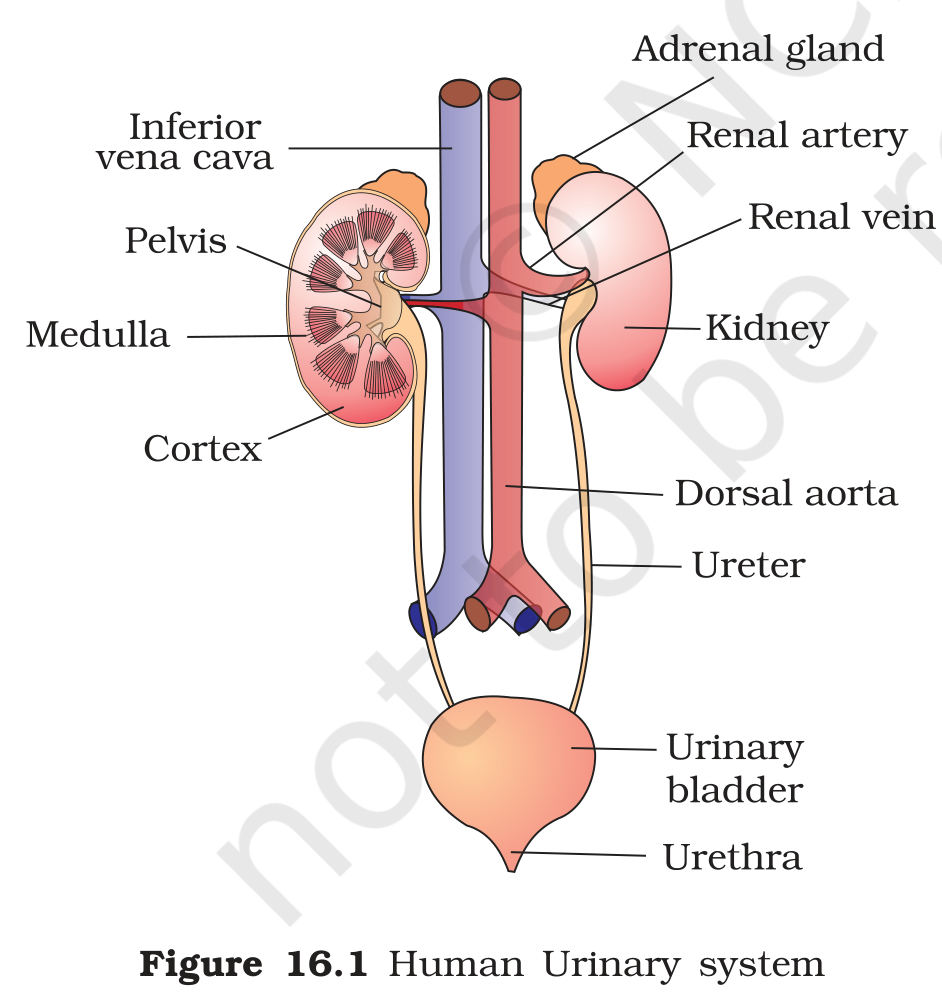
A human being has two kidneys, two ureters, one urinary bladder and one urethra that together form the excretory system. Each kidney is a reddish brown, bean shaped organ that sits at the level of the last thoracic and the third lumbar vertebrae, against the back wall of the abdomen. An adult kidney measures about 10 to 12 cm in length, 5 to 7 cm in width and 2 to 3 cm in thickness, and weighs on average about 120 to 170 g.
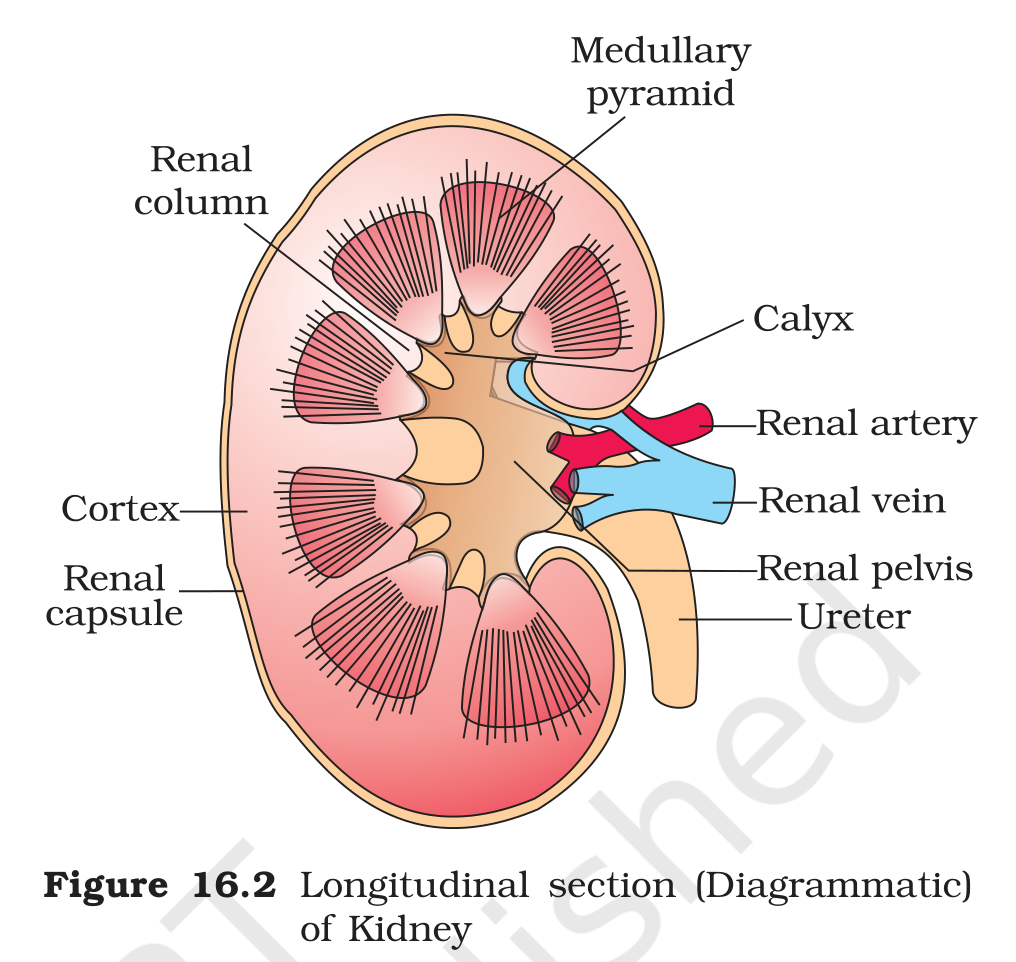
On its inner edge the kidney has a notch, the hilum, where the ureter, the blood vessels and the nerves enter and leave. Just inside sits the renal pelvis, a wide funnel whose branches are the calyces, and the whole organ is wrapped in a tough capsule. A cut surface reveals a pale granular rim around a darker core. The rim is the cortex, and the core is the medulla. The core is built of cone shaped masses, the medullary pyramids, whose points open into the calyces, and strips of cortex called the renal columns or columns of Bertini run down between them.
About a million nephrons sit in each kidney and do the filtering work. A nephron begins with the glomerulus, a knot of capillaries fed by the afferent arteriole, and blood leaves it by the efferent arteriole. The capillary knot is cupped inside Bowman's capsule, and the two together make the malpighian body or renal corpuscle. The tubule then winds as the PCT, dips as Henle's loop, winds again as the DCT, and joins a collecting duct; the ducts converge on the pyramids and calyces before reaching the pelvis.
1.3.1 Why the waste form matters so much
A fish that lives in water can afford to lose ammonia because the surrounding water dilutes it at once. A land animal cannot do that: it would have to carry a large volume of water to the kidneys just to dissolve the ammonia, and water is too precious on land. Converting ammonia into urea costs energy in the liver but needs far less water for the same amount of nitrogen, and converting it into uric acid costs more energy still but allows the waste to leave as a paste or as dry crystals. The three habits therefore map onto the water available in the habitat, which is why the same nitrogen atom may leave an animal in a very different chemical form depending on where the animal lives.
1.3.2 The kidney in cross section
A vertical section through the kidney shows why the organ is described as two zones. The outer cortex is where the renal corpuscles and the convoluted tubules lie, and it therefore looks granular. The inner medulla is where the loops of Henle and the collecting ducts run, and it is arranged as medullary pyramids that point towards the renal pelvis. Between the pyramids the cortex continues downwards as the renal columns. Blood enters at the hilum through the renal artery, branches through the kidney, and leaves through the renal vein, while the urine that the nephrons produce drains into the calyces and then into the pelvis and the ureter. The close packing of a million nephrons, with their loops dipping into the medulla, is what allows a small organ to filter the whole blood volume many times each day.
Exam
The classification question wants a three column table: waste, animal groups, one reason. Put ammonia with bony fishes and aquatic insects because it is very soluble and the animal has plenty of water; urea with mammals, adult amphibians and marine fishes because the liver can make it and it is less toxic; uric acid with birds, reptiles and land snails because it is the least soluble and saves water. For the animal structures, remember one example for each organ: flame cells for flatworms, nephridia for earthworms, Malpighian tubules for cockroaches and green glands for prawns.
Common mistake
Do not say that uric acid is the most toxic nitrogenous waste. It is the least soluble and the least harmful to lose, which is why birds and reptiles can excrete it as a paste. Do not mix up the renal pelvis with the renal pyramid: the pelvis is the funnel that collects urine, and the pyramids are the conical medullary masses that open into the calyces. Also do not call the glomerulus a gland; it is a tuft of capillaries.