

Concepts: Urine formation and the function of the tubules
Excretory Products and their Elimination26 min readLesson 2 of 6
2.1 Three processes make urine
Urine is formed in the nephron in three steps: glomerular filtration, tubular reabsorption and tubular secretion. Filtration happens in the renal corpuscle, reabsorption and secretion happen along the tubule, and the last adjustments happen in the collecting duct. Whatever remains after these steps leaves as urine.
2.1.1 Glomerular filtration
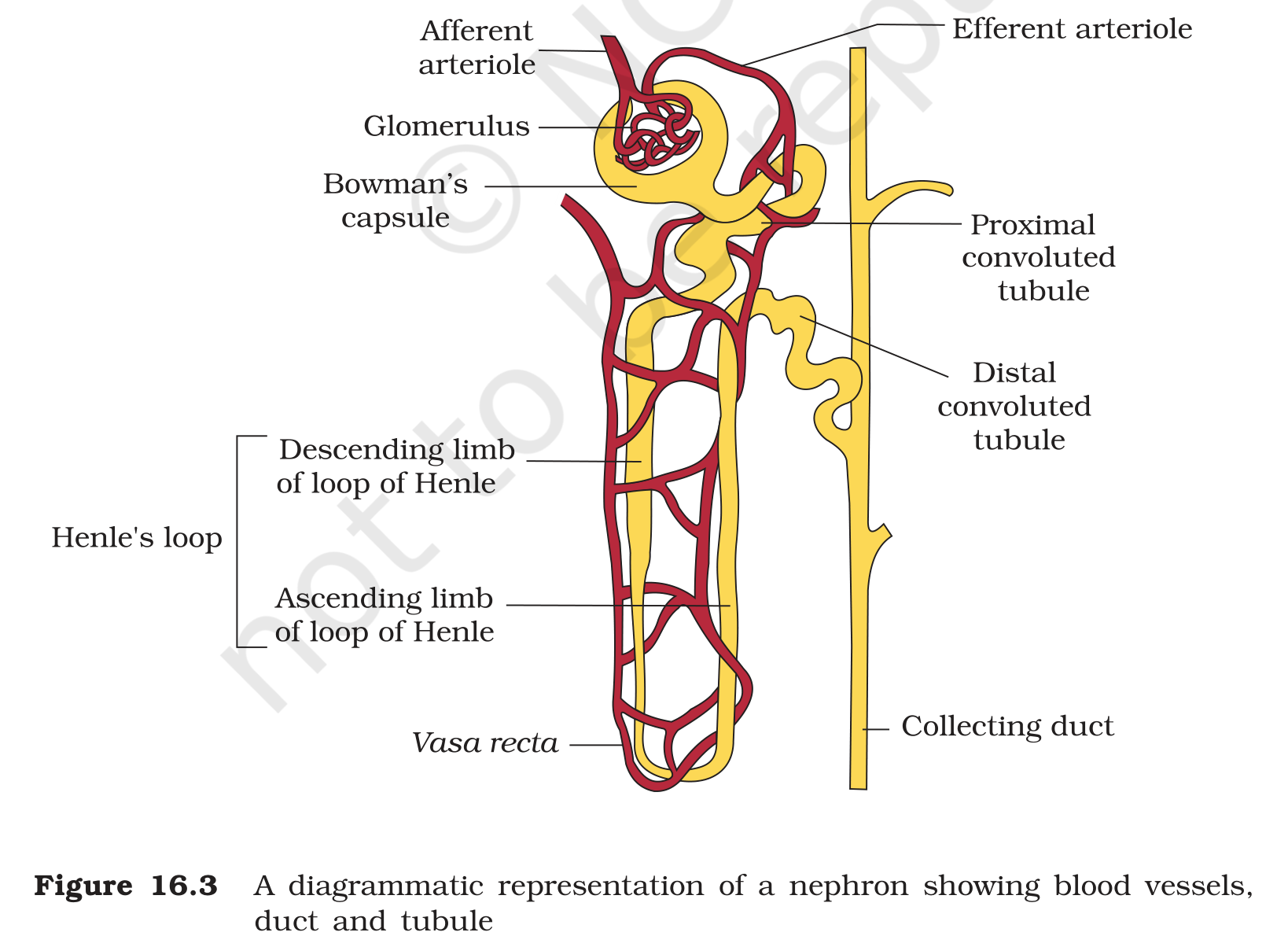
The glomerular capillary blood pressure pushes blood through three layers: the endothelium of the glomerular blood vessels, a basement membrane, and the epithelium of Bowman's capsule. The epithelial cells of Bowman's capsule are called podocytes, and small gaps called filtration slits or slit pores lie between them. The barrier is so fine that nearly every plasma constituent except the proteins crosses into the lumen of Bowman's capsule. This is why the process is called ultrafiltration.
The kidneys filter about 1100 to 1200 mL of blood every minute, and that is roughly a fifth of the volume one ventricle ejects in the same time. The amount of filtrate formed per minute is the glomerular filtration rate, or GFR. In a healthy person the GFR is about 125 mL per minute, which adds up to about 180 litres per day.
2.1.2 Keeping the GFR steady
The kidney has built in mechanisms to regulate its own filtration rate. The juxtaglomerular apparatus, or JGA, is a pressure sensing patch built where the distal convoluted tubule meets the afferent arteriole. When the glomerular blood flow or the GFR drops, the JG cells in this patch release renin, and renin lifts the glomerular blood flow so that the GFR returns to its normal level. This is the autoregulatory mechanism you are asked to explain in the exercises.
2.1.3 Reabsorption and the tubules
The daily volume of filtrate is about 180 litres while the daily urine is only about 1.5 litres, so nearly 99 per cent of the filtrate must be reabsorbed by the tubular epithelium. The cells of different segments do this by active or passive transport. Glucose, amino acids and sodium ions are reabsorbed actively, while the nitrogenous wastes are reabsorbed passively. Water is also reabsorbed passively in the early parts of the nephron.
The proximal convoluted tubule, or PCT, carries a simple cuboidal brush border epithelium, and that brush border enlarges the surface available for reabsorption. Nearly every essential nutrient and some 70 to 80 per cent of the electrolytes and water are taken back at this stretch. The PCT also corrects the pH and the ionic balance: it pushes hydrogen ions and ammonia into the tubule fluid and takes bicarbonate back out.
Along the loop of Henle, reabsorption is smallest in the ascending limb, yet this limb is the one that builds the high osmolarity of the medullary tissue. The descending limb lets water through but blocks most electrolytes, and the fluid therefore gets more concentrated on the way down. The ascending limb does the opposite: water cannot cross it, while electrolytes leave it by active or passive transport, and the fluid turns dilute again on the way up.
The distal convoluted tubule, or DCT, takes back sodium ions and water only when conditions call for it. It also absorbs bicarbonate and releases hydrogen ions, potassium ions and ammonia, which keeps the pH and the sodium potassium balance of the blood steady. The collecting duct runs from the cortex down into the inner medulla. It can take back a large amount of water and so make the urine concentrated, it lets a little urea pass into the medullary tissue to keep the osmolarity up, and it fine tunes the pH and the ionic balance by releasing hydrogen and potassium ions.
2.1.4 Tubular secretion
Tubular secretion is the opposite journey: substances move from the blood in the peritubular capillaries into the fluid inside the tubule. The cells of the tubule release hydrogen ions, potassium ions and ammonia into that fluid. This step matters because the glomerulus filters only small amounts of these substances, so the extra ions and acids would build up without it. Secretion therefore keeps the ionic and acid base balance of the body fluids steady.
2.1.5 Practice from the NCERT exercises, questions 1, 2 and 3
Exercise 1. The glomerular filtration rate is the volume of filtrate formed by both kidneys per minute, and in a healthy adult it is about 125 mL per minute, which is about 180 litres per day.
Exercise 2. The autoregulation of GFR works through the juxtaglomerular apparatus. When the glomerular blood flow or pressure falls, the JG cells release renin, renin leads to the formation of angiotensin and then aldosterone, and these changes constrict the vessels, raise the blood pressure and bring the GFR back towards normal. When the GFR is too high the same system can be damped down.
Exercise 3. The statements are: micturition is a reflex, true; ADH helps in water elimination making urine hypotonic, false, because ADH reduces water loss and makes the urine more concentrated; protein free fluid is filtered into Bowman's capsule, true; Henle's loop helps in concentrating urine, true; glucose is actively reabsorbed in the PCT, true.
Exam
For the filtration answer, give the three layers of the filtration membrane, mention the podocytes and the slit pores, and end with the words ultrafiltration and protein free. For the tubules, learn one distinctive job for each segment: PCT for bulk reabsorption and pH control, descending limb for water permeability, ascending limb for salt transport and dilution, DCT for conditional sodium and water reabsorption, and collecting duct for water saving and urea recycling. The two numbers that must be quoted are 125 mL per minute and 180 litres per day.
Common mistake
Do not say that the filtrate is urine. The filtrate contains glucose, amino acids and salts that are reabsorbed later, while the urine has only what is left over. Do not say that the ascending limb of the loop of Henle is permeable to water; it is the descending limb that is permeable to water. Do not call reabsorption and secretion the same thing: reabsorption takes useful substances back into the blood, and secretion puts substances from the blood into the tubular fluid.