

Concepts: Frog morphology and its digestive system
Structural Organisation in Animals18 min readLesson 2 of 5
2.1 The frog and its habits
Frogs live on land and in fresh water, and they belong to the class Amphibia inside the phylum Chordata. The common Indian frog is Rana tigrina. A frog does not hold a constant body temperature; its body warms and cools with the surroundings, so it is cold-blooded, or poikilothermic. Its skin can change colour to match the background, which hides it from enemies; the protective colouring is called mimicry, and the change is camouflage. In the hottest weeks of summer and in the coldest weeks of winter a frog disappears into a deep burrow and stays inactive. The summer rest is aestivation and the winter rest is hibernation.
2.1.1 External features
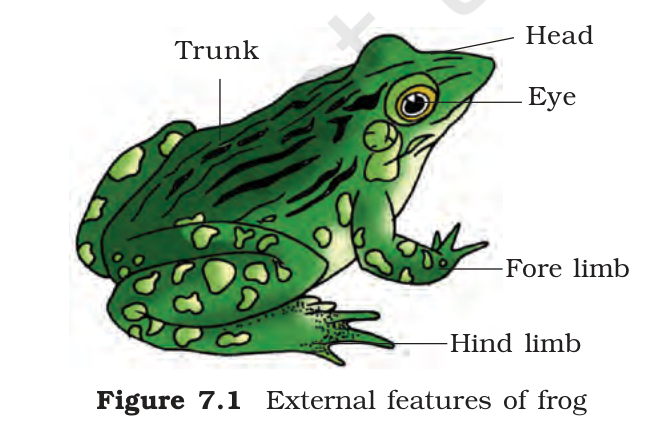
The body is covered with moist skin. It is divided into a head and a trunk, and there is no neck or tail in the adult. The mouth is at the front of the head, and a pair of eyes sit on the sides. Each eye is covered by an eyelid and a transparent nictitating membrane, which protects the eye while the frog is under water. Behind each eye is a circular, membranous tympanum, the ear that picks up sound. The trunk carries two pairs of limbs. The forelimbs end in four digits and the hind limbs in five, and the hind limbs are larger and more muscular because they do the leaping and swimming. The toes are joined by webbing, which turns the foot into a paddle in water. Frogs show sexual dimorphism. Only the male has a pair of vocal sacs, which make the croaking sound, and a copulatory pad on the forelimb's first digit.
2.1.2 How the frog digests food
The body cavity holds the organ systems, and the digestive system is the largest of them. It has two parts, the alimentary canal and the digestive glands. The canal is short, which fits a carnivorous animal: a frog eats insects and other small animals, and a short gut is enough for that kind of food. The mouth leads into the buccal cavity, and from there the food passes through the pharynx into a short oesophagus. The oesophagus opens into the stomach, and the stomach continues as the small intestine, the rectum and finally the cloaca, which opens to the outside through the cloacal aperture. Food is caught by a muscular tongue that is bilobed at the tip and attached at the front of the mouth.
The glands do the chemical work. The liver makes bile, which is stored in the gall bladder, and the pancreas makes pancreatic juice carrying digestive enzymes. Hydrochloric acid and other gastric juices come from the stomach wall. The half-digested food then leaves the stomach as chyme and passes into the duodenum, the first section of the small gut. Bile from the gall bladder and pancreatic juice reach this section through one common duct. Bile breaks the fat into small droplets, and the pancreatic enzymes digest carbohydrates and proteins. Final digestion happens in the intestine, and the products are taken up through the finger-like folds of the intestinal wall called villi and microvilli. The undigested part passes into the rectum and leaves through the cloaca.
2.1.3 Skin, body wall and body cavity
The skin is an organ with several jobs in the frog and it does more than cover the body. It is kept moist by mucous glands, it carries blood vessels close to the surface, and it takes part in respiration in water. Colour changes in the skin allow camouflage, and the nictitating membrane keeps the eye covered while the frog swims. The body wall encloses a body cavity that houses six organ systems: nervous, digestive, reproductive, circulatory, excretory and respiratory. Inside, the organs follow a fixed order, which is why a diagram of the internal organs can be read from front to back: the heart and lungs lie high, the liver occupies the front of the cavity, the stomach and intestine follow, and the kidneys and bladder sit towards the rear. The short gut, the large liver and the paired lungs together suit a predator that eats insects in bursts and then rests in water or in a burrow.
The digestive glands deserve a second look in an answer. The liver is the largest gland in the body and it does far more than make bile, while the pancreas sends its enzymes into the same duct. A labelled diagram should show both glands and their ducts beside the gut, because the examiner looks for the connection between the gland and the part of the gut it serves.
Exam
Frog morphology questions usually want the labelled diagram plus a short note. Learn the external labels in one order: eyes, nictitating membrane, tympanum, forelimb with four digits, hind limb with five digits and webbing, head and trunk. Then add the two sexual dimorphism points, vocal sacs and the copulatory pad, because those two are the standard one-mark pair.
Common mistake
Do not write that the frog has a neck or a tail in the adult stage, because the adult body divides only into head and trunk. Do not call the tympanum an ear flap, since there is no external ear and the tympanum is a membrane on the skin. And do not say the frog is warm-blooded, because it is a poikilotherm.