

Concepts: Frog respiration, circulation and reproduction
Structural Organisation in Animals22 min readLesson 3 of 5
3.1 Respiration
A frog obtains oxygen in two ways. In water the skin does the work, and dissolved oxygen passes through the moist skin by diffusion; this is cutaneous respiration. On land the mouth cavity, skin and lungs all contribute, and this lung-based exchange is pulmonary respiration. The lungs themselves are paired, pink and elongated, sitting high in the trunk. The route for air is nostril, mouth cavity, then lung. During aestivation and hibernation the frog does not breathe with lungs and gaseous exchange goes on through the skin alone.
3.2 Circulation
The vascular system is of the closed type, and a lymphatic system runs beside it. Sitting high in the body cavity, the heart is wrapped in the pericardial membrane. Its three chambers are two atria and a single ventricle. Blood reaches the right atrium from the vena cava through a triangular sinus venosus, and leaves the ventricle through a sac-like conus arteriosus on the underside. Arteries carry blood away from the heart and veins bring it back. Two special portal systems are named. The hepatic portal system connects the liver with the intestine, and the renal portal system connects the kidneys with the lower parts of the body. The blood has plasma and cells; the red cells are nucleated and carry haemoglobin, the white cells defend the body, and platelets help clotting. Lymph differs from blood in carrying fewer proteins and no red cells.
3.3 Excretion, nervous system and sense organs
The excretory system has a pair of kidneys, the ureters, the cloaca and a urinary bladder. The kidneys are compact, dark red, bean-shaped organs lying on either side of the vertebral column towards the rear of the body cavity. Each kidney is built of many nephrons, also called uriniferous tubules. In the male the two ureters also carry sperm and act as urinogenital ducts, while in the female the ureters and the oviducts open separately into the cloaca. The thin-walled urinary bladder lies below the rectum and opens into the cloaca. The frog excretes urea, so it is ureotelic.
Control and coordination run through a neural system and a set of endocrine glands. The endocrine set includes the pineal body, pituitary, thyroid and parathyroid, thymus, pancreatic islets, adrenals and gonads. Nervous control divides into the central part, made of the brain and spinal cord, the peripheral part, made of cranial and spinal nerves, and the autonomic part, which has sympathetic and parasympathetic divisions. Ten pairs of cranial nerves leave the brain, and the brain sits inside a bony cranium. The brain has three regions: the forebrain with olfactory lobes, cerebral hemispheres and diencephalon; the midbrain with a pair of optic lobes; and a hindbrain carrying the cerebellum along with the medulla. From the medulla, the cord passes down inside the backbone. Sensory structures exist for touch through papillae, taste through buds, smell through the nasal lining, sight through eyes and hearing through the tympanum and inner ear. Eyes and internal ears are well-organised; the rest are clusters of cells around nerve endings. There is no external ear, and the tympanum is the visible ear structure.
3.4 Reproduction and the ecological role
The male reproductive system has a pair of yellowish, oval testes attached to the upper part of the kidneys by a double fold of peritoneum, the mesorchium. From the testes arise 10 to 12 vasa efferentia, which enter the kidney, pass through Bidder's canal and gain the urinogenital duct leading to the cloaca. This small middle chamber sends out faeces, urine and sperms. The female has a pair of ovaries near the kidneys, with no functional connection to them, and a pair of oviducts that open separately into the cloaca. One mature female releases 2500 to 3000 ova in a single laying. The gametes meet outside the body in water, and the young pass through the tadpole stage before metamorphosis makes the adult.
Frogs help people by eating insects and so protecting crops. They hold a place in food chains and food webs, which keeps the ecosystem in balance, and in some countries the muscular legs are eaten as food.
3.4.1 Practice from the NCERT exercises, questions 1 and 2
Exercise 1. A labelled diagram of the frog digestive system should show the mouth, buccal cavity, pharynx, oesophagus, stomach, small intestine with duodenum, rectum, cloaca and cloacal aperture, together with the liver, gall bladder and pancreas.
Exercise 2. The ureters carry urine from the kidneys to the cloaca. In the male frog the same ducts also carry sperm, which is why they are called urinogenital ducts.
Slideshow, slide 1 of 3. Use the left and right arrow keys to change slides and the space bar to play or pause.
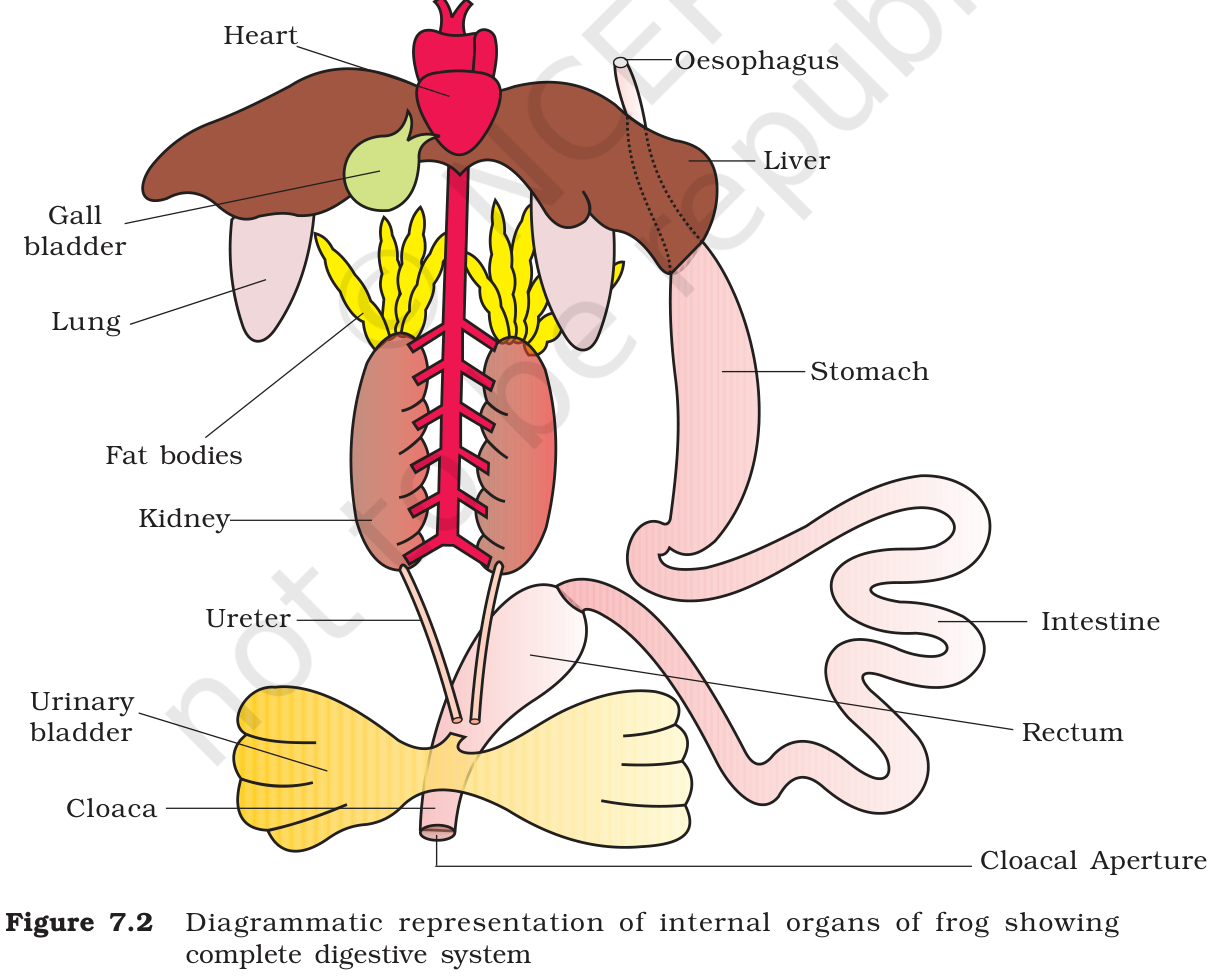
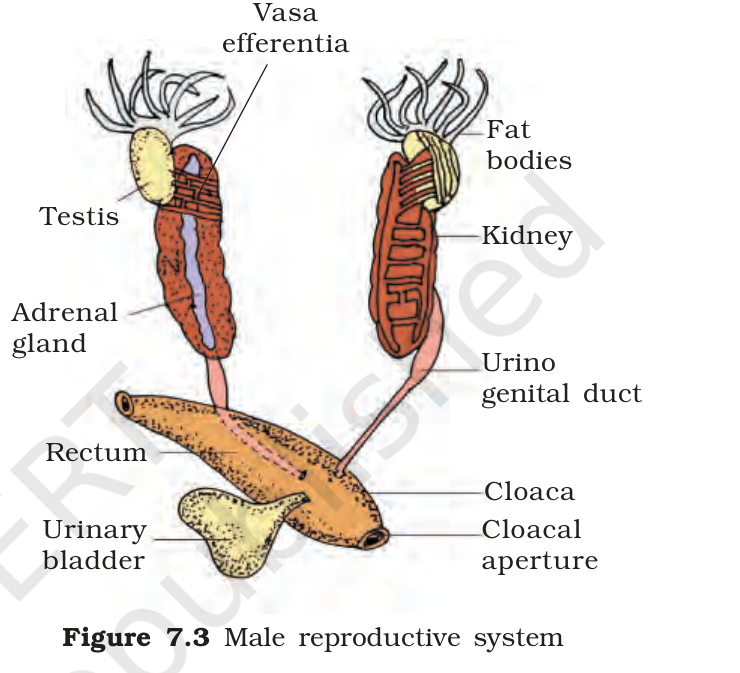
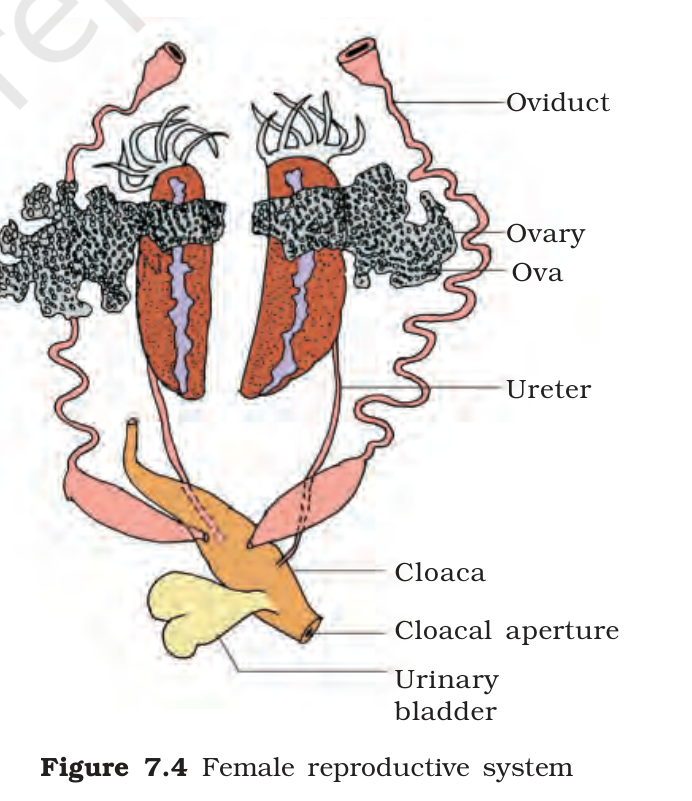
Diagrammatic view of the internal organs of a frog in the NCERT plate, with the complete digestive system, kidney, lungs, heart, urinary bladder and cloaca labelled.
Exam
For the frog systems, keep one striking fact per system. Respiration: cutaneous in water, pulmonary on land, and skin alone during dormancy. Circulation: three chambers, sinus venosus, conus arteriosus, hepatic portal and renal portal systems. Excretion: kidneys, ureters, cloaca, urinary bladder, ureotelic. Nervous: ten pairs of cranial nerves, three brain regions. Reproduction: external fertilisation, tadpole with metamorphosis. One fact per system is what a short answer needs.
Common mistake
Do not say the frog has four heart chambers, because it has three. Do not call the urinary bladder the place where urine is made, since the kidneys make urine and the bladder stores it. And do not write that fertilisation in the frog is internal, because it is external and happens in water.