

Concepts: covalent bonding, VSEPR and hybridisation
Chemical Bonding and Molecular Structure26 min readLesson 3 of 7
3.1 Lewis structures and formal charge
A Lewis structure shows every valence electron as a dot in a bond or a lone pair. Draw the skeleton, count the valence electrons, place single bonds, complete the octets of the outer atoms, and put any remaining electrons on the central atom. If the central atom is short of an octet, move lone pairs from the outer atoms into multiple bonds.
More than one structure often fits the electron count, and formal charge chooses between them. The best structure keeps formal charges close to zero, places a negative formal charge on the more electronegative atom and avoids like charges on neighbouring atoms. For carbon dioxide the structure with two double bonds has zero formal charge on every atom, while the structure with single bonds would put formal charges on all three atoms.
3.2 Resonance
When a molecule can be described by more than one Lewis structure that differ only in the position of electrons, the real molecule is a blend of them called a resonance hybrid. Ozone, the carbonate ion and the nitrate ion are standard examples. The two or three structures are not separate compounds in equilibrium; they are drawing conventions, and the real bond lengths and bond energies are averages over the contributing forms. Resonance lowers the energy of a molecule below what any single structure would suggest, and it is the reason all three carbon-oxygen bonds in carbonate are identical.
The C-O bond lengths in the carbonate ion sit between the values expected for a single bond and a double bond, which is direct evidence that the hybrid carries one third of a double bond character in each link. A single structure with one double bond would predict one short bond and two long bonds, which the ion does not show.
3.3 Sigma and pi bonds
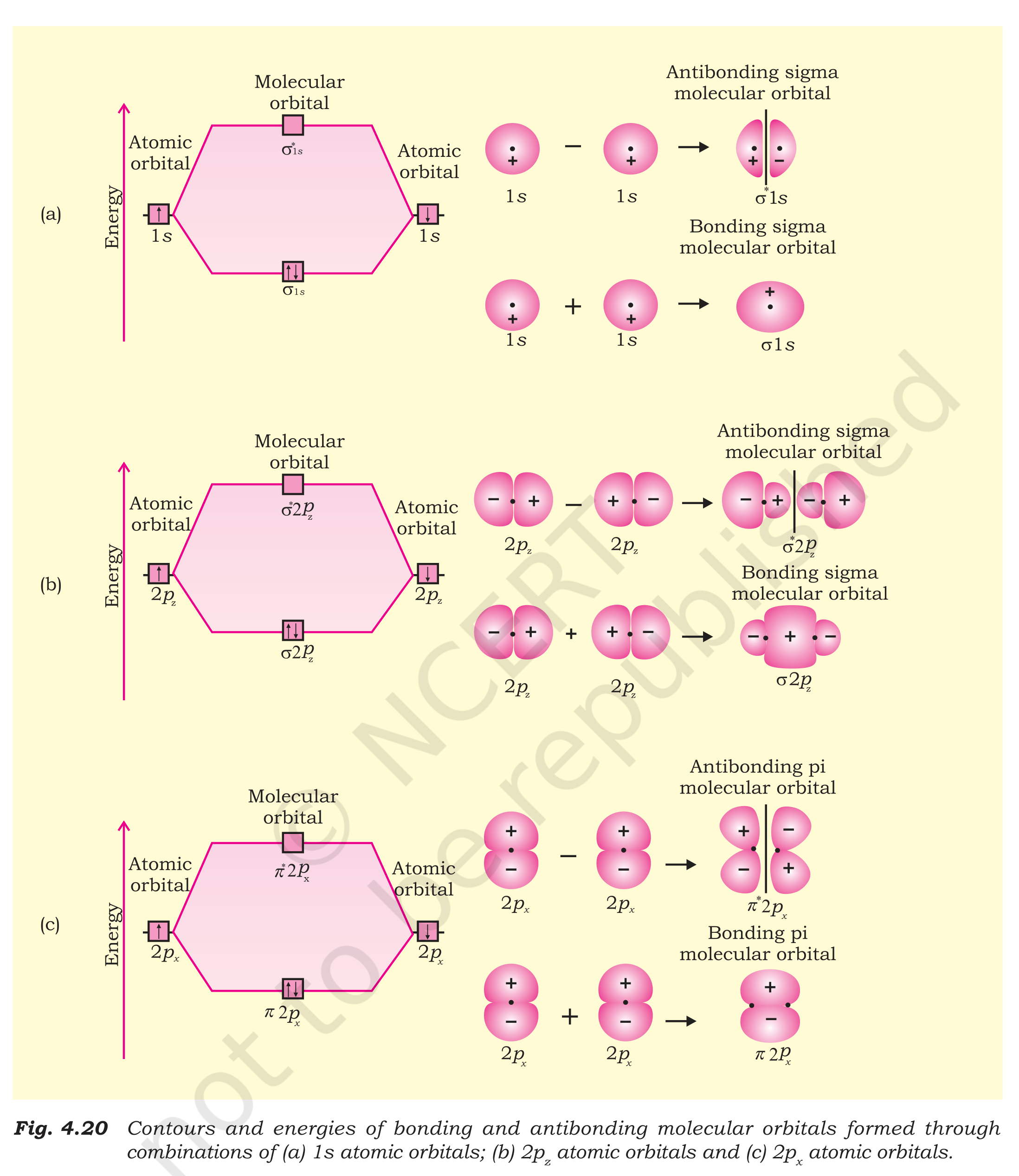
A sigma bond forms by the head-on overlap of two orbitals along the internuclear axis, so the electron density is concentrated between the nuclei. A pi bond forms by the sideways overlap of two p orbitals, so the electron density lies above and below the axis and the overlap is smaller. That is why a pi bond is usually weaker than the sigma bond of the same pair of atoms.
A double bond is one sigma plus one pi bond, and a triple bond is one sigma plus two pi bonds. Rotation is free about a single bond but blocked by a pi bond, and the combined eight electrons of a triple bond make it short and strong. Counting sigma and pi bonds in a structure is a common exam question: for example, ethene has five sigma bonds and one pi bond.
Slideshow, slide 1 of 3. Use the left and right arrow keys to change slides and the space bar to play or pause.
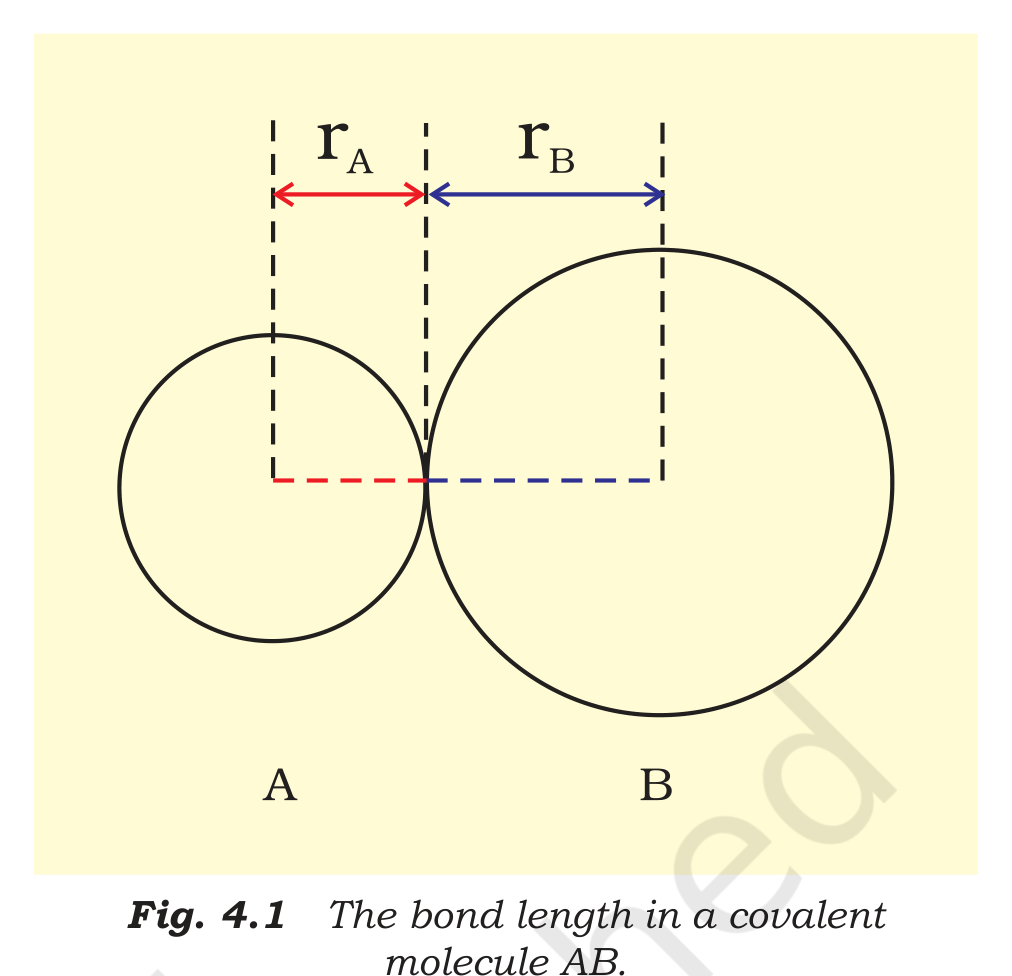
Two bonded atoms A and B with their covalent radii marked, showing that the bond length is the sum of the two radii.
3.4 VSEPR theory
The valence shell electron pair repulsion theory arranges the electron domains around the central atom so that they get as far apart as possible. The number of domains equals the number of sigma bonds plus the number of lone pairs. The repulsion order is lone pair against lone pair greater than lone pair against bond pair greater than bond pair against bond pair, so lone pairs spread out slightly more and squeeze the bond angles.
Two domains give a linear arrangement, three a trigonal plane, four a tetrahedron, five a trigonal bipyramid and six an octahedron. The electron geometry and the molecular shape differ whenever lone pairs are present. A tetrahedral electron geometry with one lone pair gives a trigonal pyramidal molecule such as ammonia, and with two lone pairs it gives a bent molecule such as water.
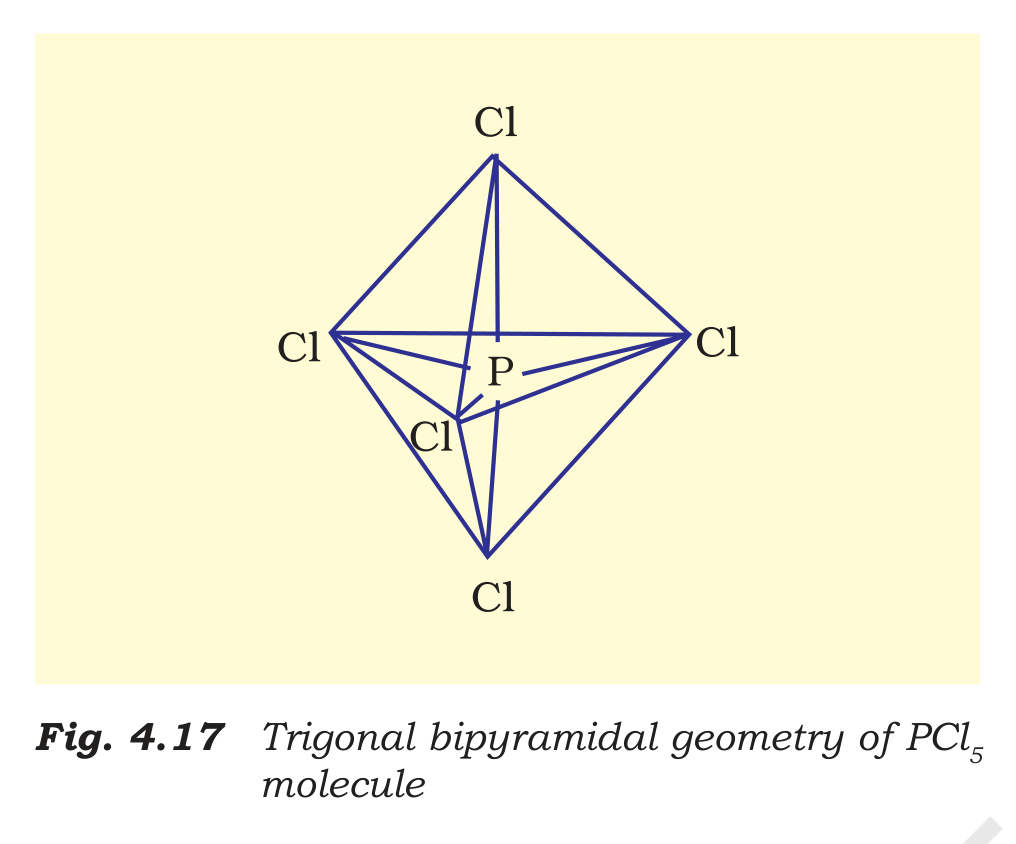
The five-domain case needs care. The trigonal bipyramid has two axial and three equatorial positions. A lone pair always takes an equatorial position because an equatorial position has only two neighbours at 90 degrees, while an axial position has three. One lone pair gives a see-saw shape, two give a T shape and three give a linear molecule.
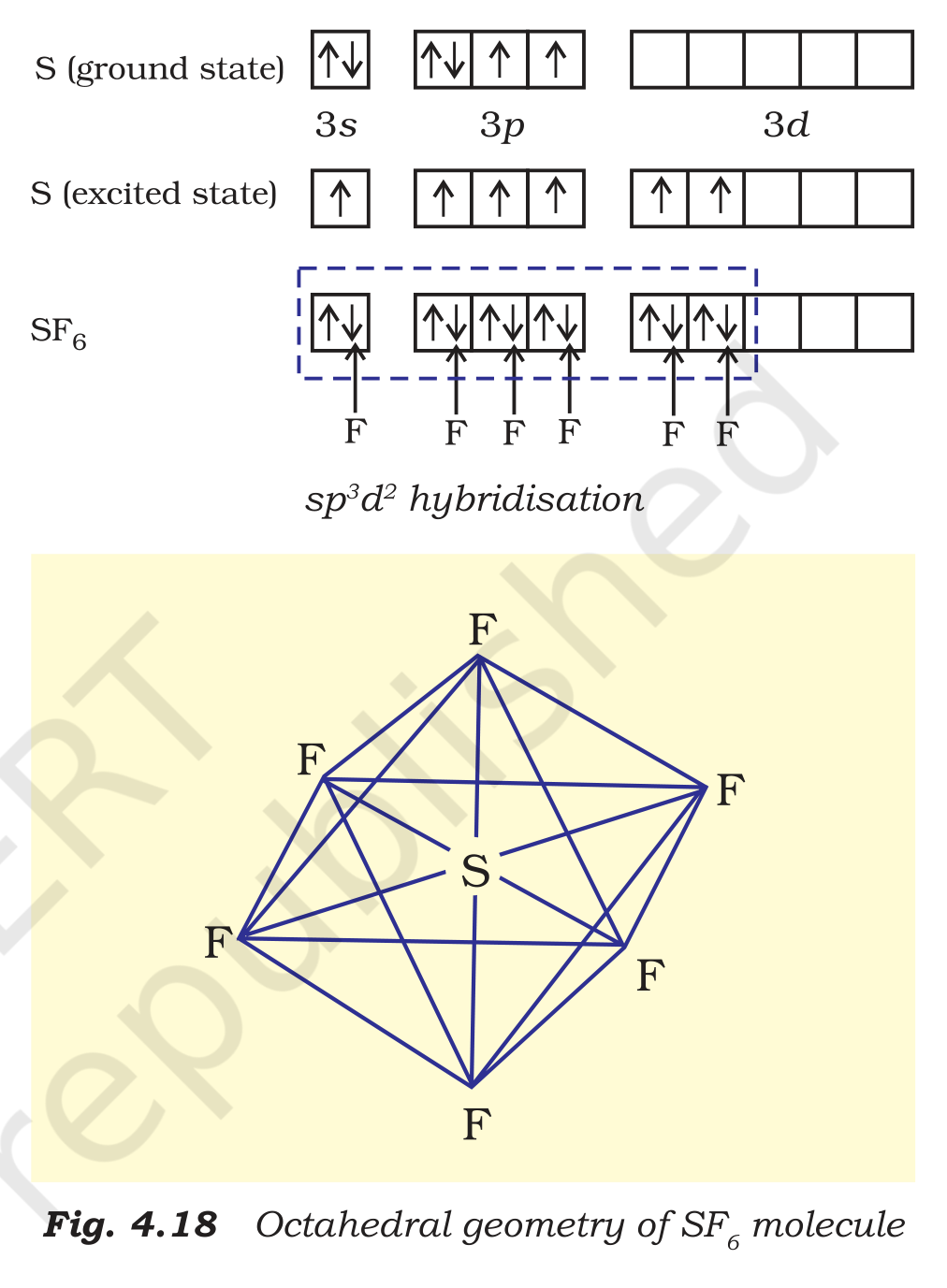
The six-domain case produces an octahedron. One lone pair gives a square pyramidal molecule and two lone pairs give a square planar one, and the lone pairs take positions opposite each other so that the repulsion between them is minimised.
3.5 Hybridisation
Hybridisation mixes atomic orbitals of similar energy on the same atom to give new orbitals of identical shape and energy. The number of hybrid orbitals equals the number of atomic orbitals mixed, and the hybrids point in the directions demanded by VSEPR. The mixing explains the observed bond angles, which the pure s and p orbitals cannot.
One s and one p orbital give two sp hybrids pointing at 180 degrees, as in beryllium chloride. One s and two p orbitals give three sp2 hybrids at 120 degrees, as in boron trifluoride and in the carbons of ethene. One s and three p orbitals give four sp3 hybrids at 109.5 degrees, as in methane and in the carbons of ethane. When five domains are needed, one d orbital joins to give five sp3d hybrids, and for six domains two d orbitals give sp3d2 hybrids.
The hybrid orbitals form sigma bonds by overlapping with orbitals of the other atoms, and any unhybridised p orbital left on each atom forms the pi bond. This is why ethene is planar: each carbon uses three sp2 hybrids for sigma bonds and keeps one p orbital for the pi bond, and the pi overlap requires the two p orbitals to be parallel.
The hybridisation can change during a reaction if the number of domains changes. Aluminium chloride in the vapour phase is a dimer, Al2Cl6, in which each aluminium has four domains and is sp3 hybridised, while monomeric AlCl3 has three domains and sp2 hybridisation.
Exam
For any molecule, first count sigma bond pairs and lone pairs, then pick the hybridisation from that total. Species with the same domain count and the same number of lone pairs are isostructural, which is the quickest way to answer shape comparison questions.