

Concepts: molecular orbital theory, magnetism and hydrogen bonding
Chemical Bonding and Molecular Structure22 min readLesson 4 of 7
4.1 Why a new theory was needed
Valence bond theory explains shapes and hybridisation, but it cannot explain why the oxygen molecule is paramagnetic. A molecule with an even number of electrons should be diamagnetic if every electron is paired in a bond, yet O2 is attracted into a magnetic field. It also cannot explain why the bond in He2 does not exist or why the bond order of O2+ is higher than that of O2. Molecular orbital theory handles all of these.
4.2 Molecular orbitals from atomic orbitals
In molecular orbital theory, atomic orbitals of comparable energy combine to give molecular orbitals that spread over the whole molecule. Two atomic orbitals combine in two ways. In phase, they add to give a bonding molecular orbital with electron density between the nuclei and an energy lower than the parent orbitals. Out of phase, they subtract to give an antibonding molecular orbital with a node between the nuclei and an energy higher than the parents. The bonding orbital is filled before the antibonding one, and an antibonding electron cancels the bonding effect of one bonding electron.
The combination of two 1s orbitals gives a sigma 1s bonding orbital and a sigma* 1s antibonding orbital. The combination of two 2p orbitals along the internuclear axis gives sigma 2p and sigma* 2p orbitals, while the two 2p orbitals perpendicular to the axis give pi 2p and pi* 2p orbitals.
4.3 Bond order and magnetic behaviour
Bond order counts the net bonding pairs. Take the number of electrons in bonding orbitals, subtract the number in antibonding orbitals, and halve the result. A positive bond order means the molecule can exist, and a larger value means a stronger, shorter bond. A bond order of zero means the molecule does not form, which is why He2 does not exist.
Magnetic behaviour follows directly from the filling. If any orbital holds an unpaired electron, the species is paramagnetic; if all electrons are paired, it is diamagnetic. Hund's rule applies to degenerate molecular orbitals just as it does to atomic orbitals, so electrons fill the pi orbitals singly before pairing.
The important cases are worth learning as a set. Hydrogen has bond order one. Helium has bond order zero and does not exist as a stable molecule. The second period diatomic molecules rise to a maximum bond order of three at nitrogen and then fall as the antibonding orbitals fill. Oxygen has bond order two and, because its two highest electrons occupy separate pi antibonding orbitals, it is paramagnetic. Fluorine has bond order one and is diamagnetic. Removing an electron from oxygen to give O2+ raises the bond order to 2.5 and shortens the bond, while adding an electron to give O2- lowers it to 1.5 and lengthens the bond. The peroxide ion O2^2- has bond order one, and the superoxide ion O2- has bond order 1.5.
4.4 Hydrogen bonding
A hydrogen bond is the attraction between a hydrogen atom that is covalently bonded to a strongly electronegative atom, usually fluorine, oxygen or nitrogen, and a lone pair on another such atom. The hydrogen carries a large partial positive charge and the lone pair carries a partial negative charge, so the two attract. The bond energy is about 10 to 40 kJ mol^-1, small compared with a covalent bond but large compared with an ordinary van der Waals attraction.
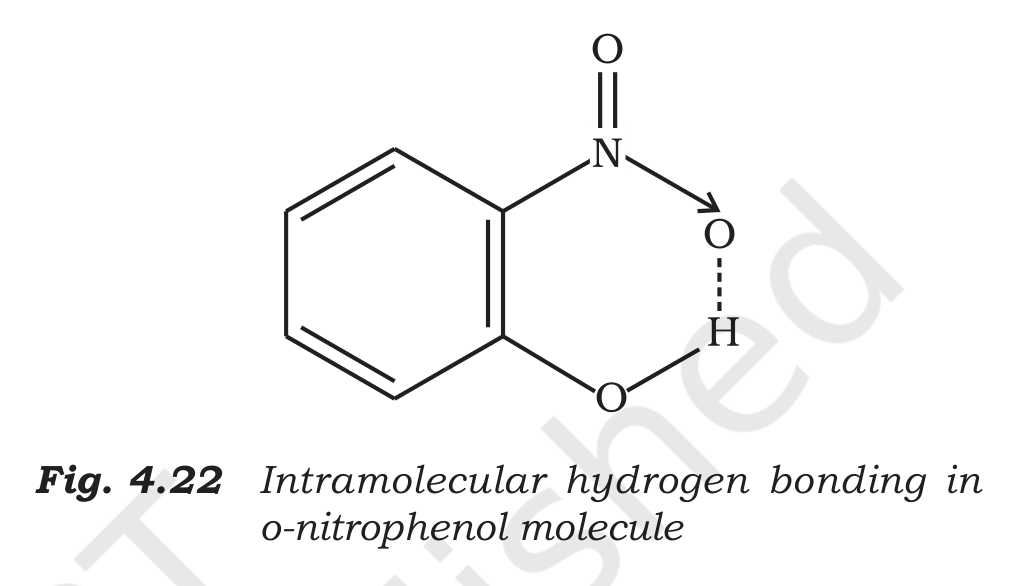
Hydrogen bonding is intermolecular when the two groups belong to different molecules and intramolecular when they belong to the same molecule. The intermolecular kind links molecules into chains or networks, so it raises the melting and boiling points of the substance. Hydrogen fluoride and water form chains and networks of intermolecular bonds, which is why their boiling points are far above those of the other hydrides of their groups. Hydrogen bonding between water and ethanol makes them miscible in all proportions, and it is the reason water is a liquid at room temperature while hydrogen sulphide, which forms no such bonds, is a gas. In o-nitrophenol the hydroxyl hydrogen is bonded to an oxygen of the adjacent nitro group on the same molecule, so the bonding is intramolecular, and the same is true of salicylaldehyde.
The consequences of hydrogen bonding go beyond boiling points. Water expands on freezing because the hydrogen-bonded network of ice holds the molecules further apart than in the liquid, so ice floats. Hydrogen bonds hold the two strands of DNA together and stabilise the folded shapes of proteins. In carboxylic acids, two molecules join through a pair of hydrogen bonds to form a dimer, which raises the apparent molar mass in non-polar solvents.
Common mistake
A hydrogen bond is not a covalent bond. Do not draw it as a shared pair of electrons. Draw it as a dotted line, because it is an electrostatic attraction whose energy is an order of magnitude smaller than a covalent bond.