

Concepts: ionic bonding, bond parameters and lattice enthalpy
Chemical Bonding and Molecular Structure22 min readLesson 2 of 7
2.1 Lewis symbols and the octet rule
A Lewis symbol writes the element's symbol with dots for its valence electrons. Sodium has one dot, chlorine has seven, oxygen has six and neon has eight. Atoms combine because the resulting arrangement of eight valence electrons, a noble gas configuration, is more stable than the arrangement they started with.
The octet rule says that atoms tend to gain, lose or share electrons until each is surrounded by eight valence electrons. Hydrogen and helium are the exceptions, because their valence shell completes with two electrons. The rule is a guide and not a law. It fails for the elements of the second period that can only accommodate eight electrons in total, and it also fails for molecules with an odd number of electrons.
2.2 Formation of an ionic bond
An ionic bond forms when one atom transfers electrons to another and the two resulting ions attract each other electrostatically. Sodium transfers its single 3s electron to chlorine to give Na+ with the neon configuration and Cl- with the argon configuration. Both ions are now closed shell, and the lattice of alternating positive and negative ions is what holds the solid together.
The transfer costs energy to ionise the metal and releases energy when the anion forms, so the balance decides whether the salt is stable. Three factors favour ionic bond formation. A cation forms most easily from an atom with low ionization enthalpy, an anion forms best from an atom with a large negative electron gain enthalpy, and a large lattice enthalpy makes the solid stable despite the energy spent.
2.3 Lattice enthalpy and the Born-Haber cycle
Lattice enthalpy is the enthalpy change when one mole of an ionic compound forms from its separated gaseous ions. It is a large negative value for a stable salt, and its magnitude measures how strongly the ions are held. The enthalpy cannot be measured directly for an ionic solid, so it is obtained through a Born-Haber cycle, which applies Hess's law to a sequence of steps that can be measured.
For sodium chloride the cycle runs through sublimation of sodium, ionisation of sodium, dissociation of chlorine molecules, electron gain by chlorine atoms and formation of the solid. Adding the measured steps gives the lattice enthalpy.
Two factors decide the size of the lattice enthalpy. A larger charge on either ion increases the attraction as the product of the charges, so an oxide with two negative charges holds its lattice far more strongly than a chloride with one. Smaller ions approach each other more closely, and Coulomb attraction grows strongly as distance falls, so the lattice enthalpy rises as the ions shrink. This is why magnesium oxide melts at a very high temperature while sodium chloride melts much lower.
2.4 Bond parameters
Four numbers describe a covalent bond, and they are used constantly in this chapter and in organic chemistry.
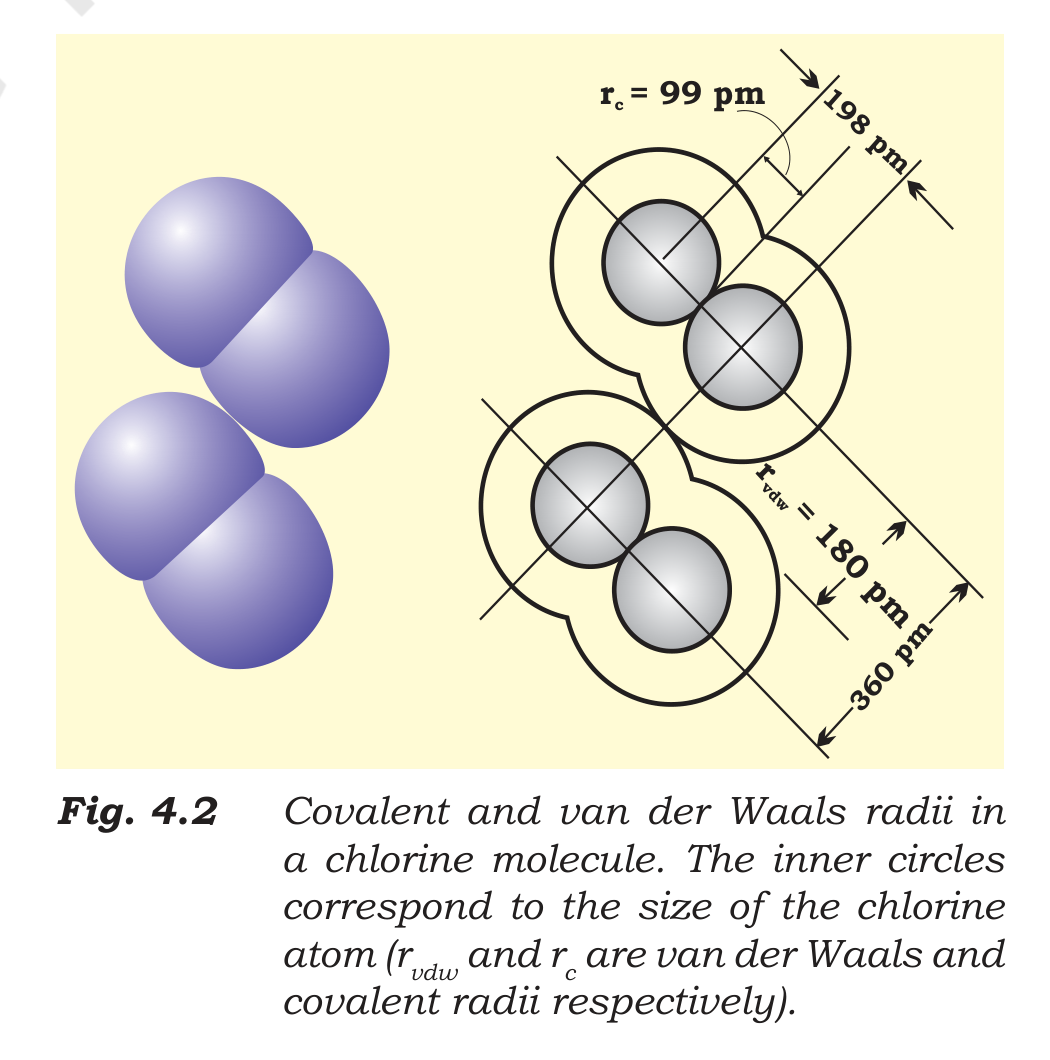
Bond length measures the separation between the two nuclei in a bond, averaged over the vibration of the molecule. It grows with the size of the atoms and falls as the bond order rises, because the extra electron pair pulls the nuclei together. The bond length is measured as the sum of the two covalent radii, as shown for chlorine in the figure above, where the van der Waals radius is clearly larger than the covalent radius.
Bond angle is the angle between two bonds at the central atom. It fixes the shape of the molecule and is measured by spectroscopy; a lone pair on the central atom usually reduces the angle below the ideal value.
Bond order is the number of electron pairs shared by two atoms in a covalent bond. Carbon-carbon single bonds have order one, double bonds order two and triple bonds order three. Higher order means shorter and stronger.
Bond energy, or bond dissociation enthalpy, is the energy needed to break one mole of a particular bond in the gas phase. Multiple bonds need more energy to break than single bonds, so a carbon-carbon triple bond is much stronger than a single bond. Comparing molecules with bonds of the same order, a shorter bond is usually a stronger one.
2.5 Dipole moment and polarity
A covalent bond between unlike atoms carries a small separation of charge, so it has a dipole moment. The vector sum of all bond moments gives the molecular dipole moment. Symmetry can cancel the bond moments completely: carbon dioxide has two polar C-O bonds pointing in opposite directions and no net moment, while water has a bent geometry and a large net moment of about 1.85 D.
The dipole moment reveals both the polarity and the shape. If a molecule is linear and made of two identical polar bonds, its moment is zero; if the same bonds are at an angle, the moments no longer cancel. Comparing the moments of molecules with the same formula can therefore tell you whether the geometry is symmetric.
Common mistake
Bond length and bond order are not independent of each other. Do not say that a higher bond order makes the bond longer. The extra electron pair pulls the nuclei closer, so a higher bond order gives a shorter bond.