

Concepts: enthalpy, calorimetry and Hess's law
Thermodynamics24 min readLesson 3 of 7
3.1 Enthalpy
Most chemical reactions are carried out in open vessels, so the pressure stays constant while the volume changes. The heat exchanged under these conditions is the enthalpy change, defined through the relation between internal energy, pressure and volume. Enthalpy is a state function and its change is what calorimetry measures for a reaction at constant pressure.
When reactants become products, the enthalpy change is the difference between the enthalpies of the products and the reactants. A negative value means the products are lower in energy and heat is released; the reaction is exothermic. A positive value means heat is absorbed and the reaction is endothermic. A standard formation enthalpy is quoted for the step that builds the substance out of its constituent elements, each in its standard state. Elements in their standard states carry zero formation enthalpy by convention.
3.2 Calorimetry
A calorimeter measures the heat exchanged in a process by observing the temperature change of a known mass of a substance, usually water. At constant pressure, a coffee-cup calorimeter made of a foamed polystyrene cup is enough. The heat measured is the enthalpy change, and the heat capacity of the calorimeter must be known or the measurement must be corrected for it.
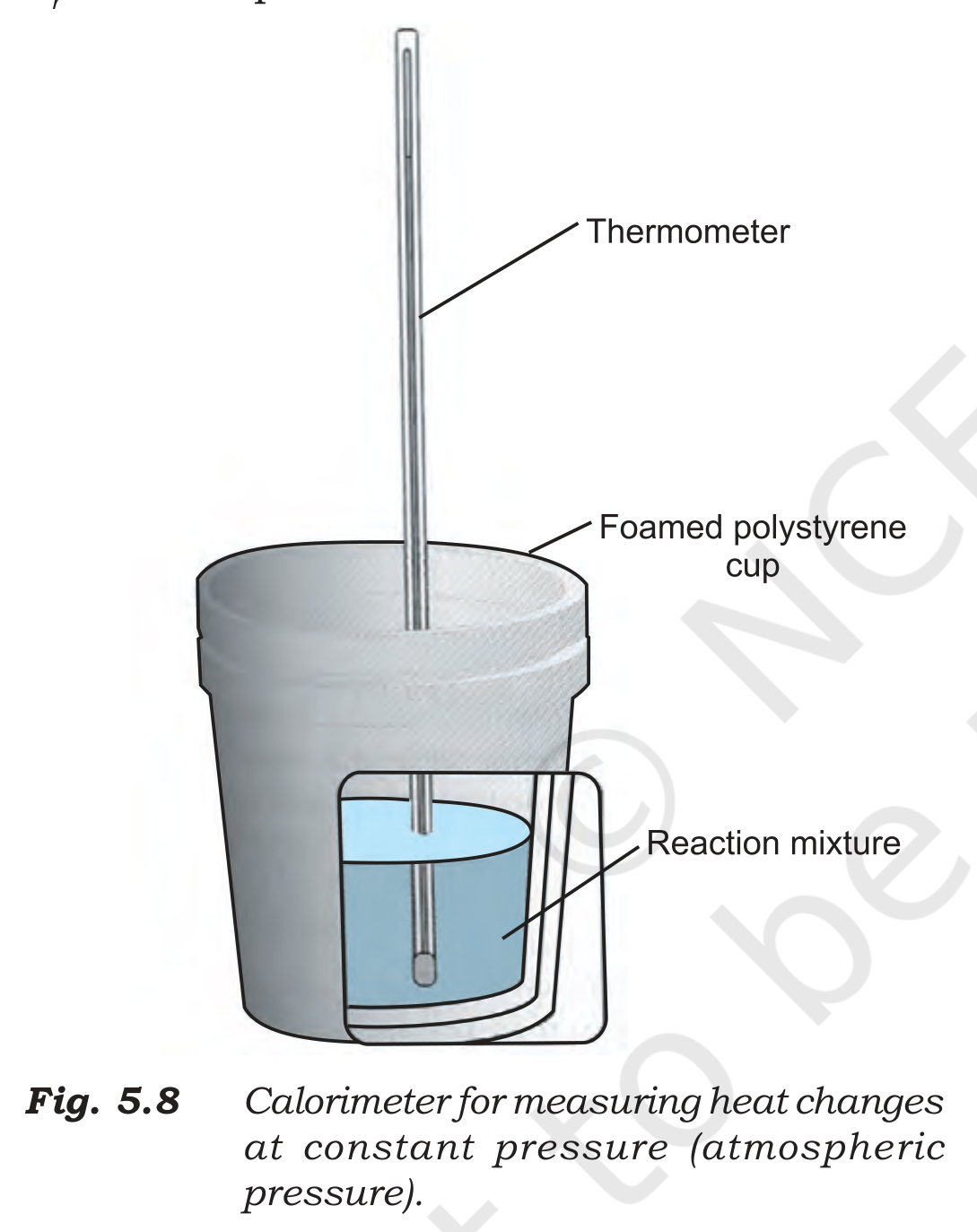
For reactions that involve gases or that run at constant volume, a bomb calorimeter is used. The sample is burned inside a sealed steel vessel filled with oxygen and surrounded by water. The vessel's volume cannot change, so the measured heat is the internal energy change rather than the enthalpy change. To compare the two, convert using the change in the number of moles of gas.
The heat released by an exothermic reaction is absorbed by the water and the calorimeter, so the temperature rise belongs to the surroundings rather than to the reaction mixture. The heat capacity of the surroundings is often used in the opposite direction. If a reaction releases a known amount of heat into a known mass of water, the temperature rise gives the enthalpy change per mole of reaction. The specific heat capacity of water is 4.18 J g^-1 K^-1.
3.3 Hess's law
Hess's law states that the enthalpy change of a reaction is the same whether it takes place in one step or in several. The law follows from the fact that enthalpy is a state function: if the initial and final states are the same, the total enthalpy change is the same, and only the route differs. This lets us combine reactions whose enthalpies are known to find one that cannot be measured directly.
Two techniques make Hess's law practical. When an equation is reversed, the sign of its enthalpy change is reversed. When an equation is multiplied by a factor, its enthalpy change is multiplied by the same factor. Most thermochemical problems reduce to arranging the given equations so that the unwanted species cancel and the target equation remains.
3.4 Standard enthalpies of formation, combustion and bond enthalpy
Standard enthalpies of formation can be used directly to compute a reaction enthalpy: sum the formation enthalpies of the products and subtract the formation enthalpies of the reactants. This single formula covers most of the numerical problems in the chapter, provided the standard states and coefficients are handled carefully.
The enthalpy of combustion covers complete burning of one mole of a substance in excess oxygen, and it is usually negative and large. Atomisation enthalpy records the complete conversion of one mole of a substance into gaseous atoms, and it is always positive because bonds must be broken.
A bond enthalpy is the energy needed to break one mole of the bond, all species being in the gas phase. For a reaction, the enthalpy change can be estimated by subtracting the bond enthalpies broken from the bond enthalpies formed, which is a direct application of Hess's law to the bond-breaking and bond-forming steps.
3.5 Lattice enthalpy and the Born-Haber cycle
Lattice enthalpy measures the formation of one mole of an ionic solid from its separated gaseous ions. It is large and negative and cannot be measured directly, so it is obtained from a Born-Haber cycle, which applies Hess's law to a sequence of measurable steps: sublimation of the metal, ionisation of the metal, dissociation of the non-metal molecule, electron gain by the non-metal atoms and formation of the solid.
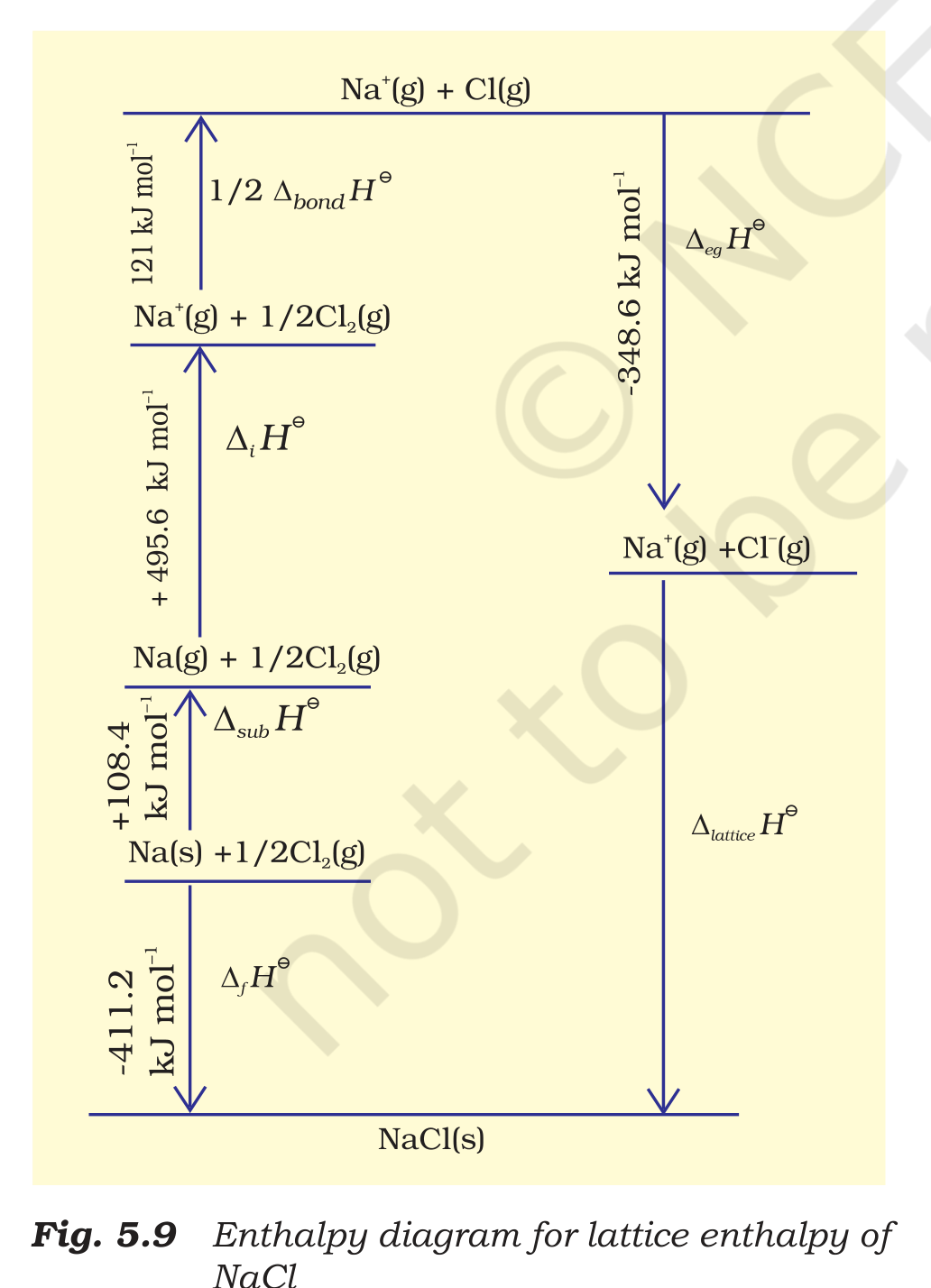
The cycle is a bookkeeping device. Start from the elements in their standard states, go up to the gaseous ions through the measurable steps, then come down to the solid. Because the start and end are the same as in the direct formation step, the sum of the steps equals the formation enthalpy, and the one unknown, the lattice enthalpy, comes out.
Exam
For formation-enthalpy problems, write the formation equation of every compound first, then multiply by its coefficient in the target reaction. It is easy to lose a factor of three on an equation with three moles of a reactant, and the error is invisible unless the equations are written out.