

Concepts: systems, first law of thermodynamics and work
Thermodynamics22 min readLesson 2 of 7
2.1 System and surroundings
A thermodynamic system is the part of the universe we choose to study, and the surroundings are everything outside it. The two are separated by a boundary, and the nature of that boundary decides what can pass through. An open system exchanges both matter and energy with the surroundings, as a beaker of water open to the air does. A closed system exchanges energy but not matter, as a sealed flask does. An isolated system exchanges neither, as a thermos flask of hot tea does.
Slideshow, slide 1 of 3. Use the left and right arrow keys to change slides and the space bar to play or pause.
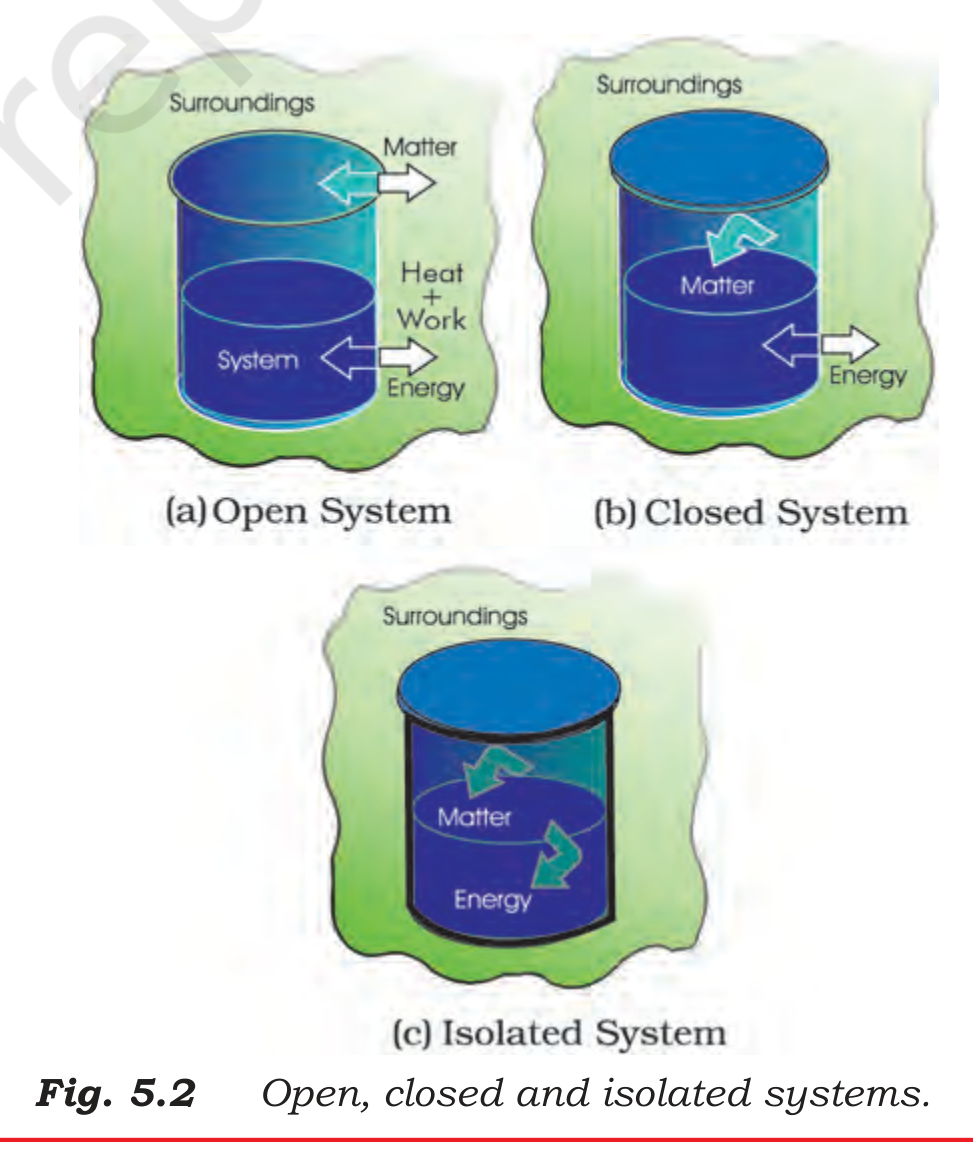
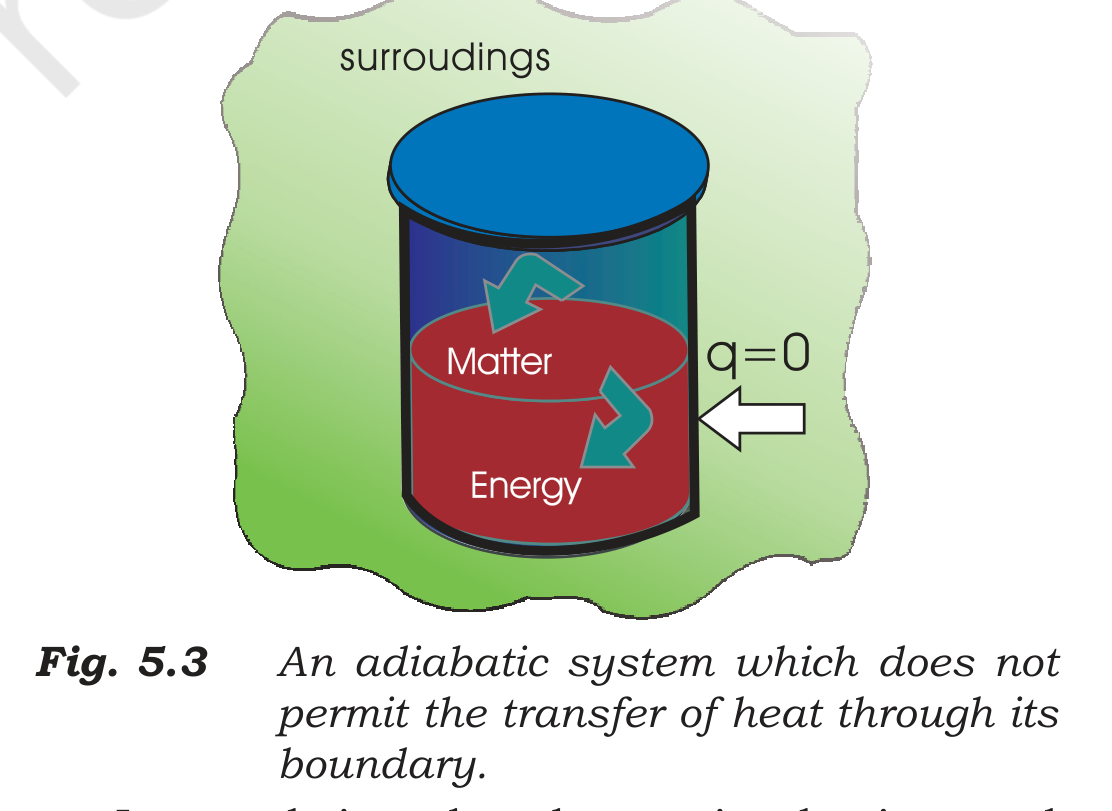
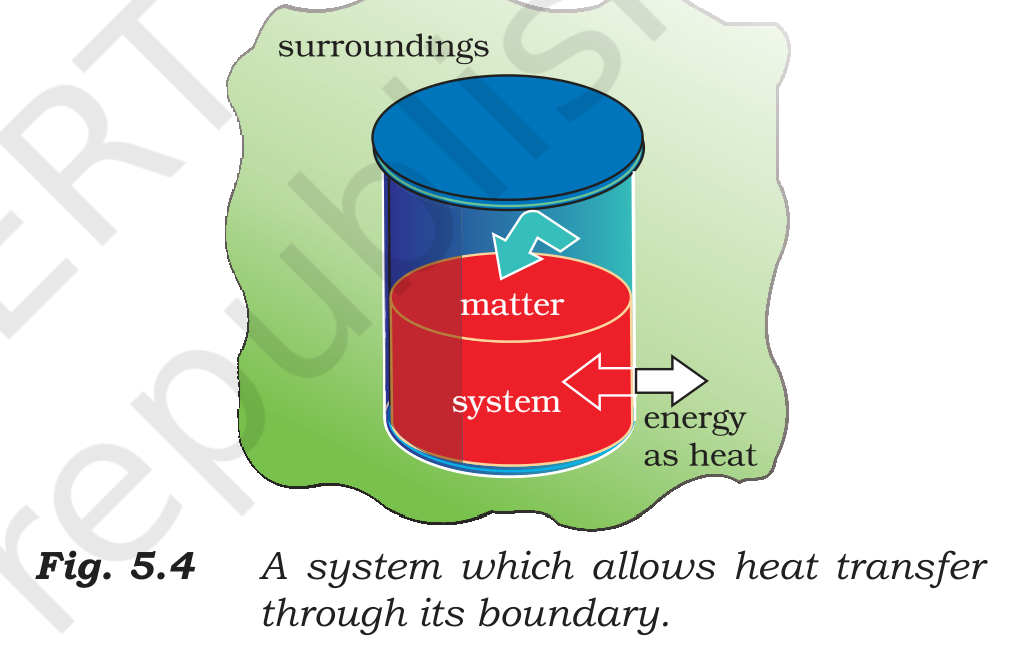
Three diagrams comparing an open system, which exchanges matter and energy, a closed system, which exchanges only energy, and an isolated system, which exchanges neither.
The state of a system is fixed by a small set of variables such as pressure, volume, temperature and amount of substance. A state function is a property whose value depends only on the current state and not on how the state was reached. Internal energy, enthalpy, entropy and Gibbs energy are state functions. Heat and work are not. A gas can be taken from one state to another by heating it at constant volume, or by letting it expand while doing work; the final state may be the same, but the heat and work exchanged are different.
2.2 Internal energy and the first law
Internal energy U is the total energy stored in a system: the kinetic energy of its particles plus the potential energy of their interactions. Its absolute value cannot be measured, but its change can be. The first law of thermodynamics states that the change in internal energy of a closed system equals the heat supplied to it plus the work done on it.
The convention matters. Heat absorbed by the system is positive and heat released is negative. Work done on the system is positive and work done by the system is negative. For an isolated system q is zero and w is zero, so the internal energy stays constant.
The first law is another way of stating conservation of energy. Energy can be transferred as heat or as work, and the internal energy changes by the net amount transferred. A process that returns the system to its starting state has no net change in internal energy, and whatever heat enters in one step must leave as work or heat in the others.
2.3 Pressure-volume work
When a gas expands against an external pressure, it pushes the surroundings back and does work. The work done is the external pressure multiplied by the change in volume, with a negative sign because the system does the work.
For one mole of an ideal gas expanding isothermally and reversibly, the external pressure is replaced by the gas pressure at every instant and the work becomes a logarithmic function of the volume ratio. Reversible work is the maximum work obtainable from a given expansion, and the corresponding compression work is the minimum work needed to return the gas to its starting volume.
Reversible and irreversible paths are worth contrasting. In a reversible process the system is always infinitesimally close to equilibrium, the change can be reversed by an infinitesimal adjustment, and the work obtained is the maximum possible. In an irreversible process the system is far from equilibrium at some stage, and the work is smaller in magnitude. All real processes are irreversible to some degree, so the reversible path is an ideal limiting case used for calculation. Two special cases are worth remembering. Free expansion into vacuum has zero external pressure and therefore zero work. An adiabatic process has no heat exchange, so the first law reduces to delta U equal to w; if the gas does work in an adiabatic expansion, its internal energy and temperature fall.
2.4 Heat, heat capacity and the relation between delta U and delta H
The heat needed to raise the temperature of a system is proportional to the temperature change and to the amount of substance. The constant of proportionality is the heat capacity. At constant volume the heat capacity is C_V and at constant pressure it is C_p, and for an ideal gas the two differ by R.
Chemists usually run reactions in open vessels, where the system stays at constant pressure rather than constant volume. The heat exchanged at constant pressure is the enthalpy change, which is why enthalpy is the central quantity in thermochemistry. The two changes are related through the change in the number of moles of gas.
The term delta n_g counts gaseous products minus gaseous reactants. For a reaction that produces gas, delta n_g is positive and delta H is more positive than delta U. For a reaction that consumes gas, the reverse is true. This relation is the source of the standard conversion question in exams.
Common mistake
Do not write w = pV without deciding whose work it is. In the chemistry convention the system's expansion against constant pressure gives negative work. The magnitude is pV, but the sign is the part that carries the meaning.