

Concepts: entropy, Gibbs energy and spontaneity
Thermodynamics22 min readLesson 4 of 7
4.1 Why direction needs a new quantity
The first law tells us that energy is conserved, but it says nothing about which way a process will go. A cup of hot tea cooling to room temperature and a room warming the tea back to boiling both conserve energy, yet only the first happens by itself. The second law supplies the missing direction. It introduces entropy, a measure of the dispersal of energy and the number of ways a state can be arranged.
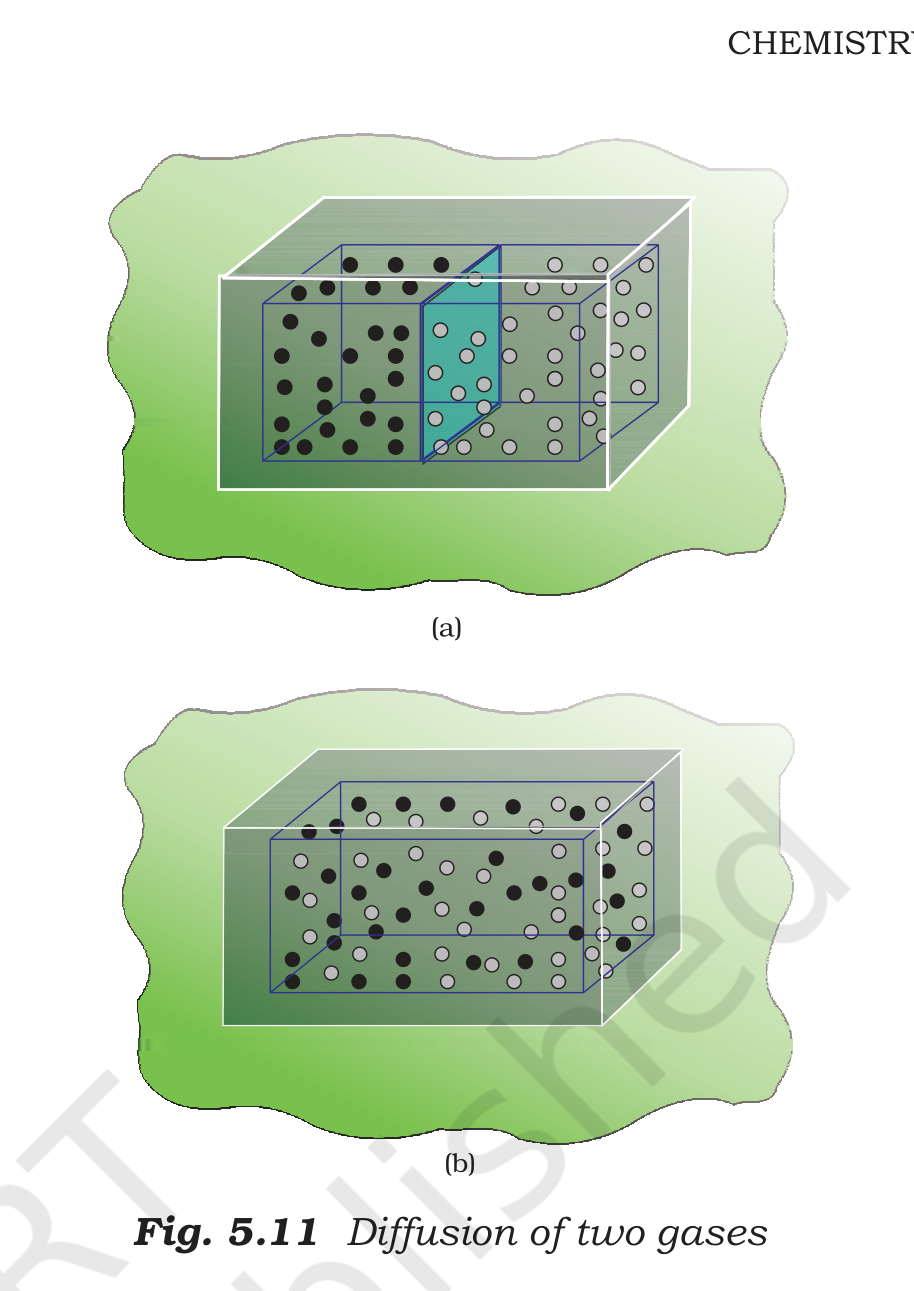
A gas expanding into a vacuum is the standard picture. Before the partition is removed, both gases are confined to one half of the container. After it is removed, the molecules spread over the whole volume. The reverse process, in which the molecules collect themselves back into one half, has never been observed. The spread state has far more possible arrangements, so its entropy is larger.
Entropy increases when a solid melts, when a liquid vaporises and when a gas expands, because the particles gain freedom of motion. It decreases when a gas is compressed or dissolved, and it usually decreases when a reaction combines several molecules into one. The unit of entropy is joule per kelvin per mole. Unlike enthalpy, entropy has an absolute scale: the third law of thermodynamics states that the entropy of a perfectly ordered crystal is zero at absolute zero, so entropy values tabulated for substances are absolute values, not changes relative to the elements. That is why standard entropies of elements are not zero, while their standard enthalpies of formation are.
4.2 The second law and entropy change
The second law says that the total entropy of the universe increases in every spontaneous process. The universe is the system plus the surroundings, so it is not enough for the system's entropy to increase; the surroundings must be included. The entropy change of a system can be measured through a reversible path between the same two states.
For an isothermal expansion of an ideal gas, the entropy change of the system is nR ln(V2/V1), which is positive for expansion and negative for compression. For heating a substance at constant pressure, the entropy change is the integral of C_p dT over T, which grows as the temperature rises.
The surroundings act as a large reservoir at constant temperature, so their entropy change is the heat they receive divided by that temperature. The reservoir is assumed to be so large that its own temperature does not change measurably when heat crosses the boundary, which is why the division is by the constant T. If the system absorbs heat, the surroundings lose it, so their entropy change is negative.
4.3 Gibbs energy
Combining the two entropy changes gives a single condition that depends only on the system. For a process at constant temperature and pressure, the total entropy change of the universe is positive exactly when the Gibbs energy change of the system is negative. The Gibbs energy is defined to make this happen.
The Gibbs energy change combines an enthalpy term and an entropy term weighted by temperature. When a reaction is exothermic and increases entropy, both terms push it forward and it is spontaneous at every temperature. When it is endothermic and decreases entropy, both terms oppose it and it never becomes spontaneous. The two mixed cases depend on temperature: the enthalpy term dominates at low temperature and the entropy term dominates at high temperature.
At this temperature the process is at equilibrium and delta G is zero. Above or below it the sign of delta G decides the direction. This is why some reactions that are not spontaneous at room temperature become spontaneous on heating, and why some spontaneous reactions stop being spontaneous when heated.
4.4 Standard Gibbs energy and equilibrium
Under standard conditions the Gibbs energy change uses standard enthalpies and entropies. The standard Gibbs energy change of a reaction is related to the equilibrium constant: a large negative value means K is much larger than one and the products dominate at equilibrium, while a positive value means K is less than one. At equilibrium delta G is zero and the reaction quotient equals the equilibrium constant.
The relation shows that a reaction with a negative standard Gibbs energy change does not run to completion. It proceeds until the reaction quotient satisfies the equilibrium condition, and at that point the free energy is at its minimum for the given conditions. The size of K indicates how far the reaction goes, while the sign of delta G at a given composition indicates which direction it moves.
Common mistake
Do not decide spontaneity from the entropy of the system alone. An entropy decrease in the system is common in freezing and in many synthesis reactions; what matters is the total entropy change of the universe, and for constant temperature and pressure that is represented by the sign of delta G.