

Concepts: angles and radian measure
Trigonometric Functions22 min readLesson 2 of 7
2.1 Angles as rotations
In geometry an angle is often drawn as the corner of a triangle. In this chapter the viewpoint shifts: an angle measures a rotation. Start with a ray fixed at a point and turn it to a new position. The fixed ray is the initial side, the final position is the terminal side, and the point of rotation is the vertex. Turning anticlockwise gives a positive angle; turning clockwise gives a negative one.
This definition has no upper limit. A wheel can spin through many full turns, and an angle can be larger than 360 degrees. It can also be negative, which simply records the opposite direction. Angles that end at the same terminal side are called coterminal, and they differ by whole turns.
Two units measure the rotation. The familiar one is the degree, with one turn split into 360 equal parts. Each degree splits into 60 minutes and each minute into 60 seconds, so a measure like 40 degrees 20 minutes is a single angle written in mixed units.
2.2 The radian
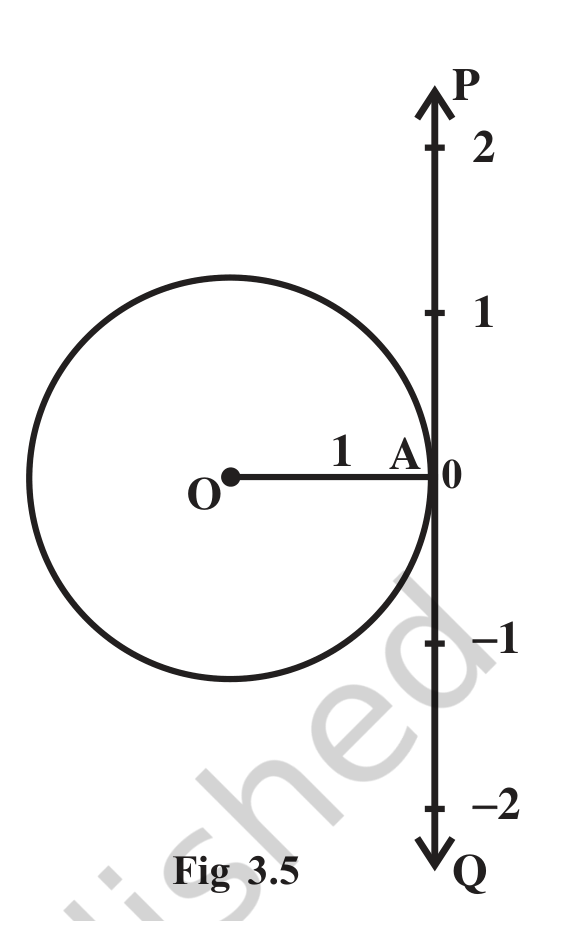
A radian is defined from the circle rather than from an arbitrary division. Take a circle of radius one, place an arc of length one along it, and join the two ends to the centre. The angle at the centre is exactly one radian.
Since the whole circumference of the unit circle has length 2 pi, one full turn is 2 pi radians. That gives the bridge between units: pi radians equal 180 degrees. Dividing by pi gives 1 radian as 180 over pi degrees, about 57 degrees 16 minutes, and 1 degree as pi over 180 radians, about 0.01746 radians.
Radians have a practical advantage. The measure of a rotation in radians is identical to the length of the arc it cuts on the unit circle, so radians and real numbers can be treated as the same thing. That is why a function such as sin x can take any real number as input without a unit conversion in the middle. When an angle is written without a degree sign, read it as radians.
2.3 Converting between the units
Conversion is a one line multiplication once the bridge is known. From degrees to radians, multiply by pi over 180. From radians to degrees, multiply by 180 over pi. Keeping pi as a symbol is usually better than substituting a decimal, because the answer then stays exact.
Some conversions appear so often that they should be automatic: 30 degrees is pi by 6, 45 degrees is pi by 4, 60 degrees is pi by 3, 90 degrees is pi by 2, 180 degrees is pi, 270 degrees is 3 pi by 2 and 360 degrees is 2 pi. Negative angles convert with the same multiplier, so minus 47 degrees 30 minutes becomes minus 19 pi by 72.
Mixed units need one step first. For 40 degrees 20 minutes, write 20 minutes as one third of a degree, so the angle is 40 and one third degrees, then multiply by pi over 180 to get 121 pi over 540. The arithmetic is easier if you convert the minutes before touching pi.
2.4 Arc length and the radius
Draw a circle of radius r and mark an arc of length l. The angle theta that the arc cuts at the centre is tied to the two lengths by l = r theta, valid when theta is in radians. The bridge between units is what makes the formula simple: in degrees the same statement would carry an extra factor, which is one reason radians are preferred.
Three quantities appear in l = r theta, so any one can be found from the other two. A central angle of 60 degrees is pi by 3 radians, and with arc length 37.4 cm the radius is 37.4 times 3 divided by pi, which is 35.7 cm using pi equal to 22 by 7. A clock hand 1.5 cm long turns through two thirds of a turn in 40 minutes, that is 4 pi by 3 radians, and its tip travels 1.5 times 4 pi by 3, about 6.28 cm.
A pair of circles with equal arcs shows the inverse relation. If the same arc length subtends 65 degrees in one circle and 110 degrees in another, the radii are in the ratio 22 to 13. Larger angle means smaller radius for a fixed arc, which is worth remembering as a sanity check.
2.5 Exercise 3.1 patterns
The exercise has three shapes. The first asks for conversion between the units. The second gives an arc and a radius and asks for the central angle. The third is a real object such as a wheel, a clock or a pendulum, where the angle per unit time has to be worked out before the arc length.
For a wheel making 360 revolutions in a minute, one revolution is 2 pi radians, so 360 revolutions give 720 pi radians per minute, which is 12 pi radians per second. For a circular arc of 22 cm on a circle of radius 100 cm, the angle is 22 divided by 100 radians, that is 0.22 radians, which converts to about 12 degrees 36 minutes. For a pendulum of length 75 cm swinging through an arc of 21 cm, the angle is 21 divided by 75, that is 0.28 radians.
Keep the units straight in every answer. An angle written as a bare number is in radians, and a length is in the unit given in the question. Mixing degrees into l = r theta is the single most common error in this exercise.
Warning
Before using l = r theta, check that the angle is in radians. If the question gives degrees, convert first; substituting degrees into the formula gives an answer that is off by a factor of pi over 180.