

Concepts: trigonometric functions, signs and graphs
Trigonometric Functions24 min readLesson 3 of 7
3.1 From right triangles to the unit circle
Earlier classes defined sine and cosine inside a right triangle. That definition works only for acute angles, so the chapter extends it. Draw a circle of radius one centred at the origin and mark a point P reached after turning through x radians from the positive x axis. Then the coordinates of P are (cos x, sin x).
Because the point sits on a circle of radius one, its distance from the origin is one, so the sum of the squares of its coordinates is one. That single observation produces the first fundamental identity. The other four functions come from ratios of the first two, with the usual restriction that a denominator must not be zero.
This construction also explains why trig functions repeat. A full extra turn brings the point back to the same place, so adding or subtracting 2 pi leaves sine and cosine unchanged. The functions are periodic, and the period of sine and cosine is 2 pi. Tangent and cotangent repeat after pi, as the algebra of their ratios shows.
3.2 Values at the standard angles
The quadrantal angles are the multiples of pi by 2, where the point lands on an axis. At 0 the point is (1, 0), so cosine is 1 and sine is 0. At pi by 2 the point is (0, 1), so cosine is 0 and sine is 1. At pi the point is (-1, 0), and at 3 pi by 2 it is (0, -1). Sine vanishes at whole multiples of pi, and cosine vanishes at odd multiples of pi by 2.
The values at 30, 45 and 60 degrees come from two right triangles. The 45 degree triangle with legs 1 and 1 gives sine and cosine equal to 1 over the square root of 2. The 30 and 60 degree triangle with sides 1, square root of 3 and 2 gives 1 by 2, square root of 3 by 2 and their reciprocals. Every other standard value can be reduced to one of these by reflection.
Reduction is worth practising. A large angle such as 31 pi by 3 is first stripped of whole turns: 31 pi by 3 equals 10 pi plus pi by 3, and the 10 pi contributes nothing, so the sine is that of pi by 3, which is square root of 3 by 2. A negative degree angle such as minus 1710 degrees is brought inside one turn by adding 5 times 360 degrees, giving 90 degrees, whose cosine is 0.
3.3 Signs by quadrant
The signs of the functions follow from the signs of the coordinates. In the first quadrant both coordinates are positive, so all six ratios are positive. In the second quadrant the x coordinate is negative and the y coordinate is positive, so sine and cosecant are positive while cosine, secant, tangent and cotangent are negative. In the third quadrant both coordinates are negative, so sine and cosine are negative but tangent and cotangent are positive. In the fourth quadrant x is positive and y is negative, so cosine and secant are positive.
A short memory phrase lists the positive functions quadrant by quadrant as all, sine, tangent, cosine. The important consequence is that a value outside the first quadrant is not enough to fix an angle: the quadrant decides the signs of the five remaining functions.
That is why a question such as cos x equal to minus 3 by 5 with x in the third quadrant has a unique answer. In the third quadrant sine is also negative, so from sin squared x equal to 16 by 25 we take sin x equal to minus 4 by 5, not plus 4 by 5. The other four values then follow from the ratios.
3.4 Domains, ranges and graphs
Sine and cosine accept every real input and produce values between -1 and 1. Tangent accepts every real number except odd multiples of pi by 2, where cosine is zero, and its range is all real numbers. Cotangent excludes multiples of pi and also covers all real numbers. Secant and cosecant exclude the same points as cosine and sine respectively, and their ranges run outside the open interval from -1 to 1.
The graphs record the same facts visually. The sine curve starts at the origin, climbs to 1 at pi by 2, returns to 0 at pi, falls to -1 at 3 pi by 2 and closes the wave at 2 pi. The cosine curve is the same wave shifted left by pi by 2. Both repeat every 2 pi and stay inside the horizontal band from -1 to 1.
The tangent graph has a branch rising through each interval of width pi, with vertical asymptotes at the excluded points. Cotangent falls across each branch instead. Secant and cosecant have U shaped branches above 1 and below -1, separated by vertical asymptotes. Sketching one full period is enough; the rest is a copy.
Slideshow, slide 1 of 3. Use the left and right arrow keys to change slides and the space bar to play or pause.
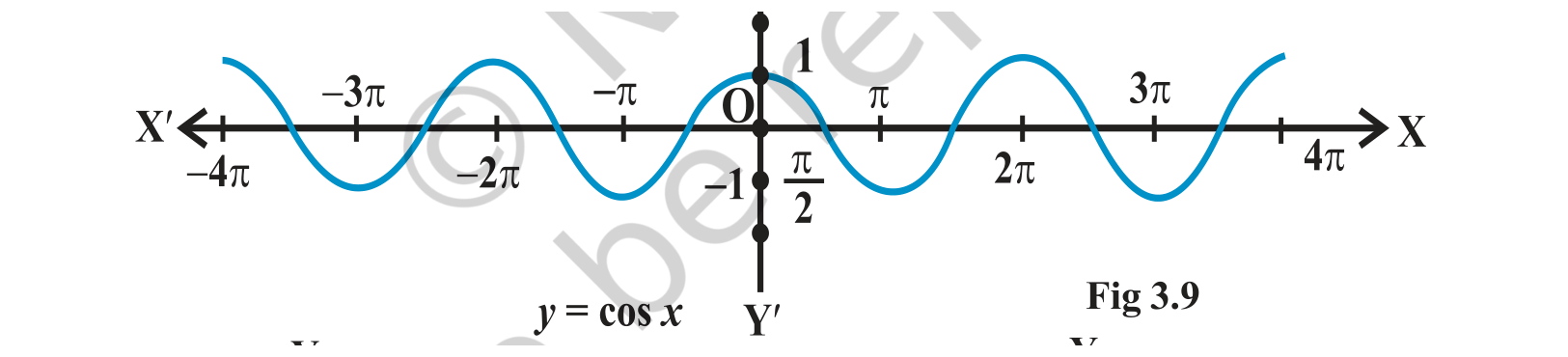
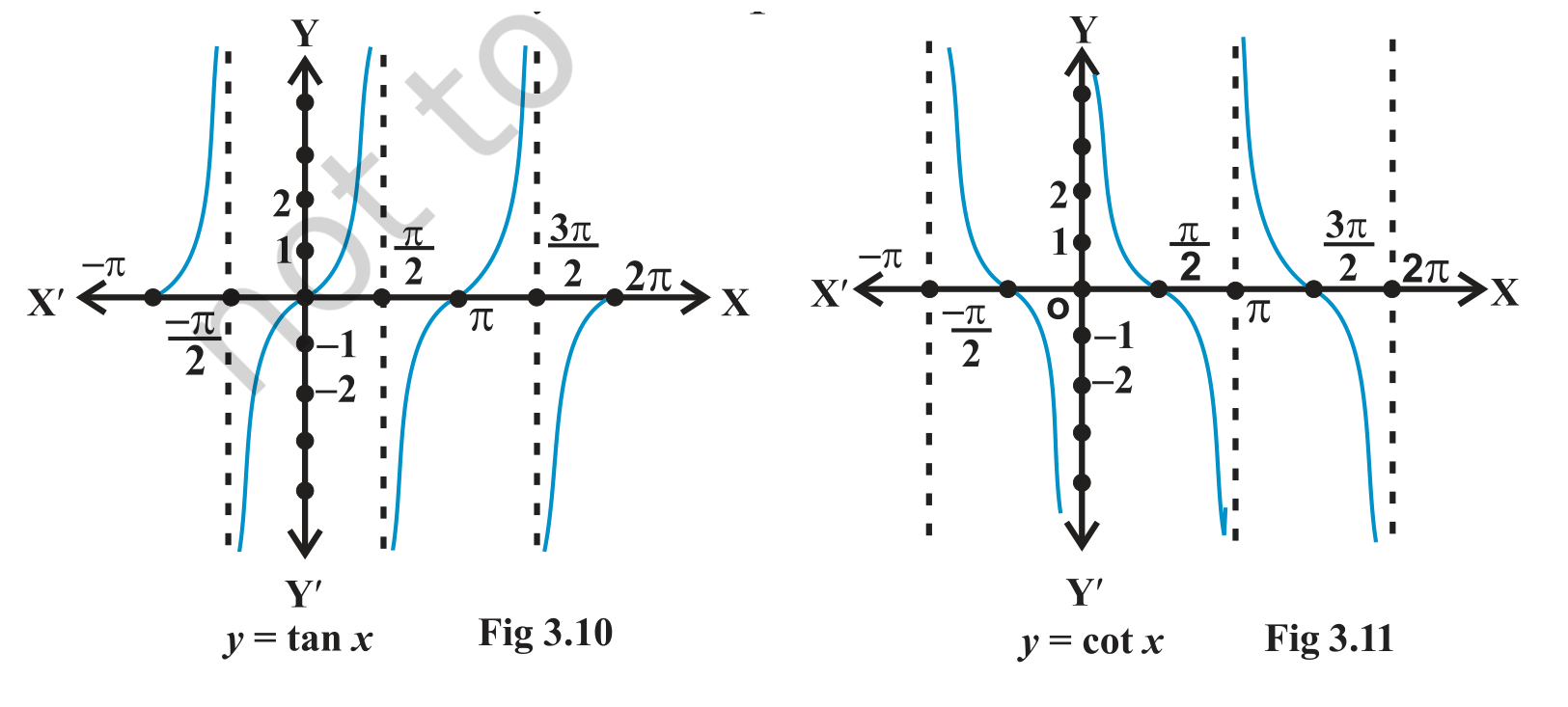
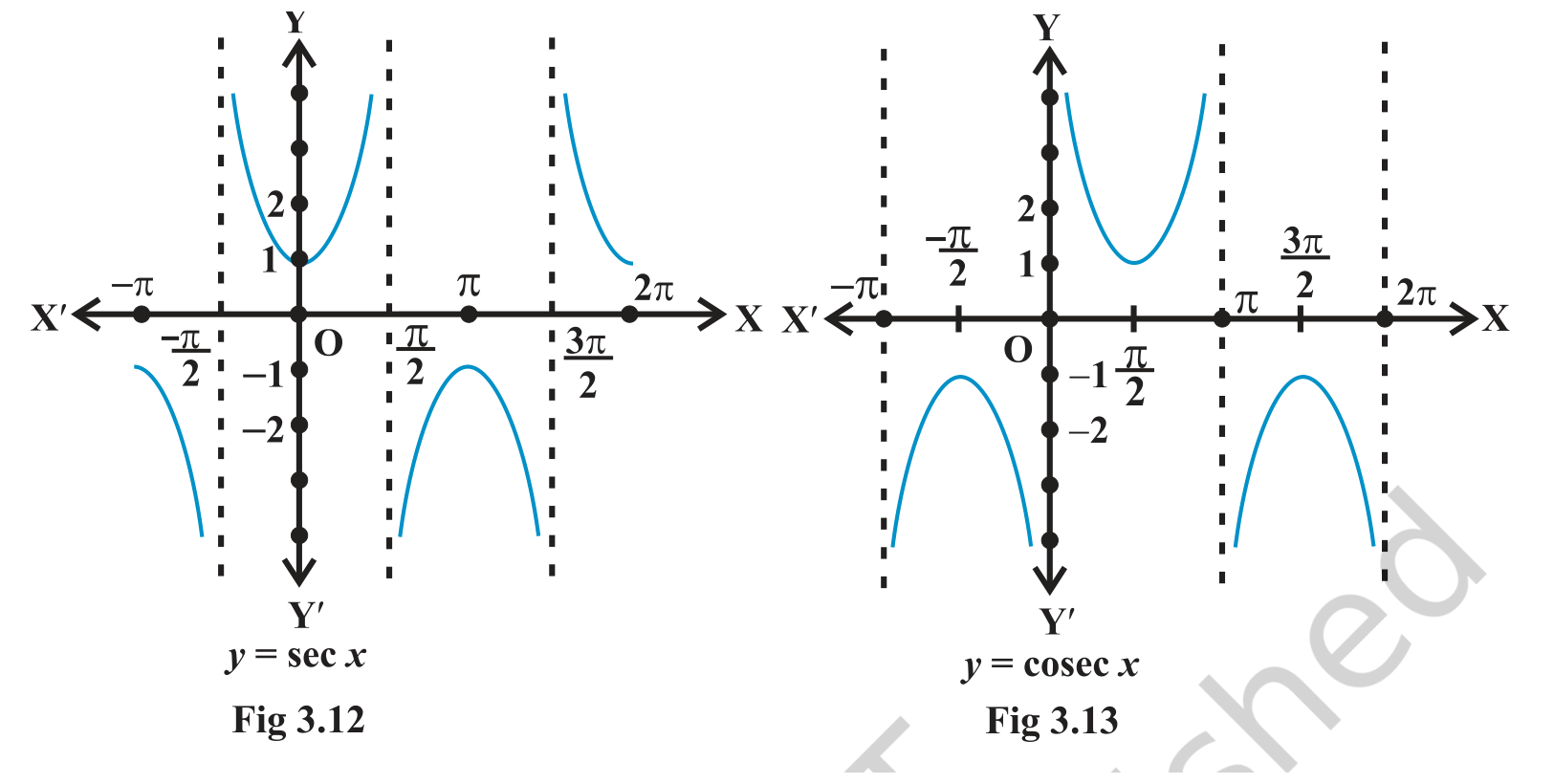
Graph of y = cos x over several periods, oscillating between 1 and minus 1 with period 2 pi
3.5 Even and odd behaviour
The reflection of the point P in the x axis gives the point for the angle minus x, whose coordinates are (a, -b). Since a is unchanged and b changes sign, the cosine function is even and the sine function is odd. In words, cos of minus x equals cos x, while sin of minus x equals minus sin x.
Dividing these by one another gives the parity of the remaining functions. Tangent and cotangent are odd, because they are ratios of an odd function to an even one. Secant is even, since it is the reciprocal of an even function, and cosecant is odd. Questions that ask for the value at a negative angle are usually testing exactly this lookup.
Exercise 3.2 mixes this with the sign rule. A typical item gives one value and a quadrant and asks for the other five, or gives a large angle and asks for a value after reduction. Both shapes are solved by doing the quadrant work first and the arithmetic second.
Common mistake
When a question gives one trigonometric value and a quadrant, take the sign from the quadrant before writing the other values. The square root step produces two candidates, and the quadrant is the reason one of them is rejected.