

Concepts: sum, difference and transformation identities
Trigonometric Functions26 min readLesson 4 of 7
4.1 The cosine of a sum, proved once
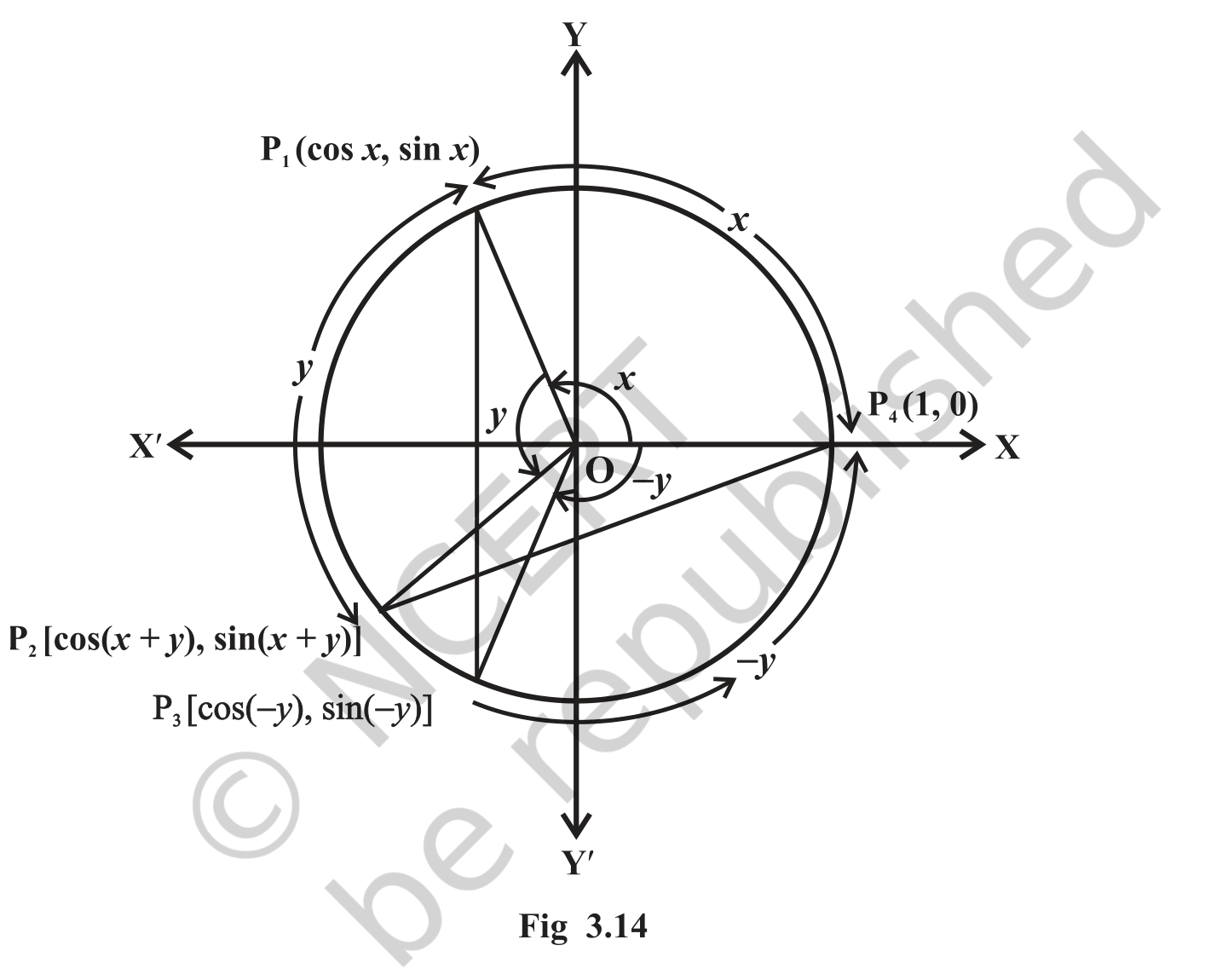
The central identity of this section is the formula for cos(x + y). The proof uses the unit circle and two congruent triangles. Mark the angles x, y, x + y and -y from a fixed point, which gives four points on the circle. The chord joining the point for angle x to the point for angle -y has the same length as the chord joining the point for x + y to the point for 0, because the two triangles are congruent.
Writing both lengths with the distance formula and cancelling the common terms leaves cos(x + y) equal to cos x cos y minus sin x sin y. The diagram in Figure 3.14 records the four points and the two chords.
Replacing y by minus y turns the result into the formula for cos(x - y), with the middle sign flipped to plus. A similar substitution inside the sine versions produces the sine addition and subtraction formulas. From there, dividing sine by cosine gives the tangent formulas, subject to the standard restriction on the angles.
4.2 Allied angle results
Once the addition and subtraction formulas are available, the values at angles such as pi by 2 plus x or pi minus x follow by substitution. Setting the two angles to specific values in the formulas gives a small table of allied angles that saves time in later chapters.
For example, cos(pi minus x) is minus cos x and sin(pi minus x) is sin x. Similarly, cos(pi plus x) is minus cos x and sin(pi plus x) is minus sin x. Moving by pi by 2 swaps sine and cosine with a sign: cos(pi by 2 minus x) is sin x, and sin(pi by 2 plus x) is cos x.
These rules are not worth memorising as independent facts. Recompute one of them from the addition formula in your head, notice the pattern, and the rest become quick checks. Board questions frequently reduce a large angle with exactly these identities.
4.3 Double and triple angles
Double angle formulas are the sum formulas with y set equal to x. Writes sine of 2x as 2 sin x cos x and cosine of 2x as cos squared minus sin squared. Because of the Pythagorean identity, the cosine form has two other versions: 2 cos squared x minus 1 and 1 minus 2 sin squared x. Choose the version that cancels with whatever else appears in the question.
The half angle versions matter as much as the double angle ones. From 1 minus 2 sin squared x equal to cos 2x, write sin squared x equal to (1 minus cos 2x) over 2. Similarly, cos squared x equals (1 plus cos 2x) over 2. These two lines remove squares, which is the standard first move in a proof that mixes degree one and degree two terms.
Triple angle formulas are built by writing 3x as 2x plus x and substituting twice. The results are 3 sin x minus 4 sin cubed x for sine and 4 cos cubed x minus 3 cos x for cosine. The tangent triple is the corresponding ratio and is used less often.
4.4 Transformation formulas
The transformation formulas switch between a sum and a product. Add the cosine of a sum to the cosine of a difference and the sine terms cancel, leaving twice the product of the cosines. Subtract the same two lines and the cosine terms cancel, leaving minus twice the product of the sines.
The same trick on the sine pair gives the sine addition and subtraction formulas as products. These four identities are the standard tool for proving statements such as sin 3x plus sin 2x minus sin x equal to 4 sin x cos(x/2) cos(3x/2). The method is always the same: group the terms whose angles average to a nice value, apply the formula, and factor.
A useful pattern check is that the product form contains the average of the two angles and the half difference. If your answer does not show these two combinations, a sign or a factor of 2 has probably slipped.
4.5 Proof technique for the exercise set
Exercise 3.3 asks you to prove identities. Three habits carry most of the marks. Start from the more complicated side, since simplifying towards the other side is easier than expanding it. Replace every tangent and cotangent by sine over cosine early, so that all terms live in sine and cosine. When squares appear, use the half angle forms to lower the degree.
An example shows the method. To prove that sin(x plus y) equals tan x plus tan y over something similar, write the tangent side as sine over cosine and combine the two fractions over a common denominator. The numerator becomes sin x cos y plus cos x sin y, which is the numerator of the sine addition formula, and the denominator follows the cosine addition pattern.
For equations rather than proofs, the same tools apply but the goal is to isolate x. Reduce to one trigonometric function, solve for its value, and then list all solutions inside the given interval. Check the boundary values, because equations from this chapter regularly have two or four solutions in a turn.
Tip
In identity proofs, never move terms from one side to the other as if you were solving an equation. Work on one side until it becomes the other, and write LHS and RHS labels clearly.