

Concepts: limits, left and right limits and algebra of limits
Limits and Derivatives24 min readLesson 3 of 7
3.1 What a limit means
A limit describes the behaviour of a function near a point, not at the point. The function may be undefined at a, or defined with a different value, and the limit can still exist. This is why a limit question cannot be answered by substitution alone when substitution gives an undefined expression.
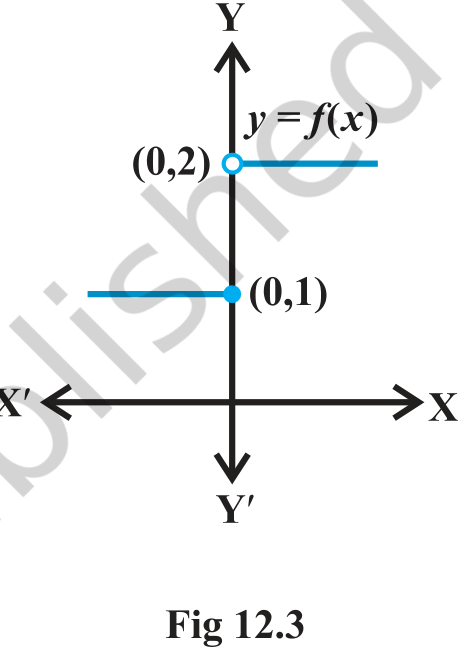
The two one-sided limits are the key to existence. If the function approaches different values from the left and the right, the limit does not exist even though both one-sided limits exist. Jump functions, step functions and greatest integer functions behave this way at their breakpoints. If both one-sided limits agree, the common value is the limit.
A useful practical rule is to evaluate from both sides whenever the function has an absolute value, a greatest integer part, or a piecewise definition. For polynomial and rational functions with no such feature, direct substitution works whenever the denominator is non-zero.
3.2 Algebra of limits
When the individual limits exist, the limit of a sum is the sum of the limits, the limit of a product is the product of the limits, and the limit of a quotient is the quotient of the limits provided the denominator limit is non-zero. These rules allow a complicated expression to be broken into simple pieces. They also explain why substitution works for polynomials: each power of x has a limit, and the addition rule combines them.
The zero over zero case needs a transformation before the rules can be used. Factoring is the first choice when the numerator and denominator are polynomials; rationalising is the standard method when a square root appears; dividing by the highest power of x is the method for limits at infinity. Each transformation removes the common factor that caused the indeterminate form.
Limits at infinity describe the long-term behaviour of a function. For a rational function, divide numerator and denominator by the highest power of x in the denominator; the terms with negative powers tend to zero and the limit is the ratio of the leading coefficients if the degrees match, zero if the denominator has higher degree, and infinite otherwise.
3.3 Standard techniques with examples
For the limit of (x squared minus 9) by (x minus 3) as x tends to 3, substitution gives zero over zero. Factoring the numerator as (x minus 3)(x plus 3) cancels the common factor and leaves the limit 6. This is the template for every polynomial indeterminate form.
For the limit of (square root of (x plus 2) minus 2) by x as x tends to 2, substitution again gives zero over zero. Multiplying numerator and denominator by the conjugate removes the root and simplifies to 1 by 4. Rationalisation is the standard move whenever a square root is subtracted.
For limits at infinity of a ratio of polynomials, the leading terms decide. A degree-three numerator over a degree-two denominator grows without bound, a degree-one over degree-three tends to zero, and equal degrees give the ratio of leading coefficients. Checking the degrees before any algebra saves time and prevents mistakes.
Standard algebraic identities do a lot of the work in this exercise. Difference of squares handles x squared minus a squared, sum and difference of cubes handle x cubed minus a cubed, and the conjugate factor handles square roots. When the indeterminate form survives one round, check whether another factor of the same kind is hidden. A limit question in this chapter rarely needs more than two transformations, and the correct transformation is usually suggested by the shape of the expression.
When a question gives a piecewise function and asks about a limit at the breakpoint, compute the two one-sided limits separately and compare. If they agree, the limit exists; if not, it does not, and the function is not continuous there. Writing the branches in separate lines before taking limits is essential, because a single substitution cannot see the other branch. This is exactly the pattern used in the left-right limit exercises and in the objective questions on jump discontinuities.
At infinity the same rules apply after the division step. A ratio of two polynomials is handled by comparing degrees; a ratio involving square roots is handled by dividing numerator and denominator by the highest power of x that appears, inside or outside the root. The sign of the leading term then decides between plus and minus infinity, which matters when the question asks for behaviour rather than a number.
Common mistake
Treating an indeterminate form as an answer is the most common limit error. Zero over zero, infinity over infinity and infinity minus infinity are forms to transform, not values.