

Concepts: rate of change and the intuitive derivative
Limits and Derivatives22 min readLesson 2 of 7
2.1 Average rate and instantaneous rate
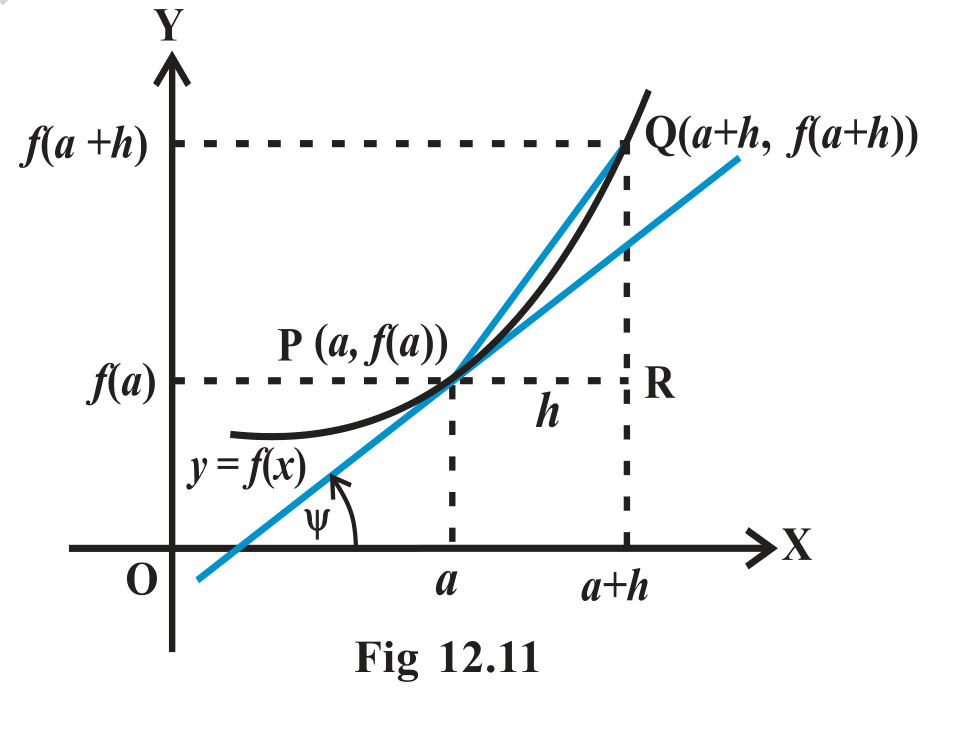
The average rate of change of a function over an interval is the change in the function divided by the change in the variable. Geometrically it is the slope of the secant joining two points on the graph. As the second point moves closer to the first, the secant turns into a tangent and the average rate tends to the instantaneous rate.
This limiting process is the derivative. For a position function the derivative is velocity, and the rate of change of velocity is acceleration. For a cost function the derivative is marginal cost. Recognising the physical meaning of the derivative is often the quickest way to start a word problem, because the question usually asks for a rate, a slope or a tangent.
The difference quotient is the algebraic form of this process. Writing it, substituting the function and simplifying is the standard first step. The limit is taken only after the simplification, because the denominator carries an h that must cancel before h is set to zero.
2.2 Continuity and differentiability
A function is continuous at a point when its limit there equals its value there. A jump, a hole or a vertical asymptote breaks continuity. Differentiability is a stronger condition: the derivative exists only when the left and right difference quotients have the same limit. A corner, a cusp or a vertical tangent makes a continuous function non-differentiable at that point.
The graph of the modulus function shows the difference clearly. It is continuous everywhere, but at the origin the left slope is minus 1 and the right slope is plus 1, so no single tangent exists and the derivative does not exist there. Questions that ask for the number of points where a function is not differentiable are usually asking you to find such corners and jumps.
For the exercises, the useful checks are: substitute near the point from both sides, compare with the function value, and compute the two one-sided difference quotients if differentiability is asked. Writing the piecewise function in its separate branches before taking limits avoids almost every error.
2.3 Exercise practice on rates
The exercise style for this section is to compute a difference quotient for a simple function, or to find the derivative at a given point from the definition. For f(x) equal to x squared, the difference quotient simplifies to 2x plus h, and letting h tend to zero gives 2x. At x equal to 3 the derivative is 6, which is also the slope of the tangent at that point.
For a constant function the difference quotient is zero, so the derivative is zero. This matches the geometric picture of a horizontal line. For a linear function the quotient simplifies to the slope itself, so every point has the same derivative; this is the first indication that the derivative of a line is its slope.
Worded questions use the same algebra with a physical label. A ball dropped from a height has position proportional to time squared, and its velocity at a time is the derivative, which is linear in time. A question asking for the velocity after two seconds is then a derivative computation, not a physics formula to recall.
A third pattern is the derivative at a point found from the graph. The slope of the tangent drawn at a point is the derivative there, so reading two points on the tangent gives the value. When the tangent is horizontal the derivative is zero, and when the tangent is vertical the derivative does not exist. These graphical questions appear in the NCERT illustrations and are worth practising because they connect the algebra to the picture and make the first-principles formula easier to remember.
The idea of a limit and the idea of a derivative are the same limiting process applied to two different quotients. A limit asks where a function goes; the derivative asks where a difference quotient goes. That is why the chapter places limits first: once the limit tools are secure, the derivative is a single new formula rather than a new subject. Reading the chapter in that order, and revising the two standard trigonometric limits before the derivative of sine, keeps the logic clear.
One more distinction worth keeping clear: the value of a function at a point and the limit of the function at that point are independent facts. A function can be defined at a point and still have a different limit there, or be undefined there and yet have a limit. Every example in the chapter is built to make this separation visible, and the questions page repeats it deliberately.
Tip
In a first-principles derivative, simplify the difference quotient until the h in the denominator cancels. Setting h to zero before cancelling is the standard mistake.