

Concepts: acceleration, kinematic equations and free fall
Motion in a Straight Line24 min readLesson 3 of 6
3.1 Acceleration
Velocity can change in size, in direction, or both, and acceleration measures how fast it changes. Average acceleration divides the change in velocity by the interval, while instantaneous acceleration is the derivative of velocity with respect to time. Both are vectors along the line, so the sign records whether the change points forward or backward.
A positive acceleration does not guarantee speeding up. If the velocity is negative and the acceleration is positive, the body is slowing down while moving in the negative direction. The safe statement is that speed rises when velocity and acceleration share a sign and falls when they have opposite signs. Uniform acceleration means a constant value, and only then do the kinematic equations of the next section apply.
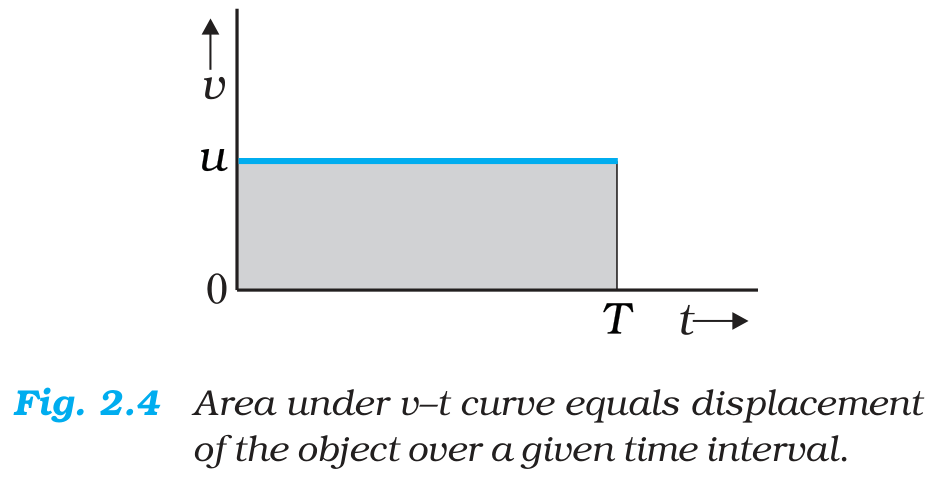
On a velocity-time graph, acceleration is the slope. A horizontal segment means zero acceleration, a rising straight segment means constant positive acceleration, and a falling straight segment means constant negative acceleration. The graph in the figure below shows areas that correspond to displacement.
3.2 Deriving the kinematic equations
Start with a constant acceleration a and initial velocity u at t = 0. The definition a = dv/dt integrates to v = u + at, which is the first equation. Integrate v = dx/dt next, with the body starting at x = 0, and the result is x = ut + (1/2)at^2. Eliminate t between the two equations and the third result appears, v^2 = u^2 + 2ax.
Each equation omits one of the five quantities u, v, a, t and x, which is why a numerical usually points to one equation. If the time is neither given nor asked, use v^2 = u^2 + 2ax. If the final velocity is not needed, use x = ut + (1/2)at^2. A useful check is to differentiate each equation and see that it returns the definition of acceleration.
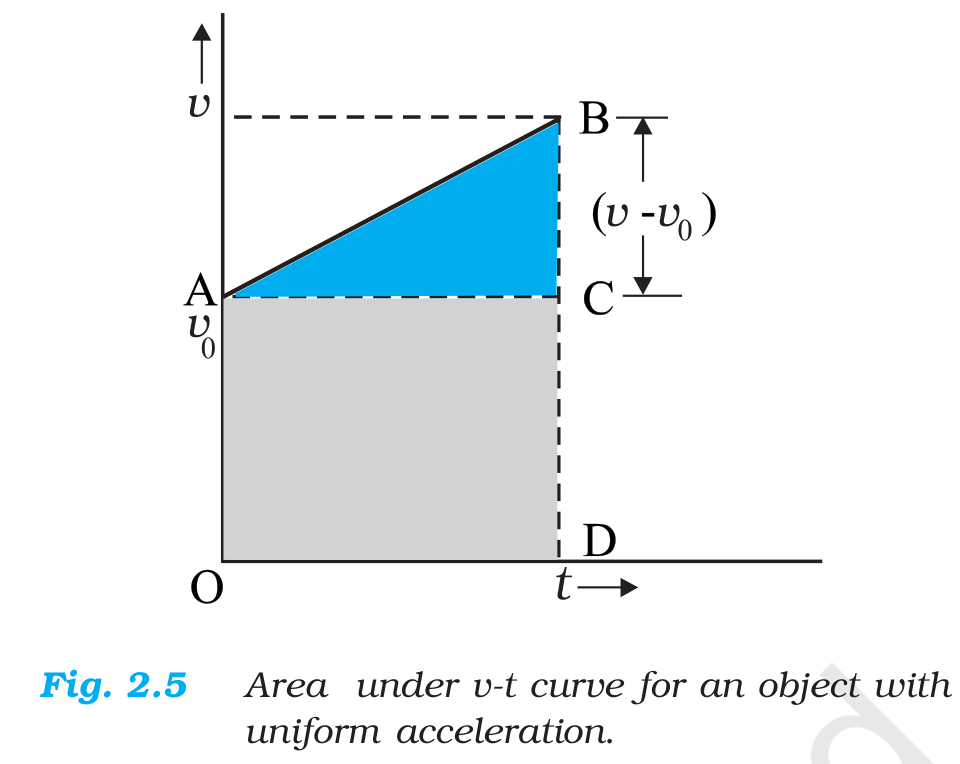
The velocity-time graph gives a second route to the same results. For uniform acceleration the graph is a straight line, and the area under it is a trapezium whose parallel sides are u and v and whose height is t. That area is (u + v)t/2, which is displacement. Setting the two expressions for displacement equal recovers v = u + at and the third equation.
3.3 Worked examples with the equations
A car moving at 126 km h^-1 is brought to rest in 200 m. Convert the speed first: 126 km h^-1 is 35 m s^-1, so u = 35, v = 0 and x = 200. The equation without t gives 0 = 1225 + 400a, so a = -3.06 m s^-2. The minus sign says the acceleration opposes the motion. Then v = u + at gives t = 35/3.06 = 11.4 s.
A body starting from rest covers 40 m in the first 4 s. From x = (1/2)at^2, 40 = 8a, so a = 5 m s^-2. Its velocity at 4 s is 20 m s^-1, and the distance covered in the fifth second is u + a(2n - 1)/2 with u = 0, n = 5, which gives 22.5 m. A common error is to use the total time instead of the interval; in the nth second the interval is one second, not five.
For a round trip, split the journey at the turning point. A ball thrown up at 20 m s^-1 reaches 20 m in 2 s with g = 10 m s^-2, then returns to the hand at 4 s with velocity -20 m s^-1. The displacement is zero and the path length is 40 m, so the average velocity is zero while the average speed is 10 m s^-1.
3.4 Free fall
A body released from rest falls with acceleration g directed downward. Taking upward as positive, a = -g and the equations read v = -gt, x = -(1/2)gt^2 and v^2 = -2gx when x is measured upward from the release point. A ball thrown upward with speed u rises for a time u/g, reaches a height u^2/(2g), and comes back to the thrower after 2u/g with the same speed reversed.
At the highest point the velocity is zero, but the acceleration is still g downward. Many students take the acceleration to be zero there and conclude the ball floats, which contradicts the fact that it comes back down. The deceleration on the way up and the acceleration on the way down are the same value of g with the same downward direction; only the velocity changes sign.
The independence of mass is another free fall result. Two objects dropped together from the same height land together when air resistance is ignored, whatever their masses. With air resistance the lighter object is slowed more, and the difference grows as the speed rises. A feather and a coin behave as the equations predict only in a vacuum.
Common mistake
When a body is thrown upward, keep one sign convention for the whole motion. If upward is positive, then a = -g on the way up and a = -g on the way down. Flipping the sign after the top is the single most common source of wrong answers in this topic.