

Concepts: position, displacement, speed and velocity
Motion in a Straight Line22 min readLesson 2 of 6
2.1 Describing motion needs a frame
Motion means a change of position with time, and position only has meaning against a chosen origin, axis and clock. This set of choices is the frame of reference. A passenger sitting still in a moving train is at rest in the train frame and moving in the ground frame, and both statements are correct because they name different frames. Unless a question says otherwise, take the ground as the frame.
For motion along a straight line, one axis and a sign convention are enough. Fix the origin, choose which direction counts as positive, and report every position as a coordinate on that axis. Objects are treated as point objects, which is valid when their size is much less than the distance they cover. This chapter studies only rectilinear motion, so the position is a single number x at each instant t.
2.2 Path length and displacement are different
Suppose a student walks 3 km east, turns and walks 3 km west. The position is back where it started, so the displacement is zero, but the distance walked is 6 km. Displacement measures only the change of position, from the initial point to the final point, and its sign tells the direction. Path length counts every metre actually covered and is always positive.
In one dimension the magnitude of displacement equals the path length only when the motion never reverses direction. Any turn raises the path length above the displacement. A student who walks 60 m north and then 20 m south has a displacement of 40 m north, but the path length is 80 m, and the two averages defined next take different inputs for exactly this reason. Average speed uses path length and average velocity uses displacement.
2.3 Reading a position-time graph
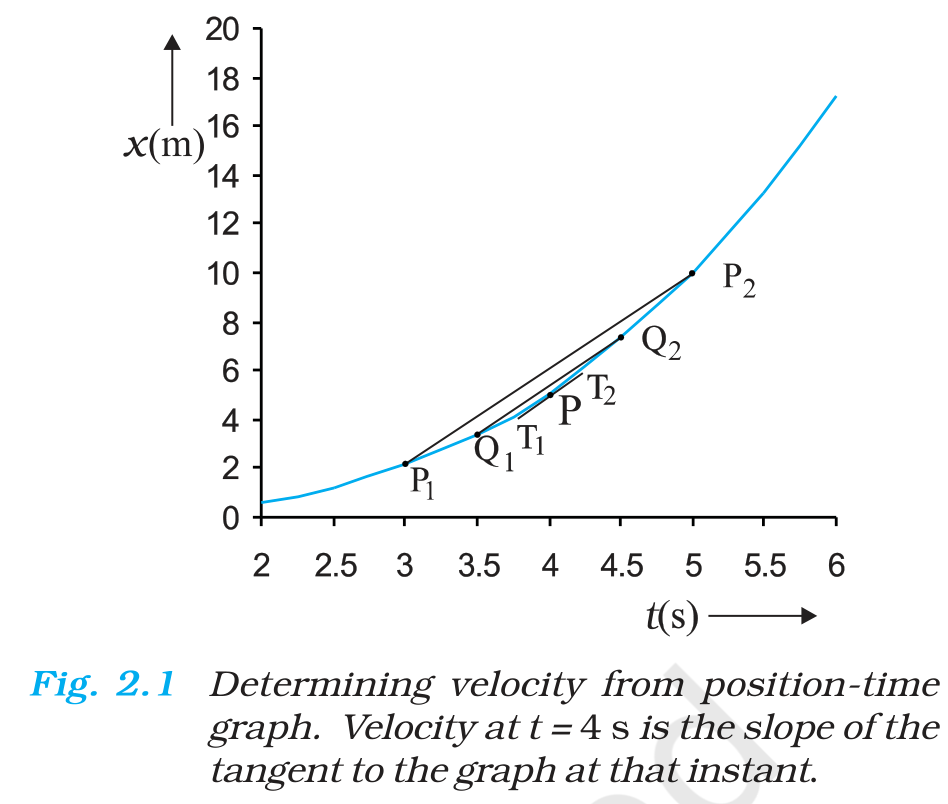
The position-time graph records where the body is at every instant. Its slope between two points is the average velocity over that interval. As the second point slides toward the first, the chord becomes a tangent, and the slope of the tangent at a point is the instantaneous velocity there. That is exactly what the limit defining velocity does, and the figure shows the construction.
A horizontal line means the body is at rest, since the slope is zero. A straight line with a constant slope means uniform velocity. A curve that gets steeper means rising speed, and a curve that flattens means slowing down. A graph that crosses the time axis shows the body passing the origin. Two different bodies can have graphs that cross, and the crossing means they are at the same place at that instant.
2.4 Instantaneous velocity and speed
The average velocity over a long interval hides the freedom of the body within that interval. To recover the velocity at one instant, take the average over shorter and shorter intervals centred on that instant. The limit as the interval tends to zero is the instantaneous velocity, and it equals the derivative of position with respect to time.
The instantaneous speed is the magnitude of the instantaneous velocity. For an object that moves forward and then backward, the instantaneous velocity changes sign at the turning point while the instantaneous speed stays positive. At any single instant the two differ only by a sign, which is why the distinction between average speed and the magnitude of average velocity disappears in the limit.
A worked case makes the derivative concrete. Take x = 0.08 t^3 in metre, so the position at t = 0 s is 0 m, at 2 s is 0.64 m and at 4 s is 5.12 m. The average velocity between 2 s and 4 s is (5.12 - 0.64)/2 = 2.24 m s^-1. Differentiate instead: v = 0.24 t^2, so the velocity at 4 s is 3.84 m s^-1. The two numbers differ because the motion is accelerating, and the instantaneous value is the one the tangent in the figure measures. The chords in that figure are the same shrinking intervals used above, and as the second point slides toward the first, the chord slope approaches the tangent slope.
Use averages when the question asks about an interval and instantaneous values when it asks about an instant. A body can have zero instantaneous velocity and non-zero acceleration at the same time, as a ball does at the top of a vertical throw. The reverse is also possible: a body moving with constant velocity has zero acceleration at every instant.
Warning
Do not average speeds directly when the two halves of a journey have different speeds. A car covering half the distance at v1 and the other half at v2 has an average speed of 2v1v2/(v1+v2), which is the harmonic mean and is always smaller than the arithmetic mean.