

Concepts: force law, energy and the spring
Oscillations24 min readLesson 3 of 6
3.1 The force law for SHM
By Newton's second law, the acceleration a = -omega squared x requires a force F = -m omega squared x. This force is proportional to the displacement and always points towards the mean position, so it is a restoring force. The constant k = m omega squared is the force constant of the oscillator, and the angular frequency follows as omega = sqrt(k/m). Any system whose restoring force is proportional to the displacement therefore oscillates with simple harmonic motion, whatever its physical construction: a spring, a wire under tension, a liquid column in a U-tube or a ball rolling in a bowl all fit the same equation. The equation a = -omega squared x is the signature of SHM, and it is often enough to identify a motion as simple harmonic without solving anything.
3.2 Worked example: spring constant from a static extension
A 0.4 kg mass hung on a spring stretches it by 8 cm and rests in equilibrium. At equilibrium the spring force balances the weight, so k x0 = m g, giving k = m g/x0 = 0.4 x 9.8/0.08 = 49 N m^-1. The angular frequency of vertical oscillations is sqrt(k/m) = sqrt(49/0.4) = 11.1 rad s^-1, and the period is 2 pi/11.1 = 0.57 s. Notice that the equilibrium extension cancels out of the period: it only locates the centre of the oscillation. If the same mass were hung on a spring twice as stiff, the extension would be half and the period would be shorter by a factor of sqrt 2.
3.3 The spring-mass oscillator
Hang a mass on a vertical spring and stretch it a little; the spring pulls back with a force proportional to the extension, and the mass oscillates up and down about the new equilibrium position. The spring constant k is the force per unit extension, and the angular frequency is omega = sqrt(k/m). The period T = 2 pi sqrt(m/k) grows with the mass but falls with the stiffness, so a heavy mass on a weak spring oscillates slowly. The equilibrium extension is x0 = m g/k; it shifts the centre of the oscillation but does not change the period. Cutting a spring in half doubles its spring constant, so the same mass oscillates sqrt 2 times faster on the shorter spring. This is why the period of a spring-mass system is the same on the earth and on the moon. A vertical spring therefore shows the same simple harmonic motion as a horizontal one, with the same period, because gravity only shifts the middle position. The oscillation about that new position is symmetric, and the extension of the spring varies with the same amplitude as the displacement. A stiff spring with a small mass makes a fast oscillator, which is why a stiffer suspension makes a car bounce more quickly over a bump.
3.4 Energy in simple harmonic motion
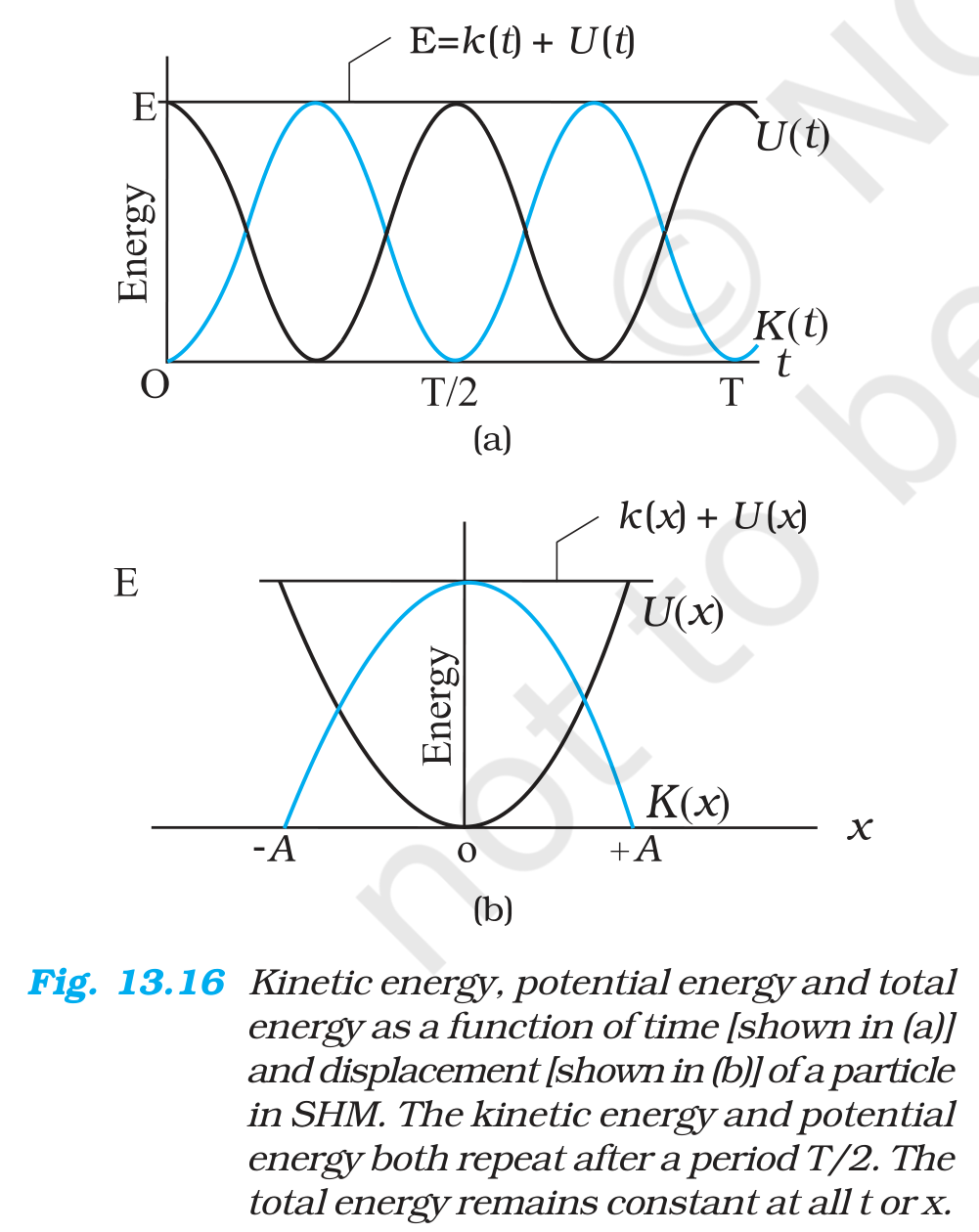
The restoring force is conservative, so the mechanical energy of an oscillator is constant. The potential energy stored at displacement x is (1/2) k x squared, and the kinetic energy is (1/2) m v squared. Since v squared = omega squared (A squared minus x squared), the kinetic energy is (1/2) m omega squared (A squared minus x squared), and adding the two gives the total energy (1/2) m omega squared A squared = (1/2) k A squared. The total energy is proportional to the square of the amplitude. At the mean position the whole energy is kinetic; at the extremes the whole energy is potential. The graphs of K, U and E against x show that K and U are parabolas and that E is a horizontal line.
3.5 Worked example: oscillator energy
A 0.2 kg mass oscillates in SHM with amplitude 0.05 m and period 0.4 pi s. The angular frequency is omega = 2 pi/T = 2 pi/(0.4 pi) = 5 rad s^-1. The force constant is k = m omega squared = 0.2 x 25 = 5 N m^-1. The total energy is (1/2) k A squared = 0.5 x 5 x 0.0025 = 6.25 x 10^-3 J. The maximum speed is A omega = 0.05 x 5 = 0.25 m s^-1, and the maximum acceleration is A omega squared = 0.05 x 25 = 1.25 m s^-2. At a displacement of 0.03 m, the speed is omega sqrt(A squared minus x squared) = 5 x sqrt(0.0025 - 0.0009) = 5 x 0.04 = 0.2 m s^-1, and the kinetic energy is then 0.5 x 0.2 x 0.04 = 4 x 10^-3 J.
Common mistake
Do not use the amplitude in place of the displacement in energy formulas. At the extreme position the kinetic energy is zero even though the total energy is maximum there.