

Concepts: periodic motion and simple harmonic motion
Oscillations24 min readLesson 2 of 6
2.1 Periodic and oscillatory motion
When a motion repeats itself after equal intervals of time it is called periodic. The turning of the earth about its axis, the sweep of a clock hand and the swinging of a swing are all periodic. In the last of these the body moves back and forth about a fixed middle point, and such a motion is called oscillatory. An oscillatory motion is therefore periodic, while a periodic motion can fail to be oscillatory: a body going round and round returns to the same point again and again without moving back and forth. The time for one complete cycle is the period T, and the number of cycles in one second is the frequency, f = 1/T. The displacement from the middle point, the velocity and the acceleration all repeat with the same period.
2.2 Simple harmonic motion
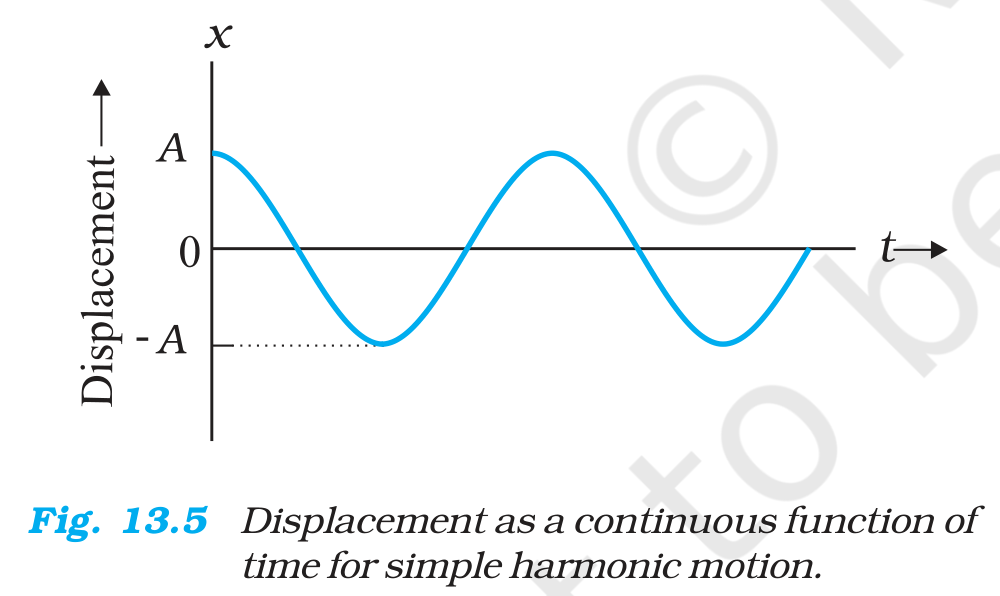
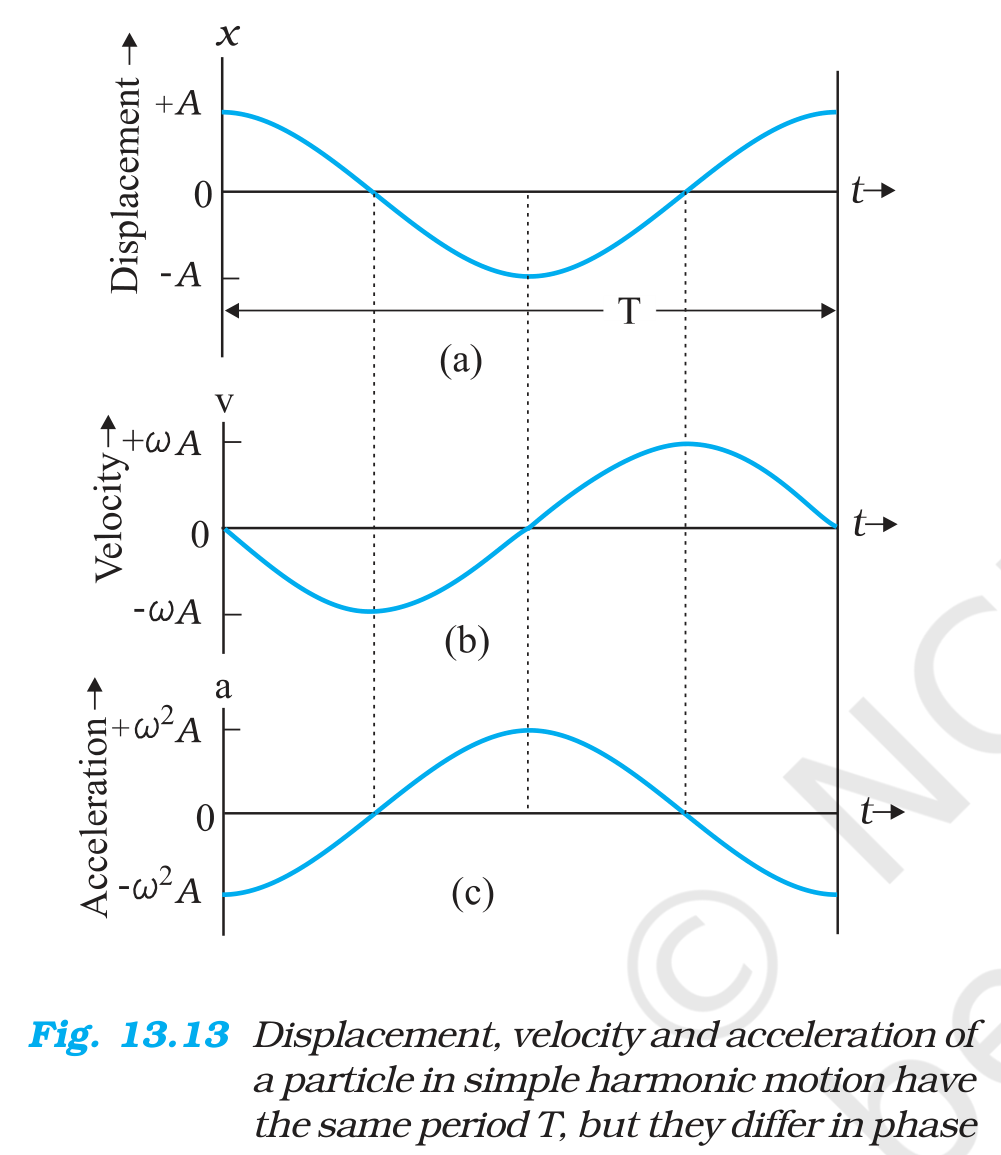
Among all oscillatory motions, the simplest is simple harmonic motion. In SHM the displacement is a sine or cosine function of time, x = A cos(omega t + phi). The constant A is the amplitude, the maximum distance from the mean position; omega is the angular frequency, related to the period by omega = 2 pi/T; and phi is the phase constant, fixed by where the particle is at t = 0. The quantity (omega t + phi) is called the phase, and the phase changes by 2 pi in one period. The displacement, velocity and acceleration all vary sinusoidally with the same omega, but with different amplitudes and with fixed phase differences. A particle in SHM passes through the mean position twice per period, once in each direction, and its speed is largest there.
2.3 Amplitude, phase and the SHM graph
The three constants in x = A cos(omega t + phi) have clear meanings. The amplitude A is the largest distance from the middle point, so the particle never goes beyond plus A or minus A. The angular frequency omega fixes the period through omega = 2 pi/T and tells us how fast the phase advances. The phase constant phi tells us where the particle is at t = 0 and in which direction it is moving. Changing phi slides the whole cosine graph along the time axis without changing its shape: a positive phi shifts the graph to the left, a negative phi shifts it to the right. Two particles with the same A and omega but different phi are out of step, and the phase difference between them stays constant. The graph of displacement against time is a cosine curve, and the slope of this curve at any instant gives the velocity.
2.4 Worked example: reading an SHM equation
A particle moves as x = 0.08 cos(4 pi t + pi/3) metre. Comparing with x = A cos(omega t + phi), the amplitude is 0.08 m, the angular frequency is 4 pi rad s^-1 and the phase constant is pi/3. The period is 2 pi/omega = 0.5 s, so the frequency is 2 Hz. At t = 0 the displacement is 0.08 cos(pi/3) = 0.04 m. The maximum speed is A omega = 0.08 x 4 pi = 1.0 m s^-1, and the maximum acceleration is A omega squared = 0.08 x 16 pi squared = 12.6 m s^-2. The particle reaches the mean position when the phase equals pi/2, which first happens at t = (pi/2 - pi/3)/(4 pi) = 1/24 s.
2.5 SHM and uniform circular motion
There is a close link between SHM and uniform circular motion. Take a particle moving with constant angular speed on a circle of radius A. Its projection on any diameter moves to and fro between A and minus A, and the projection of the circular motion is exactly SHM of amplitude A and angular frequency omega. This is why the equations of SHM contain the same omega that describes the circular motion, and why the phase can be read as the angle of the rotating particle. The projection on the x-axis is A cos(omega t + phi), and the projection on the y-axis is A sin(omega t + phi); the two differ only in phase. This geometrical picture makes the phase, the amplitude and the period easy to visualise, and it explains why the maximum speed is A omega, the speed of the particle on the circle.
2.6 Velocity and acceleration
The velocity of a particle in SHM is obtained by differentiating the displacement with respect to time, giving v = -A omega sin(omega t + phi). Using the displacement relation, the velocity can also be written as v = plus or minus omega sqrt(A squared minus x squared). It is zero at the extreme positions and has magnitude A omega at the mean position. Differentiating again gives the acceleration a = -omega squared x, which is proportional to the displacement and directed towards the mean position. The acceleration is zero at the centre and has magnitude omega squared A at the extremes. Note that the velocity and the acceleration are never both zero: when the particle is at an extreme, its velocity is zero but the acceleration is maximum, which is why it turns back.
Slideshow, slide 1 of 3. Use the left and right arrow keys to change slides and the space bar to play or pause.
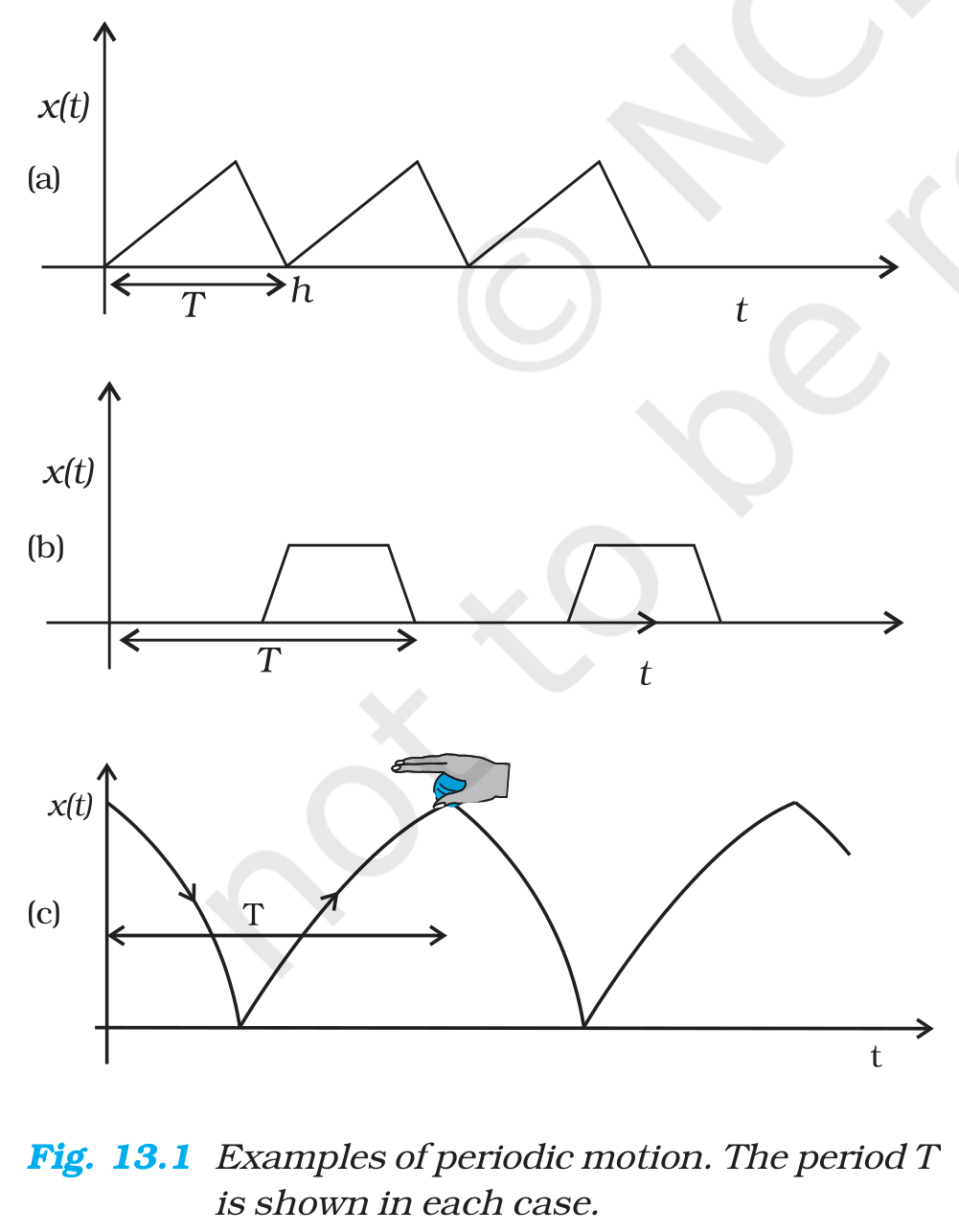
NCERT Figure 13.1: three examples of periodic motion with the period T marked on the height against time graphs.
Tip
Write every SHM answer in the form x = A cos(omega t + phi). Once A, omega and phi are known, the positions, speeds and times follow directly from this one equation.