

Concepts: the simple pendulum and exercise practice
Oscillations24 min readLesson 4 of 6
4.1 The simple pendulum
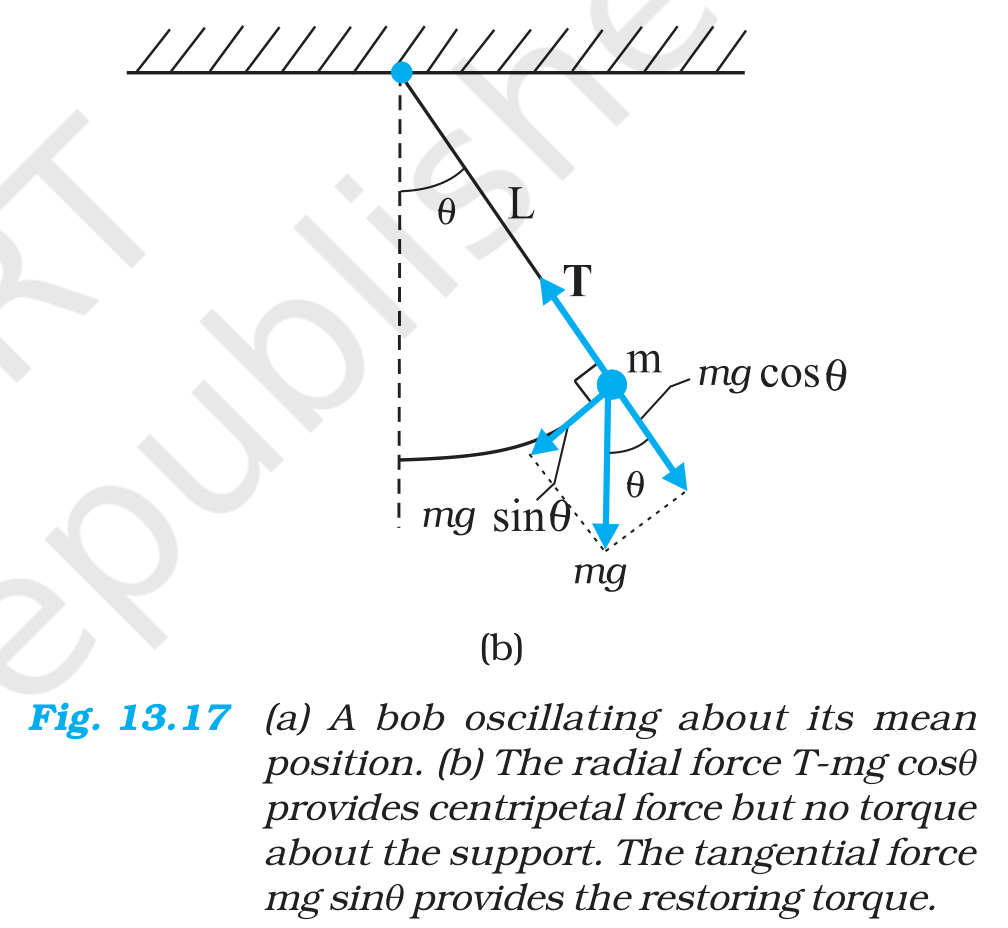
A simple pendulum is a small heavy bob suspended by a light inextensible string from a rigid support. When the bob is displaced to one side and released, it swings to and fro. The forces on the bob are the tension along the string and the weight downwards. The component of the weight along the arc is the restoring force, and it equals minus m g sin theta, where theta is the angle of the string with the vertical. For small angles, sin theta is nearly equal to theta in radians, so the restoring force becomes minus m g theta. Because theta = x/l for a small displacement x, the force becomes minus (m g/l) x, which is the SHM force law with k = m g/l.
4.2 Deriving the pendulum period from torque
Take the pivot as the axis and write the restoring torque. The tension passes through the pivot and gives no torque; the weight gives a torque of magnitude m g l sin theta about the pivot, and the torque acts so as to reduce theta. The moment of inertia of the bob about the pivot is m l squared, so Newton's law for rotation gives m l squared alpha = -m g l sin theta. Dividing by m l squared gives alpha = -(g/l) sin theta. For small theta, sin theta is approximately theta, so alpha = -(g/l) theta. This has the same form as a = -omega squared x with x replaced by theta and omega squared = g/l. Hence the angular frequency is sqrt(g/l) and the period is 2 pi sqrt(l/g). The mass and the size of the bob cancel out because both the torque and the moment of inertia are proportional to the mass. If the string is replaced by a light rod, the same formula holds and only the moment of inertia changes. For a real pendulum the bob is not a point, so the simple formula is an approximation that improves as the bob becomes more compact. The same torque argument explains the physical pendulum, where the moment of inertia is not simply m l squared.
4.3 Period of a pendulum
Using omega = sqrt(k/m) with k = m g/l gives omega = sqrt(g/l), so the period is T = 2 pi sqrt(l/g). The result depends only on the length of the string and the value of g; the mass of the bob and the amplitude cancel out. This is why the period is independent of the material and size of the bob, and why a pendulum clock runs slightly slower on a mountain, where g is smaller, and slightly faster in a deep mine. The formula holds only for small oscillations, typically below about 10 degrees; for larger angles the period increases, because sin theta is no longer equal to theta. A pendulum cannot be used to determine g reliably on a spacecraft in orbit, where the effective g is zero.
4.4 Worked example: pendulum period and g
A pendulum of length 1.0 m swings through a small angle. Taking g = 9.8 m s^-2, the period is 2 pi sqrt(1.0/9.8) = 2 pi x 0.319 = 2.0 s. If a clock loses time, its pendulum must be shortened slightly, because a shorter pendulum has a smaller period. On a mountain top g is smaller, so the same pendulum takes longer and the clock loses time. Measuring the period of a known length is a standard way of finding g: square T = 2 pi sqrt(l/g) to get g = 4 pi squared l/T squared. The energy of the bob is (1/2) m omega squared A squared at the extremes and pure kinetic energy at the centre.
4.5 Exercise practice: NCERT questions worked in short
13.2 The rotation of the earth about its axis is periodic but not SHM, because the motion is not back and forth about a mean position. The mercury column in a U-tube and the ball bearing in a smooth bowl both perform nearly simple harmonic motion, and the general vibration of a polyatomic molecule is quasi-periodic. 13.6 Of the given relations, only a = -10x is of the SHM form a = -omega squared x, with omega squared = 10. 13.7 With x(0) = 1 cm and v(0) = omega cm/s, the amplitude is sqrt(1 squared + 1 squared) = sqrt 2 cm and the phase constant is -pi/4 for the cosine form. Written with a sine, the amplitude is still sqrt 2 cm and the initial phase is pi/4. The remaining exercises 13.1, 13.3 to 13.5, and 13.8 to 13.15 use the same relations with other data and are listed for practice.
Exam
State clearly that the small-angle approximation sin theta approximately equals theta is what makes the pendulum motion simple harmonic. Without it, the restoring force is not proportional to displacement.