

Concepts: standing waves in pipes and resonance
Waves24 min readLesson 5 of 8
5.1 Standing waves in air columns
An organ pipe contains a column of air that can vibrate as a standing wave. The boundary conditions are different from those of a string: at a closed end the air cannot move, so the closed end is a displacement node, while at an open end the air is free to move, so the open end is an antinode. The sound heard from the pipe depends on which harmonics the boundary conditions allow.
In a standing sound wave the pressure and the displacement are out of step. Where the air moves least, at a displacement node, the pressure variation is largest; where the air moves most, at a displacement antinode, the pressure variation is smallest. Either description works, but the displacement picture is easier to draw.
5.2 Open pipes
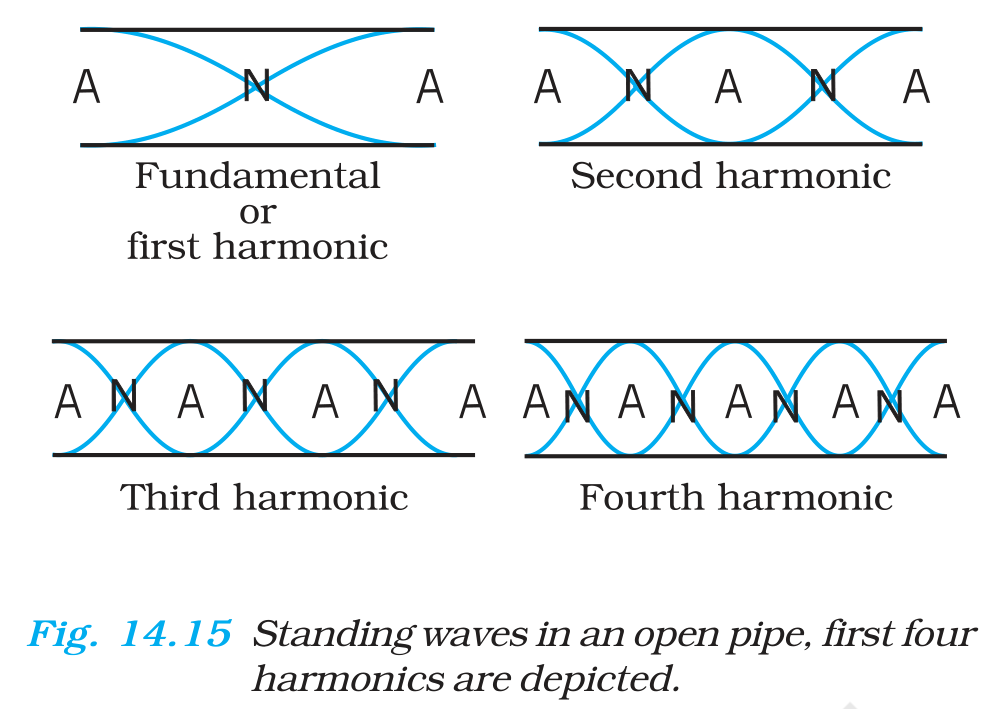
A pipe open at both ends has an antinode at each end. The simplest standing wave has one node between the two antinodes, which is half a wavelength. The next allowed pattern has two nodes, which is one full wavelength, and so on. The allowed wavelengths are therefore two L over n.
An open pipe supports the entire harmonic series. Its fundamental is v over 2L, and the second harmonic and all higher harmonics are present. An open pipe therefore has a bright tone, because the full set of overtones is present.
5.3 Closed pipes
When one end of a pipe is sealed and the other is left open, the sealed end behaves as a displacement node and the open end as a displacement antinode. The simplest standing wave has a quarter wavelength in the pipe. The next allowed pattern has three quarter wavelengths, then five, and so on, because the closed end must always be a node and the open end an antinode.
A closed pipe therefore supports only the odd harmonics. Its fundamental is v over 4L, which is half the fundamental of an open pipe of the same length, so a closed pipe sounds an octave lower. The first overtone is the third harmonic, at three times the fundamental, and the second harmonic and all other even harmonics are missing.
5.4 Resonance and end correction
A pipe responds strongly when it is driven at one of its natural frequencies. This is resonance, and it is the principle of wind instruments and of resonance tubes used to measure the speed of sound. In a resonance tube experiment, a vibrating tuning fork is held over a tube whose length can be changed by moving a water level, and the loudest sound occurs at lengths that satisfy the pipe condition.
The open end of a pipe is not exactly at the physical end of the tube: the air just outside also moves, so the effective length is slightly greater than the measured length. The correction is about 0.6 times the radius of the pipe at each open end. For a closed pipe with one open end, the condition becomes that the effective length equals an odd number of quarter wavelengths.
A practical consequence is that the difference between the first and second resonance lengths of a closed pipe is half a wavelength. Measuring that difference avoids the end correction entirely, which is why the resonance tube method is reliable.
5.5 Comparing pipes and strings
Strings and air columns obey the same logic: the boundaries decide which wavelengths fit, and the wave speed then fixes the frequencies. The difference is the type of boundary. A string fixed at both ends has nodes at both ends, so all harmonics appear. An open pipe has antinodes at both ends, so again all harmonics appear. A closed pipe mixes a node and an antinode, and only odd harmonics survive.
The harmonic content is what gives each instrument its character. A pipe open at both ends carries all the harmonics, so its sound is bright and full. A closed pipe carries only the odd harmonics, so its sound is hollow and its pitch is an octave below that of an open pipe of the same length. Two instruments playing the same fundamental note can still sound different because their overtone patterns differ.
A resonance tube uses a single closed pipe and a tuning fork, and the two resonance positions differ by half a wavelength. That difference is independent of the end correction, so the measured positions give the wavelength directly, and combining the wavelength with the known frequency of the fork gives the speed of sound in the air column. This is one of the standard laboratory experiments of the chapter.
5.6 A worked example
A closed organ pipe is 50 centimetres long and the speed of sound is 340 metres per second. Ignoring the end correction, the fundamental wavelength is four times the length, 2.0 metres, so the fundamental frequency is 340 divided by 2.0, which is 170 hertz. The first overtone is the third harmonic, at 510 hertz, and the second overtone is the fifth harmonic, at 850 hertz. The even harmonics at 340 and 680 hertz do not exist for this pipe.
Exam
Before using a pipe formula, decide which end is closed. A pipe described as closed at one end has odd harmonics only; a pipe open at both ends has all harmonics. Mixing the two formulas gives frequencies off by a factor of two, which is the most common error in this topic.