

Concepts: superposition, interference and standing waves on strings
Waves24 min readLesson 4 of 8
4.1 The principle of superposition
When two or more waves arrive at the same point of a medium, the resultant displacement is the algebraically sum of the displacements of the individual waves. This simple statement is the principle of superposition, and it holds for small disturbances in linear media. It is the reason that the sound of an orchestra can reach the ear as a single vibration containing many frequencies.
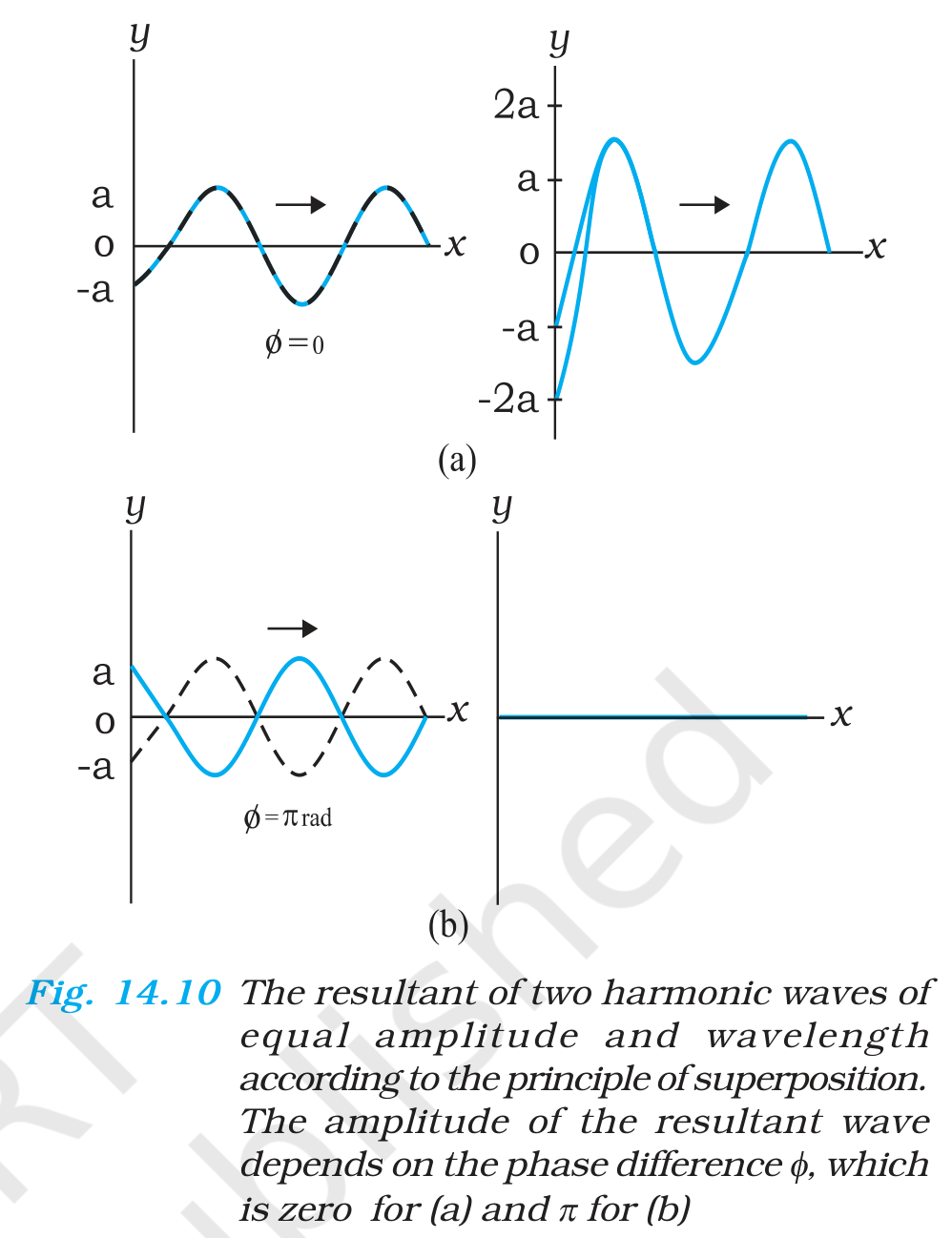
Superposition explains interference. If two waves of the same frequency arrive in phase at a point, their displacements add and the resultant amplitude is large; this is constructive interference. If they arrive in opposite phase, their displacements cancel and the resultant amplitude is small; this is destructive interference. For two waves of equal amplitude, the resultant amplitude ranges from zero to twice the individual amplitude.
A wave meeting a boundary is partly reflected and partly transmitted. A reflection at a rigid end is accompanied by a phase change of pi, which is why a pulse on a string fixed at a wall comes back inverted. A reflection at a free end has no phase change and the pulse returns upright. The phase change matters when reflected waves superpose with incoming waves.
4.2 Standing waves on a string
The most important application of superposition in this chapter is the standing wave. A string fixed at both ends can carry two identical waves travelling in opposite directions, one moving towards each end and the other returning after reflection. Their superposition does not travel: some points, the nodes, remain permanently at rest, while the points halfway between them, the antinodes, oscillate with maximum amplitude.
Writing the two waves as A sin(kx minus omega t) and A sin(kx plus omega t) and adding them gives a product of a space factor and a time factor. The space factor is a sine of kx, which is zero at the nodes, and the time factor oscillates at the same frequency as the original waves. The distance between two adjacent nodes is half a wavelength, and the distance between a node and the nearest antinode is a quarter wavelength.
4.3 Normal modes and harmonics
When a string of length L is clamped at each end, the pattern is allowed only when both ends of the pattern are nodes. This condition forces an integer number of half wavelengths into the string. Each permitted standing wave is a normal mode, and its frequency is an integer multiple of the lowest frequency.
The lowest mode, with one loop between the ends, is the fundamental or first harmonic. The mode with two loops is the second harmonic, with three loops the third harmonic, and so on. A string fixed at both ends therefore supports the whole harmonic series, which is why a plucked string sounds a full tone plus its overtones.
The fundamental frequency rises if the string is shorter, lighter or under greater tension. This is exactly how a musician controls pitch: stopping a string shortens the vibrating length, and tightening it raises the tension.
4.4 Standing waves and travelling waves compared
A travelling wave has a definite speed and carries energy through the medium. A standing wave does not transport energy along the string, because the two travelling waves carry equal energy in opposite directions. In a travelling wave, every point oscillates with the same amplitude and the phase changes continuously with position. In a standing wave, the amplitude varies with position between zero at the nodes and a maximum at the antinodes, while all points between two nodes oscillate in phase.
A third difference is the wavelength relation. In a travelling wave the wavelength is set by the source frequency and the medium. In a standing wave the allowed wavelengths are fixed by the boundaries, and the frequency is then determined by the medium and the geometry.
The standing wave is the key idea behind every musical instrument. A string, a pipe and a drum all select the wavelengths that fit their boundaries, and the sound they produce is a mixture of the selected frequencies. The same superposition argument applies whether the wave is on a string, in an air column, or on the surface of a drum, and only the boundary conditions change.
4.5 A worked example
A string of length 1.5 metres is clamped at both ends. A standing wave on it is described by y = 0.06 sin(2 pi x divided by 3) cos(120 pi t). Comparing with the standard form gives the wavelength from the coefficient of x: 2 pi divided by 3 equals 2 pi divided by lambda, so the wavelength is 3 metres. The frequency is 120 pi divided by 2 pi, which is 60 hertz. The speed of each travelling component is the product of wavelength and frequency, 180 metres per second.
Common mistake
A standing wave is not a third kind of wave. It is the superposition of two identical travelling waves moving in opposite directions. When a question asks for the speed of the wave in a standing-wave pattern, it means the speed of either component, not the speed of the pattern, which does not move at all.