

Concepts: wave motion and the progressive wave
Waves22 min readLesson 2 of 8
2.1 What a wave is
A wave is a disturbance that travels through a medium, carrying energy and momentum from one place to another without transporting the medium itself. A ripple on water, a pulse on a rope and a sound signal in air are all waves. The particles of the medium oscillate about their mean positions, and the disturbance moves forward because each particle passes its motion on to the next.
Waves are classified by the direction of the particle motion relative to the direction in which the wave travels. In a transverse wave the particles oscillate perpendicular to the direction of propagation. A wave on a stretched string is the standard example. In a longitudinal wave the particles oscillate parallel to the direction of propagation, and a sound wave in air, where the air is alternately compressed and rarefied, is the standard example.
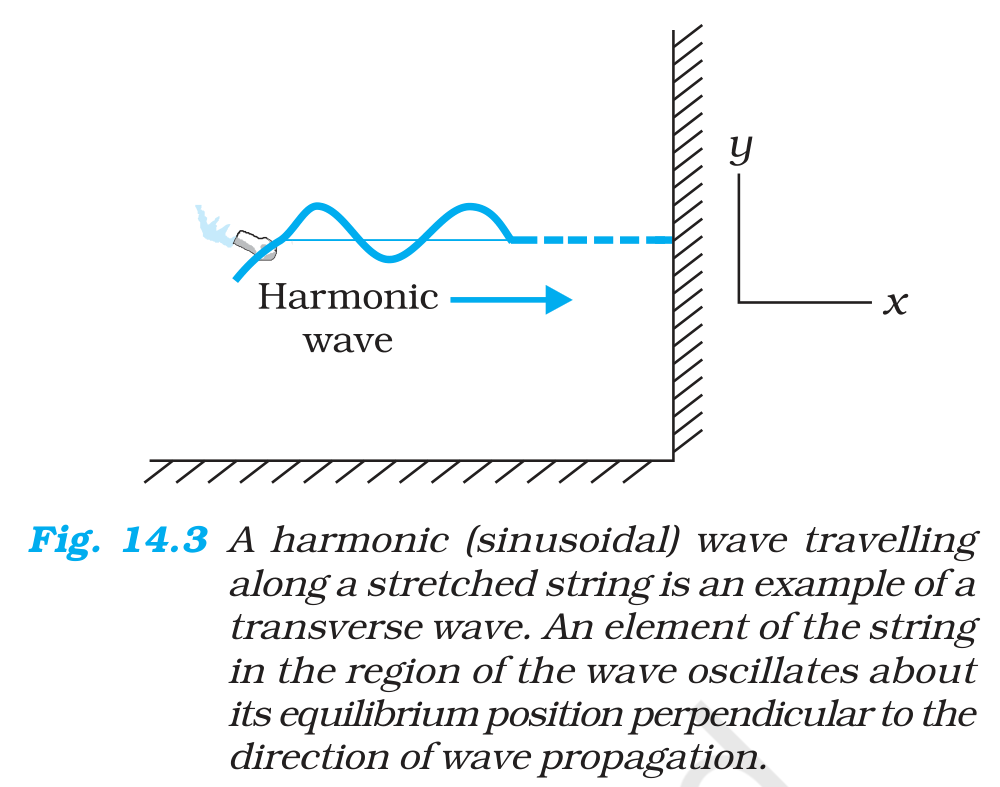
Sound needs a material medium, while light does not, which is why sound cannot travel through vacuum but light can. Mechanical waves such as sound and water waves require a medium; electromagnetic waves do not.
Slideshow, slide 1 of 3. Use the left and right arrow keys to change slides and the space bar to play or pause.
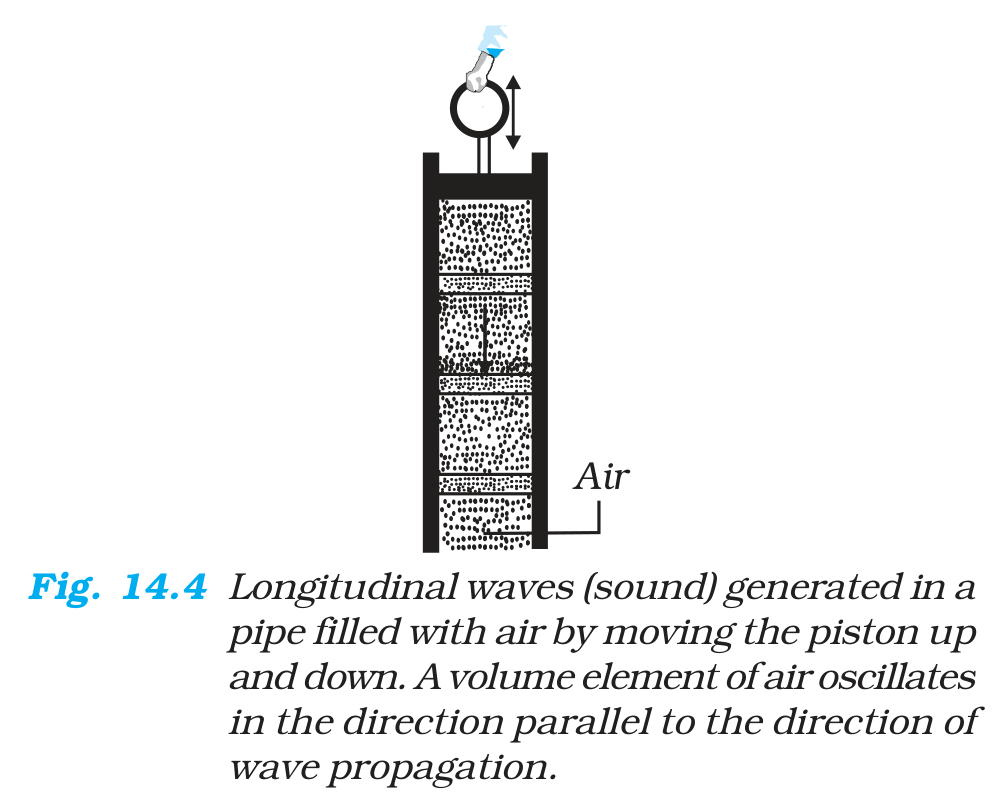
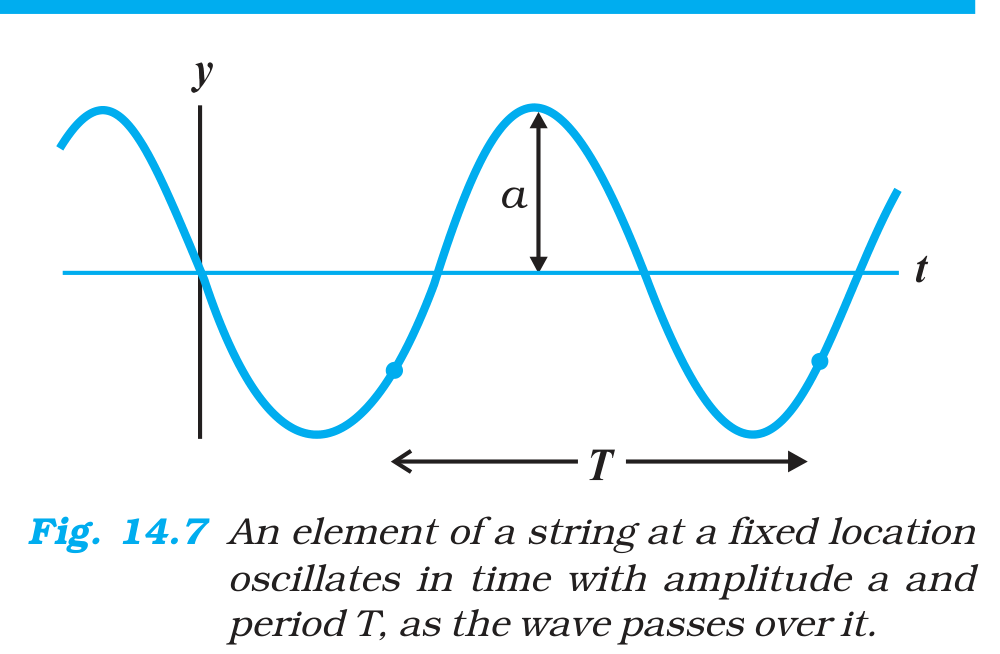
Longitudinal sound waves generated in a pipe filled with air by a vibrating piston, with a volume element oscillating parallel to the direction of propagation.
2.2 Describing a wave
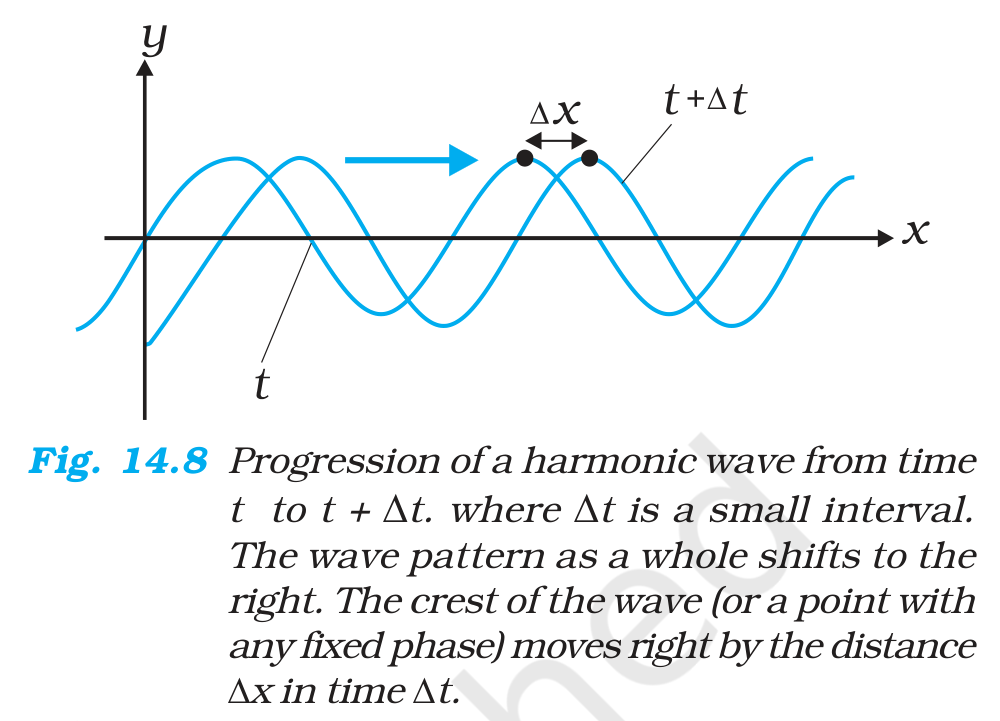
A sinusoidal wave is described by its amplitude, wavelength, period and frequency. The amplitude A is the maximum displacement of a particle from its mean position. The wavelength lambda is the distance between two successive crests, or between any two nearest points with the same phase. The period T is the time for one complete oscillation of a particle, and the frequency f is the number of oscillations per second, so f is the reciprocal of T.
The wave travels one wavelength in one period, which gives the basic relation of wave motion: the speed equals the wavelength divided by the period, and therefore equals the wavelength times the frequency. This relation holds for every kind of progressive wave, whatever the medium.
Two more quantities are useful. The angular frequency omega is 2 pi times the frequency, measured in radians per second. The wave number k is 2 pi divided by the wavelength, measured in radians per metre. With these, the wave equation takes its compact form.
2.3 The progressive wave equation
Consider a wave travelling in the positive x direction. A particle at position x receives the disturbance at a time x/v later than a particle at the origin, so its displacement copies what the origin did at the earlier time t minus x/v. Writing the oscillation at the origin as A sin(omega t) gives the displacement of the whole wave.
The two forms differ only in the sign of the phase constant, because changing the order of terms in the argument adds or subtracts pi. The form most often used in examinations is y = A sin(kx minus omega t plus phi), where a positive coefficient of x with a negative coefficient of t means travel along the positive x direction. If the signs are reversed, with kx plus omega t, the wave travels along the negative x direction.
At a fixed time the equation is a sine curve in space, with successive crests separated by the wavelength. At a fixed position it is a sine curve in time, with successive maxima separated by the period. A particle at any position executes the same amplitude and frequency, and only the phase changes with position.
The phase difference between two points separated by a distance delta x is 2 pi delta x divided by the wavelength. Two points separated by one wavelength are in phase; points separated by half a wavelength are in opposite phase. Points within one wavelength differ only in phase, not in amplitude or frequency.
A wave can also be described without any reference to the medium particles, as a pattern that moves. This is the view used in the equation: at a fixed time the equation gives the shape of the pattern, and at a fixed position it gives the history of one particle. Both views describe the same disturbance, and a question may ask for either the snapshot or the history.
2.4 A worked example
Suppose a wave on a string obeys the relation y = 3 sin(36t plus 0.018x plus 1.2), taking x and y in centimetres and t in seconds. Comparing with the standard form gives the angular frequency 36 rad per second and the wave number 0.018 rad per centimetre.
The frequency is 36 divided by 2 pi, which is about 5.7 hertz, and the period is about 0.17 second. The wavelength is 2 pi divided by 0.018, which is about 349 centimetres, so the least distance between successive crests is 349 centimetres. The speed is omega divided by k, which is 2000 centimetres per second, or 20 metres per second. The coefficient of x in the argument is positive, so this wave travels along the positive x direction.
Common mistake
Do not assume that a wave equation with a plus sign in the argument describes a wave in the negative x direction. The direction follows from the signs of the two terms, not from the phase constant. Write the argument as kx minus omega t or kx plus omega t first, then read the direction.