Concepts: Cloning vectors and competent hosts
Biotechnology: Principles and Processes19 min readLesson 3 of 6
3.1 What a vector does
A vector carries a foreign DNA into a host and multiplies with it. Plasmids and bacteriophages suit this job because both copy themselves inside bacterial cells without waiting on the bacterial chromosome. Copy number matters: some plasmids keep only one or two copies per cell, others keep 15 to 100, and bacteriophages, which are numerous in an infected cell, hold many genome copies. Joining an alien DNA to such a molecule lets the alien piece multiply to the same copy number. Modern vectors are engineered for two practical ends, easy linking of foreign DNA and easy picking of recombinants from non-recombinants.
3.2 The three features of a cloning vector
The origin of replication, or ori, is the sequence where copying begins. Any DNA joined to an ori can replicate in the host, and the ori also sets the copy number. A vector with a high copy number ori is the right choice when many copies of the target DNA are wanted.
The selectable marker lets a worker identify and remove cells that failed to take up the vector, and grow only the cells that did. Transformation is the procedure of putting a DNA piece into a host bacterium. Resistance genes for drugs such as ampicillin, chloramphenicol, tetracycline or kanamycin are handy markers in E. coli, since ordinary cells of this bacterium are sensitive to all of them.
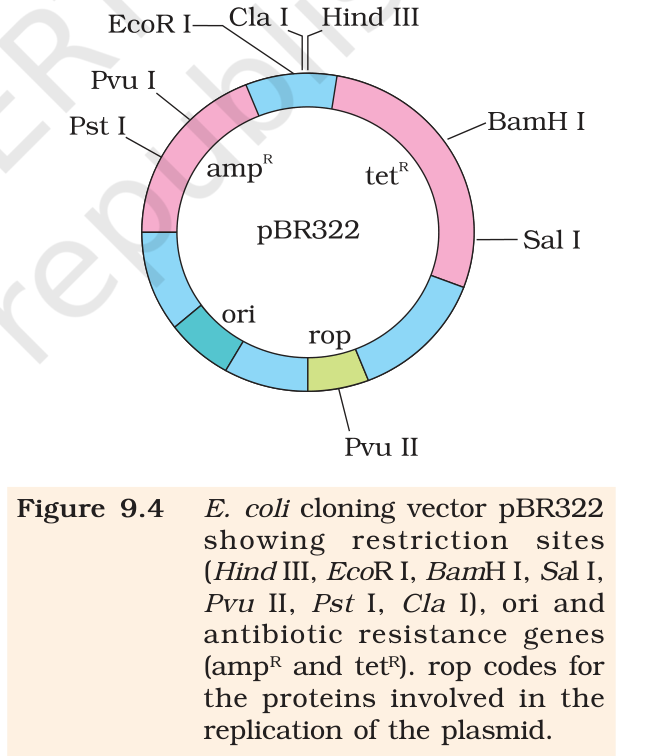
Cloning sites are the places where foreign DNA is inserted. A good vector has very few recognition sites, ideally one for each commonly used restriction enzyme. Extra sites would cut the vector into several fragments and make gene cloning messy. The insertion is usually placed inside one of two antibiotic resistance genes.
3.3 Selection with pBR322
In pBR322, foreign DNA can be ligated at the BamH I site inside the tetracycline resistance gene. Insertion there destroys that gene's function, so recombinant plasmids no longer give tetracycline resistance. They still give ampicillin resistance, so the first selection plate contains ampicillin and only transformants grow on it. Those transformants are then copied onto a plate containing tetracycline. Recombinants grow on ampicillin but fail on tetracycline, while non-recombinants grow on both. One resistance gene selects the transformants and the other, inactivated by the insert, identifies the recombinants.
3.4 Colour helps when two plates are too much work
Selecting recombinants through antibiotic inactivation is slow because it needs plating on two media with different antibiotics. Alternative markers use a chromogenic substrate. The insert is placed inside the coding sequence of the enzyme beta-galactosidase, which inactivates the enzyme. If a bacterium carries a plasmid with no insert, the enzyme works on the substrate and the colony turns blue. If an insert is present, the enzyme is inactivated, no colour appears, and the colony is identified as recombinant. This is insertional inactivation read through colour.
3.5 Vectors for plants and animals
The trick of gene delivery was learnt from bacteria and viruses. Agrobacterium tumefaciens, a pathogen of several dicot plants, delivers a piece of DNA called T-DNA into plant cells, turns them into tumour cells and makes them produce chemicals the pathogen needs. Retroviruses in animals can turn normal cells into cancerous ones. Studying these delivery systems turned them into vectors. The tumour inducing Ti plasmid of Agrobacterium has been modified into a cloning vector that no longer harms plants but still delivers genes into many plant species. Retroviruses have been disarmed and now carry desirable genes into animal cells.
3.6 Making a host competent
DNA is hydrophilic and cannot cross a cell membrane on its own. A bacterial cell must first be made competent, able to take DNA from its surroundings. A measured dose of a divalent cation such as calcium improves the odds that DNA will pass through pores in the cell wall. The cells are then kept with the recombinant DNA on ice, given a brief heat shock at 42 degrees Celsius, and returned to ice, which lets them take up the DNA.
Other routes exist. In microinjection the recombinant DNA is injected straight into the nucleus of an animal cell. For plants, tiny gold or tungsten particles coated with DNA are fired at cells at high speed, a method called biolistics or the gene gun. A third route uses disarmed pathogen vectors, which infect a cell and deliver the recombinant DNA with the infection. Without a marker, a worker would have to test every colony separately, which is impossible at the scale of a transformation experiment.