

Concepts: Tools of recombinant DNA technology
Biotechnology: Principles and Processes19 min readLesson 2 of 6
2.1 The discovery of the molecular scissors
Recombinant DNA work needs tools. The first of them are restriction enzymes, DNA polymerases, ligases, vectors and a host organism. Work in 1963 turned up two enzymes that held back bacteriophage growth in E. coli. One attached methyl groups to DNA; the other broke DNA, and this second enzyme was called a restriction endonuclease.
Hind II came five years later as the first restriction endonuclease to be described. It read a six base pair sequence and cut at one fixed point; that six base pair sequence is the enzyme's recognition sequence. Today more than 900 restriction enzymes are known, isolated from over 230 bacterial strains, and each has its own recognition sequence. That variety is what makes a cut predictable: choose an enzyme whose site is known, and the cut lands at every copy of that site in the DNA.
2.2 How restriction enzymes are named
The name packs information into a few letters. Start with the initial of the genus, add two letters from the species of the prokaryote that supplied the enzyme, and add a fourth letter for the strain when there is one. EcoRI, for example, comes from Escherichia coli strain RY 13, and the R in the name marks the strain. Roman numerals after the name show the order in which enzymes from that strain were isolated. A student can therefore read a name backwards to recover genus, species, strain and order, which is exactly what a one-mark question asks for.
2.3 Nucleases cut in two different ways
Restriction enzymes belong to a larger class called nucleases. Exonucleases nibble nucleotides away from the ends of a DNA molecule. Endonucleases make their cuts at particular places inside the molecule. A restriction endonuclease reads along the DNA until it meets its recognition sequence, binds there, and breaks the sugar-phosphate backbone of both strands. The break is clean and repeatable, so the same digest performed twice on the same DNA gives the same set of fragments.
The recognition sequence is palindromic. A word palindrome reads the same in both directions, as MALAYALAM does. A DNA palindrome is a pair of strands that read the same when the direction of reading is kept constant. The EcoRI site is written as 5' GAATTC 3' on one strand and 3' CTTAAG 5' on the other.
2.4 Sticky ends make joining possible
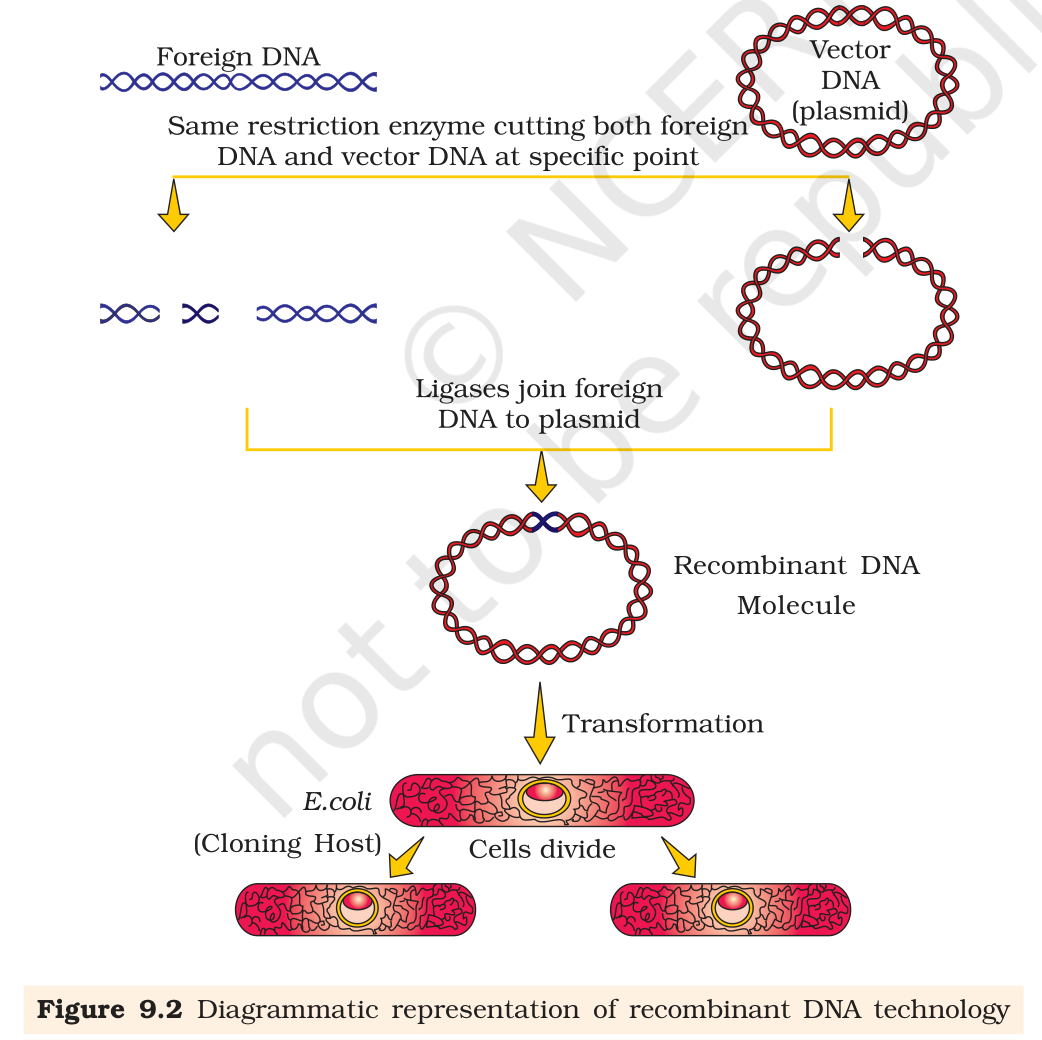
The enzyme cuts slightly off the centre of the palindrome, at the same pair of bases on both strands. Short single stranded stretches then stick out at the ends; these are the sticky ends, and they can form hydrogen bonds with a matching cut end. The stickiness is what allows DNA ligase to seal the two pieces into one molecule. Fragments cut by the same enzyme carry matching sticky ends, so they can be joined end to end. This is also why the vector and the source DNA must be cut with the same restriction enzyme: without matching ends the recombinant vector cannot be built.
2.5 Checking the cut on a gel
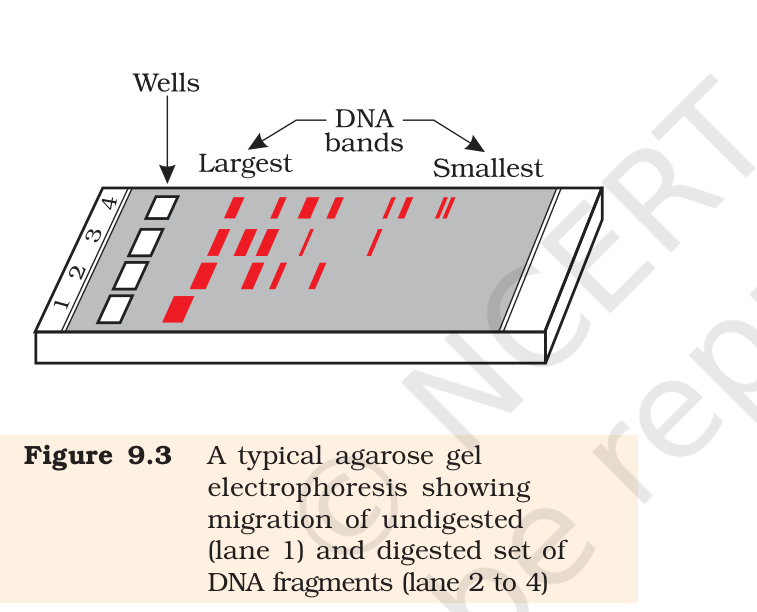
After digestion the mixture contains DNA fragments of different sizes, and agarose gel electrophoresis separates them. DNA is negatively charged, so an electric field pushes it towards the anode through the gel. Agarose is a natural polymer from seaweeds, and its mesh sieves the fragments: the smaller a fragment, the farther it travels. Pure DNA cannot be seen in ordinary light, so the gel is stained with ethidium bromide and viewed under ultraviolet light, where the DNA shows as bright orange bands. A chosen band is cut out of the gel and its DNA extracted, a step called elution. The purified fragments are then ready for joining to a vector.
The slideshow below puts three of these pictures in order: how EcoRI cuts and leaves sticky ends, how the cut pieces are joined into a recombinant molecule, and how the resulting fragments are read on a gel.
Two habits protect marks here. The first is to name the enzyme and the site together, because a bare name rarely earns the mark. The second is to describe the cut as staggered rather than straight, since the staggered cut is exactly what creates the overhangs. A straight cut across both strands at one point would give blunt ends, which ligate far less easily.
Slideshow, slide 1 of 3. Use the left and right arrow keys to change slides and the space bar to play or pause.
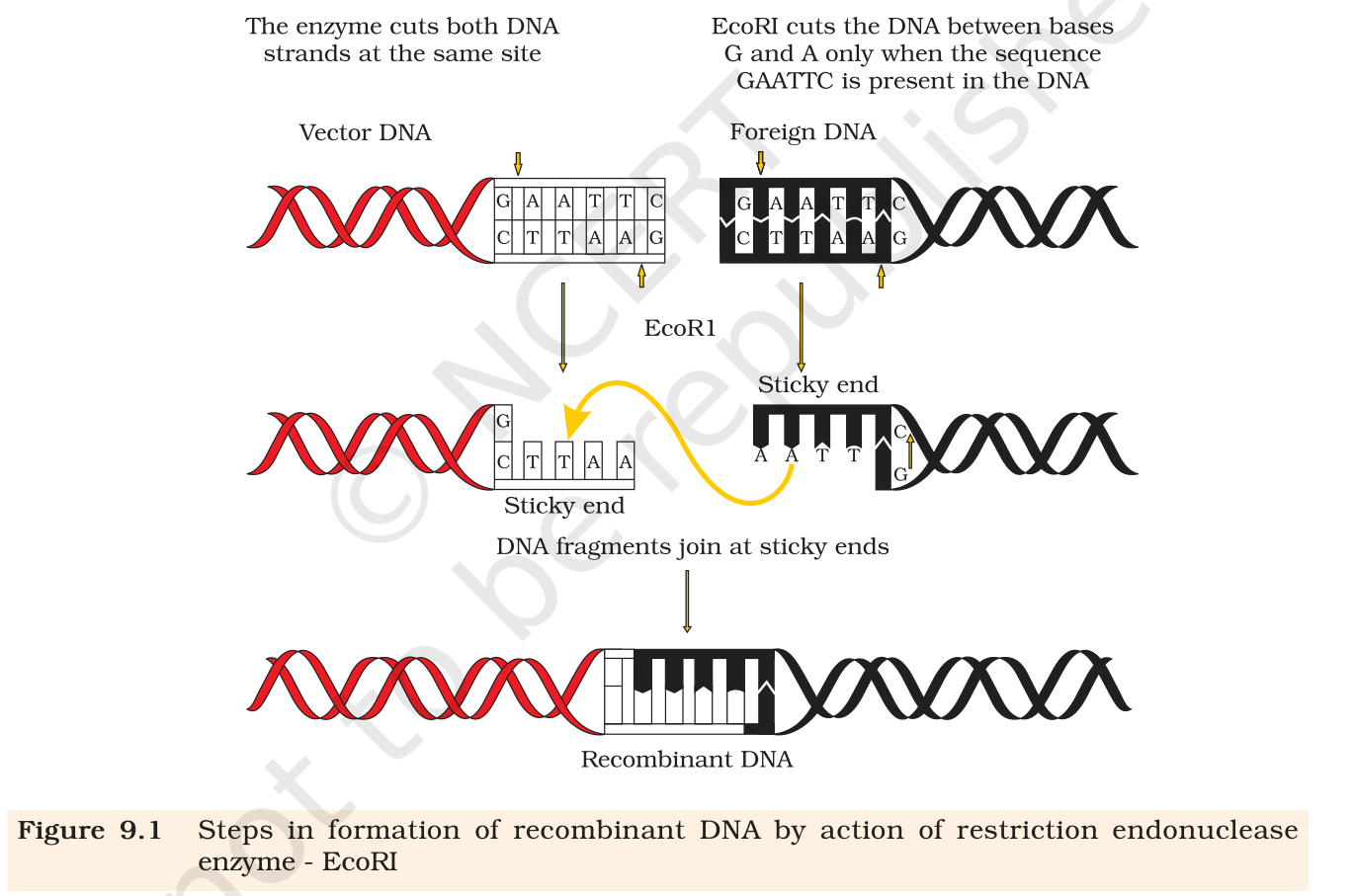
A labelled diagram of EcoRI cutting a DNA molecule and leaving sticky ends on the two fragments.
- Explain why the same restriction enzyme must cut the vector and the source DNA
- Decode the name EcoRI and explain the Roman numeral
- Describe how agarose gel electrophoresis separates DNA by size
- State the roles of restriction endonuclease and DNA ligase in making recombinant DNA