Concepts: Processes of recombinant DNA technology
Biotechnology: Principles and Processes20 min readLesson 4 of 6
4.1 The order of steps
Recombinant DNA technology runs through a fixed sequence. The DNA is isolated, cut into fragments by restriction endonucleases, the wanted fragment is picked out, the fragment is ligated into a vector, the recombinant DNA is transferred to a host, the host is cultured on a large scale, and the desired product is extracted.
4.2 Step one: isolating DNA in pure form
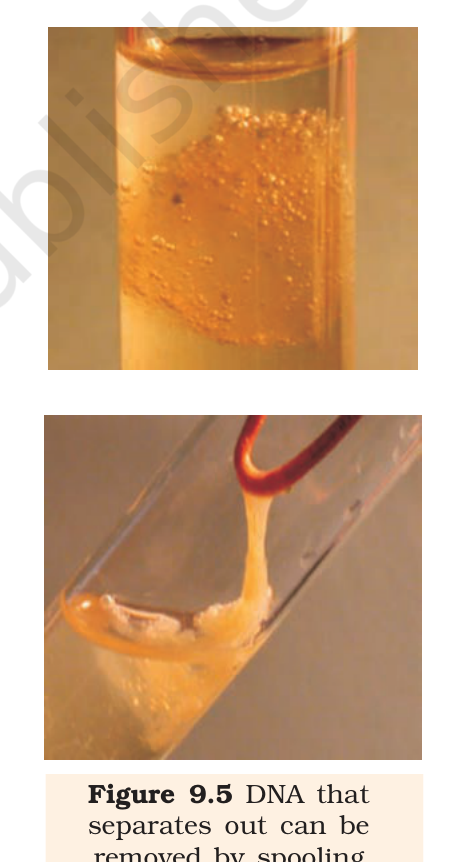
DNA has to be free of other macromolecules before restriction enzymes can act on it. The cell is broken open, which releases DNA along with RNA, proteins, polysaccharides and lipids. The enzymes chosen depend on the cell: lysozyme for bacteria, cellulase for plant cells and chitinase for fungi. Genes lie on long DNA molecules wound around proteins such as histones, so the RNA is removed with ribonuclease and the proteins with protease. Other molecules are removed by suitable treatments, and the purified DNA finally comes out of solution as fine threads when chilled ethanol is added. The threads can be lifted out by spooling (Figure 9.5).
4.3 Step two: cutting and checking
Restriction digestion is done by incubating purified DNA with the chosen enzyme under optimal conditions for that enzyme. Agarose gel electrophoresis checks how far the digestion has gone, since the negatively charged DNA moves towards the positive electrode. The vector DNA is cut in the same way.
4.4 Step three: amplification by PCR
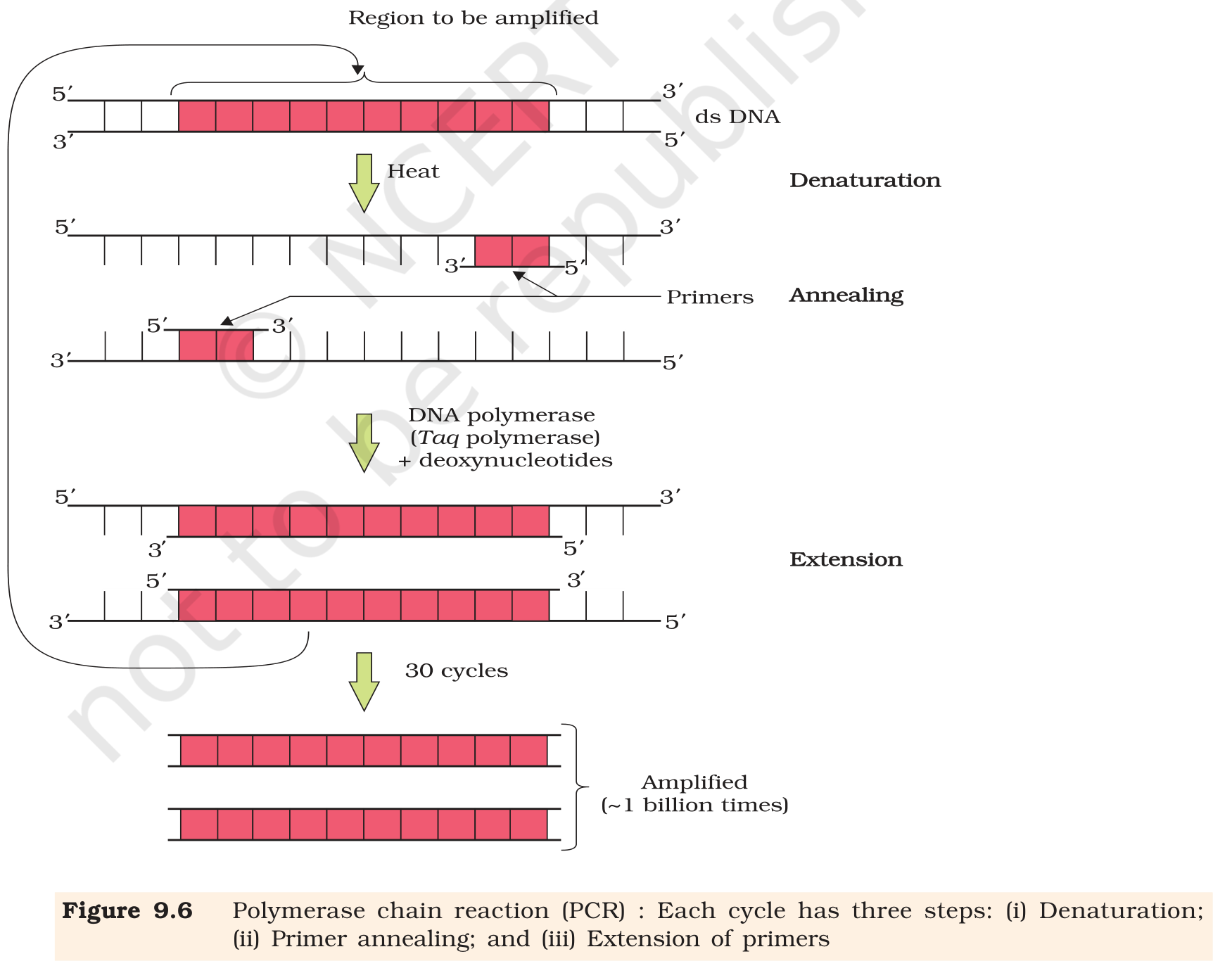
PCR, the polymerase chain reaction, makes many copies of a gene outside a living cell. Two sets of primers, short chemically synthesised oligonucleotides complementary to regions of the DNA, flank the target. The polymerase adds nucleotides to each primer, reading the genomic DNA as its template. Many repeats of the cycle can take the segment to about a billion copies. The enzyme that makes this possible is a thermostable DNA polymerase taken from the bacterium Thermus aquaticus, because it survives the high temperature used to separate the two strands. Each cycle has three steps: denaturation, primer annealing and extension of the primers (Figure 9.6). The amplified fragment can then be ligated to a vector.
4.5 Step four: getting the DNA into the host
Recipient cells, once made competent, take up DNA from the surrounding medium. If the recombinant DNA carries an ampicillin resistance gene and is put into E. coli, the host cells become ampicillin resistant. Spread on agar with ampicillin, only the transformed cells grow and the untransformed ones die. The resistance gene in this case is the selectable marker.
4.6 Step five: expressing the gene and scaling up
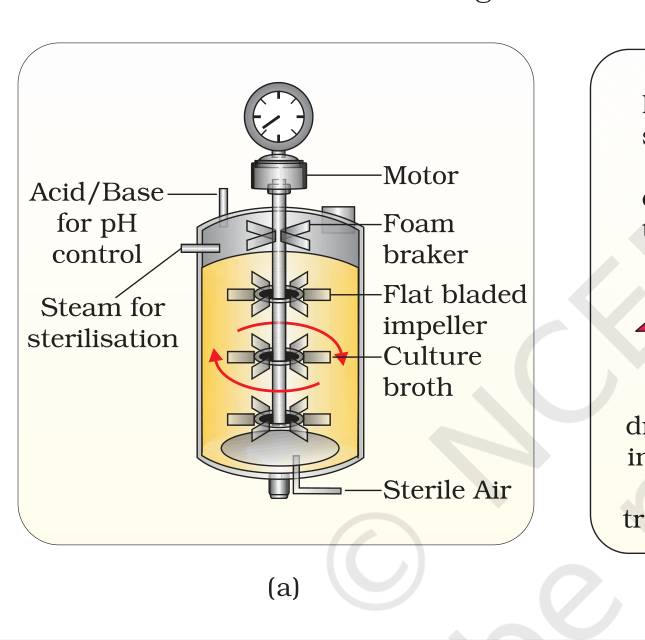
Inserting alien DNA into a bacterial, plant or animal cell multiplies it, but the usual aim is the protein it codes for, so the recombinant DNA must be expressed under conditions that suit the host. A protein made from a gene expressed in a heterologous host is a recombinant protein. Cells carrying cloned genes can be grown in small laboratory cultures, and the protein extracted and purified from them. For larger amounts, a continuous culture system keeps the cells in the log or exponential phase by draining used medium on one side and adding fresh medium on the other, which gives more biomass and a higher yield. Small volumes cannot yield appreciable product, so bioreactors were developed to handle 100 to 1000 litres of culture. A bioreactor is a vessel in which raw materials are converted biologically into specific products, individual enzymes and so on, using microbial, plant, animal or human cells, and it supplies optimum growth conditions such as temperature, pH, substrate, salts, vitamins and oxygen.
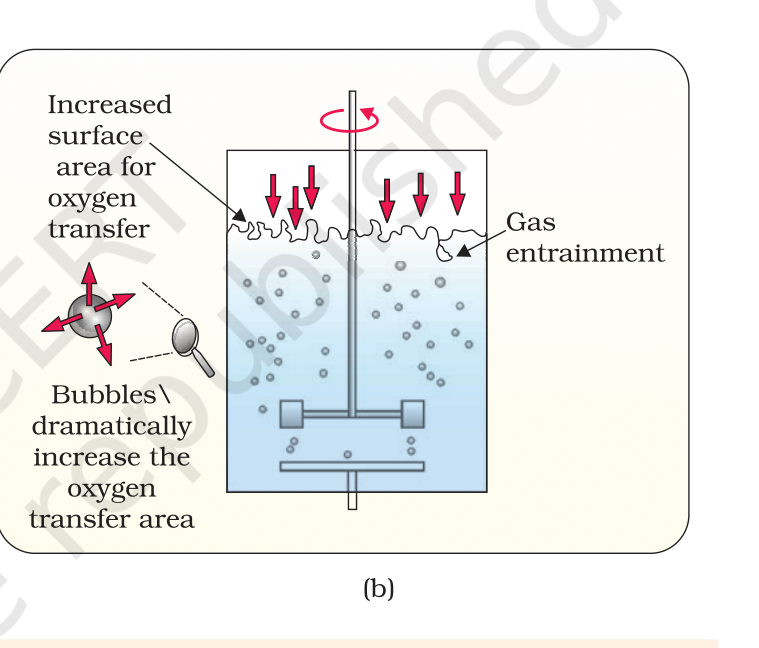
The stirring design is the one used most often (Figure 9.7). Such a reactor is cylindrical, or has a curved base, to help the contents mix. The stirrer keeps the broth even and helps oxygen reach all of it; air may instead be bubbled through the vessel. It also has systems for agitation, oxygen supply, foam control, temperature and pH, plus sampling ports for taking out small volumes of culture at intervals.
4.7 Step six: downstream processing
After the biosynthetic stage, the product goes through separation and purification, together called downstream processing. It is then formulated with suitable preservatives and, for a drug, must clear clinical trials. Every product goes through strict quality control testing, and both the downstream steps and the testing vary from product to product. The continuous system is preferred for products that the cells secrete, because the product can be collected from the drained medium while the culture keeps growing.