

Concepts: Mendel and the inheritance of one gene
Principles of Inheritance and Variation18 min readLesson 1 of 6
1.1 Why pea plants
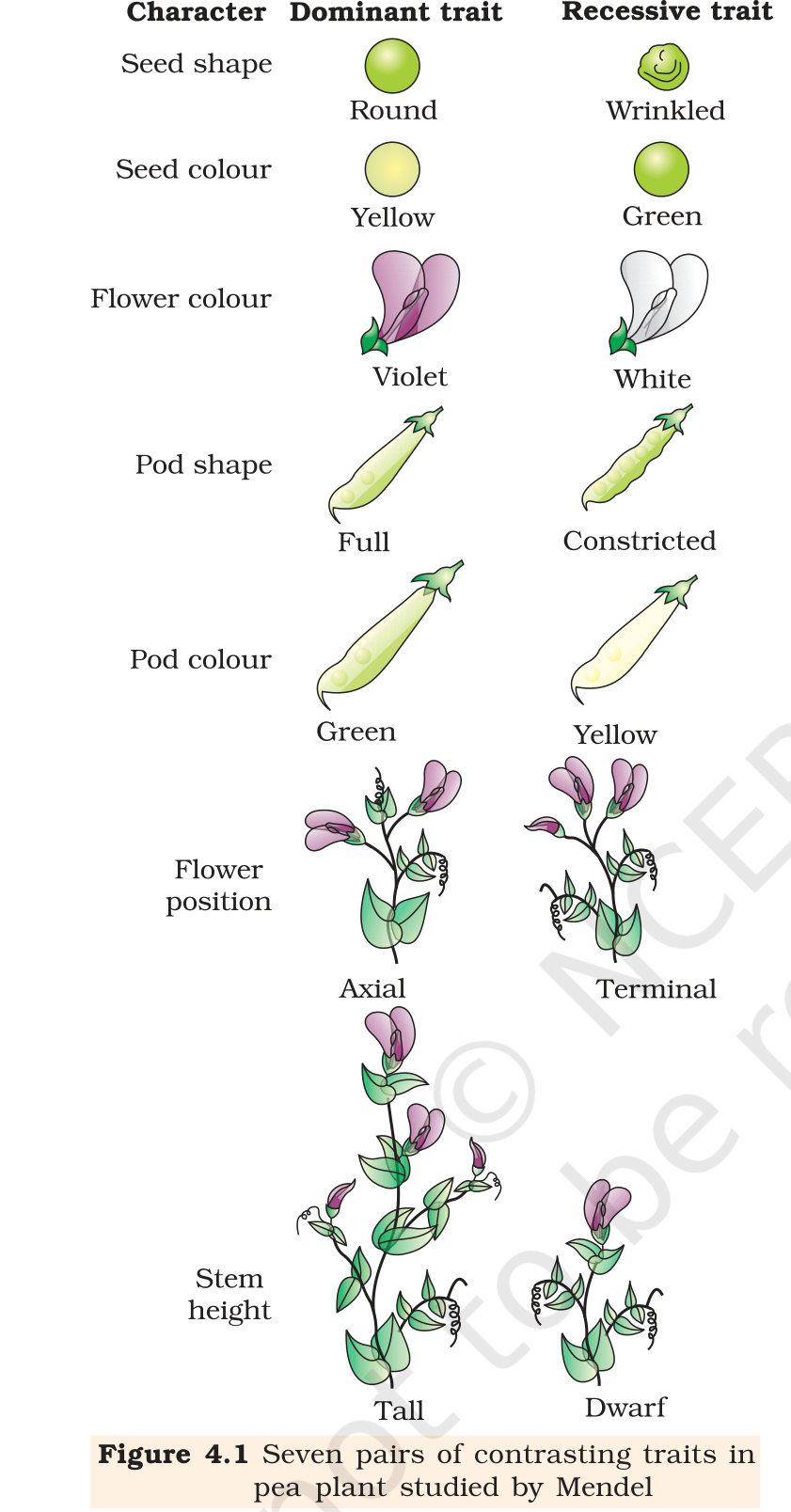
Gregor Mendel worked with the garden pea, Pisum sativum, because the plant was easy to grow and had clear pairs of contrasting traits. He chose seven such pairs: flower colour, flower position, seed colour, seed shape, pod colour, pod shape and stem height. The plants could be self pollinated, so he could keep a line pure for a trait, and he could also cross two plants by hand. He studied one trait at a time and counted the offspring of each cross, which is why his results worked when earlier breeders had failed.
A plant that breeds true for a trait produces only that form of the trait when self pollinated. Mendel crossed such true breeding pairs, for example tall with dwarf, and called the offspring the first filial or F1 generation. The F1 plants were then self pollinated to give the F2 generation. The same design is used in every breeding experiment today.
1.2 The monohybrid cross
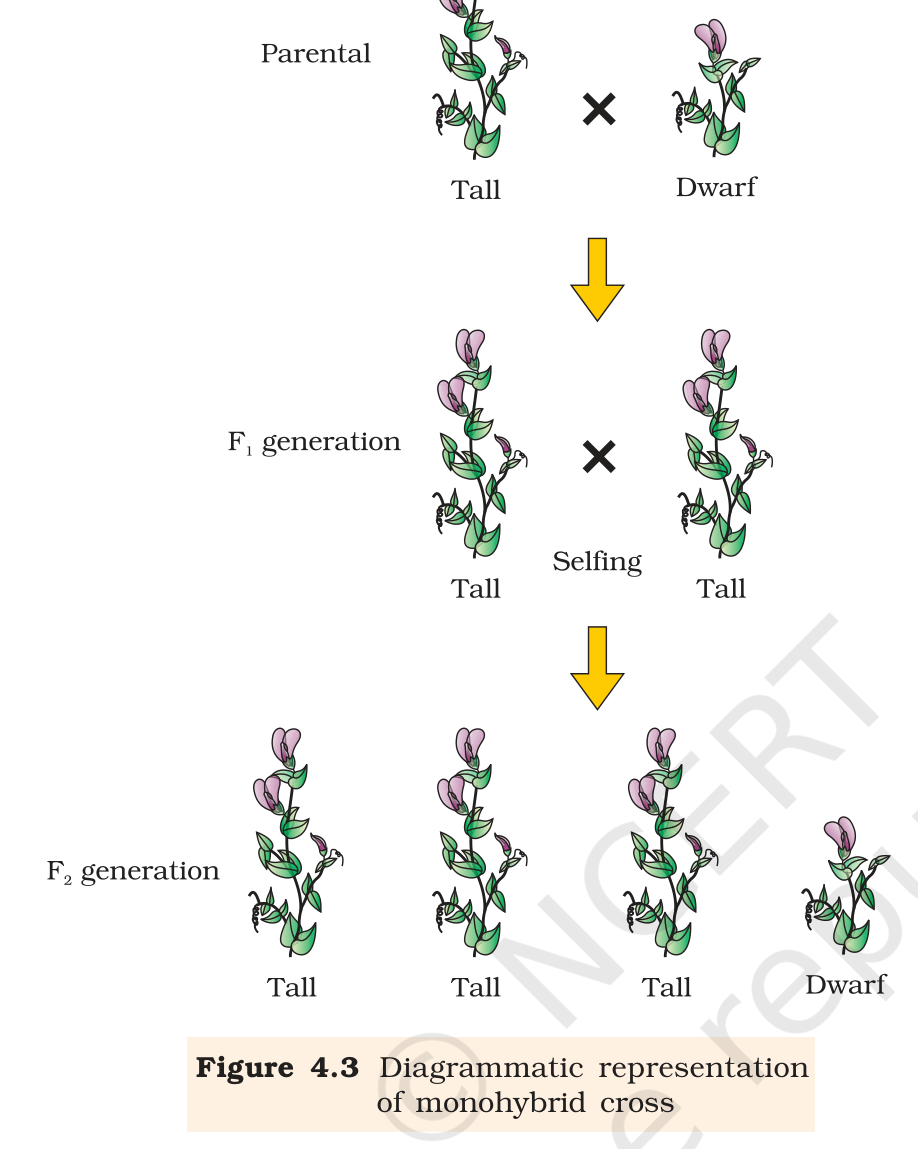
In a monohybrid cross only one pair of contrasting traits is followed. Mendel crossed a true breeding tall plant with a true breeding dwarf plant. All the F1 plants were tall, so the tall form was called dominant and the dwarf form recessive. When the F1 plants were self pollinated, the F2 generation contained both tall and dwarf plants in the ratio 3 : 1. The recessive trait had not disappeared in F1; it reappeared in F2.
Two conclusions follow. First, each plant carries two factors for a trait, one from each parent. Second, the two factors separate during gamete formation, so a gamete carries only one factor. The monohybrid cross therefore shows segregation, and it explains why the 3 : 1 ratio appears.
A test cross confirms the genotype of a tall plant whose two factors may be different. Cross the plant with a dwarf plant. If the tall plant is homozygous, all offspring are tall; if it is heterozygous, half the offspring are dwarf.
1.3 The Punnett square
A Punnett square lists the gametes of each parent along the two sides and fills the boxes with the combinations that can form. For a cross between two heterozygotes Tt, the gametes are T and t on both sides, so the boxes are TT, Tt, Tt and tt. The genotypic ratio is 1 : 2 : 1 and the phenotypic ratio is 3 : 1 because Tt looks like TT.
Mendel's laws are two statements about this cross. The law of dominance says that in a pair of contrasting factors, the one that expresses itself in the heterozygote is dominant and the other is recessive. The law of segregation says that the two factors of a pair separate during gamete formation and each gamete receives one of them. The law of segregation is universal; the law of dominance is not, because several traits show a mixed or joint phenotype.
1.4 Deviations from complete dominance
Incomplete dominance appears in snapdragon. A cross between red and white flowered plants gives pink F1 plants, and selfing the F1 gives red, pink and white in the ratio 1 : 2 : 1. The heterozygote has an intermediate phenotype, so the genotypic and phenotypic ratios are the same. The same pattern is seen in the four o'clock plant.
Co-dominance appears in the human ABO blood group, where both A and B alleles express themselves fully in the AB person. Multiple alleles means that a gene has more than two alternative forms in a population; the ABO gene has three, A, B and O. A person still carries only two of them. The ABO group is therefore an example of multiple alleles, co-dominance and different dominance relations at once, and it is a favourite question.
Exam
In a cross answer, write the parental genotypes, then the gametes, then the Punnett square, then the ratio. The examiner gives marks for the working, so do not jump straight to 3 : 1 or 9 : 3 : 3 : 1.
1.5 Genotype, phenotype and the symbols
A genotype is the pair of factors an organism carries for a trait, written as two letters such as TT, Tt or tt. A phenotype is the form of the trait that can be seen, tall or dwarf. A homozygous organism carries two identical factors, and a heterozygous organism carries two different ones. The dominant allele is written in capital letters and the recessive in small letters. This notation is not decoration: the examiner reads your genotype from the letters, so keep the same letter for the same gene and never mix symbols between crosses. A plant can look tall with two different genotypes, TT or Tt, and the test cross exists only because the phenotype cannot show which one is present.
The ratio is a prediction, not a guarantee: it appears when the number of offspring is large. With only four offspring, chance can easily produce a different split, which is why Mendel counted thousands of seeds.