

Concepts: two genes, independent assortment and linkage
Principles of Inheritance and Variation18 min readLesson 2 of 6
2.1 The dihybrid cross
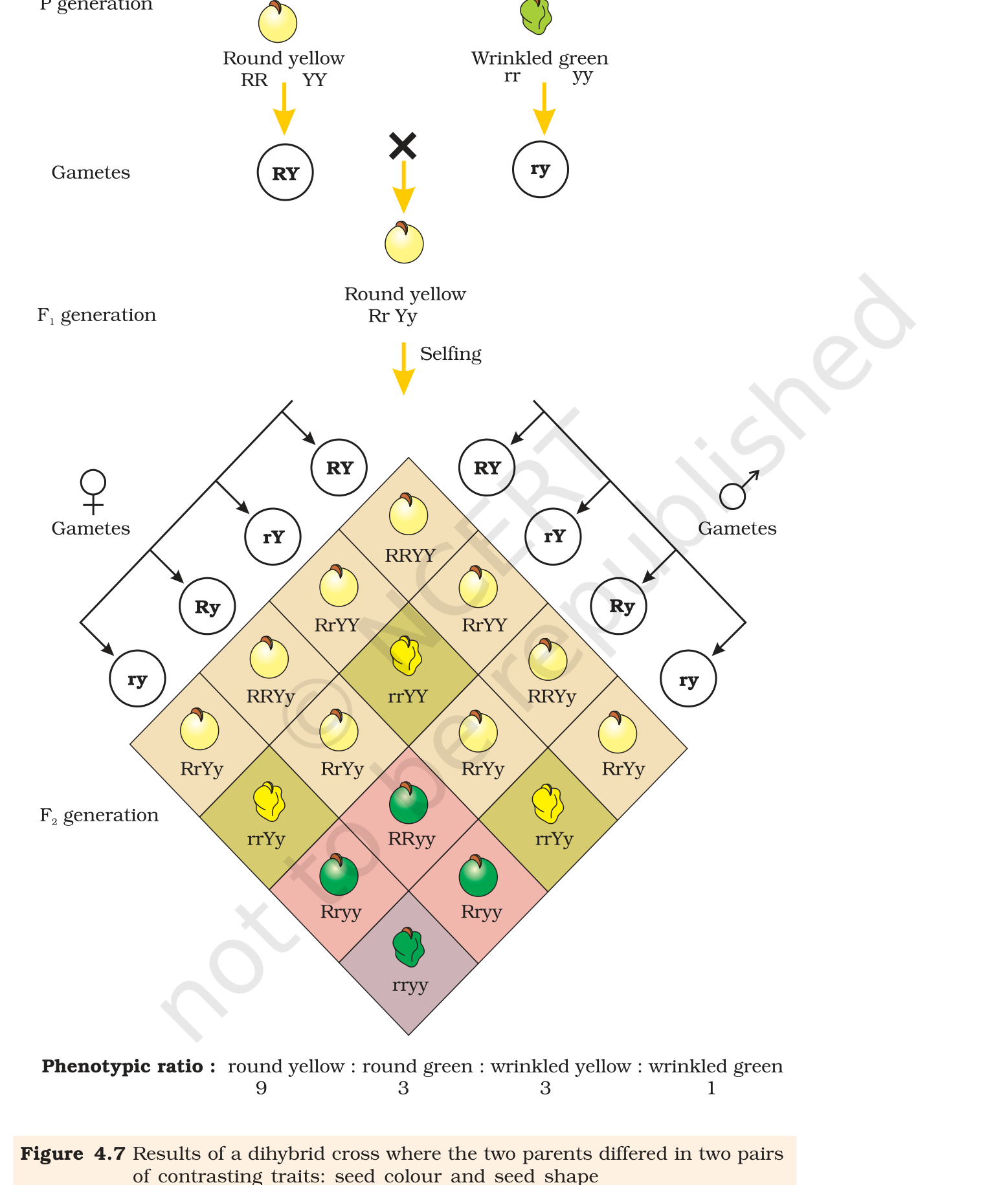
A dihybrid cross follows two pairs of traits at the same time. Mendel crossed a plant with round yellow seeds with a plant with wrinkled green seeds. The F1 seeds were all round and yellow, so round was dominant over wrinkled and yellow over green. Selfing the F1 gave four kinds of seeds in the F2 generation in the ratio 9 : 3 : 3 : 1: round yellow, round green, wrinkled yellow and wrinkled green.
That ratio needs explanation. If each pair separated independently, the round or wrinkled form has no influence on yellow or green. The F2 ratio is built from two separate 3 : 1 ratios multiplied together, which gives 9 : 3 : 3 : 1. The new combinations, round green and wrinkled yellow, appear because the two pairs assort independently of each other.
2.2 The law of independent assortment
The law of independent assortment says that when two pairs of traits are followed together, the segregation of one pair is independent of the segregation of the other. This law only holds when the two genes lie on different chromosomes, or far apart on the same chromosome. When two genes sit close together on the same chromosome, they tend to travel together into the gamete, and the law fails.
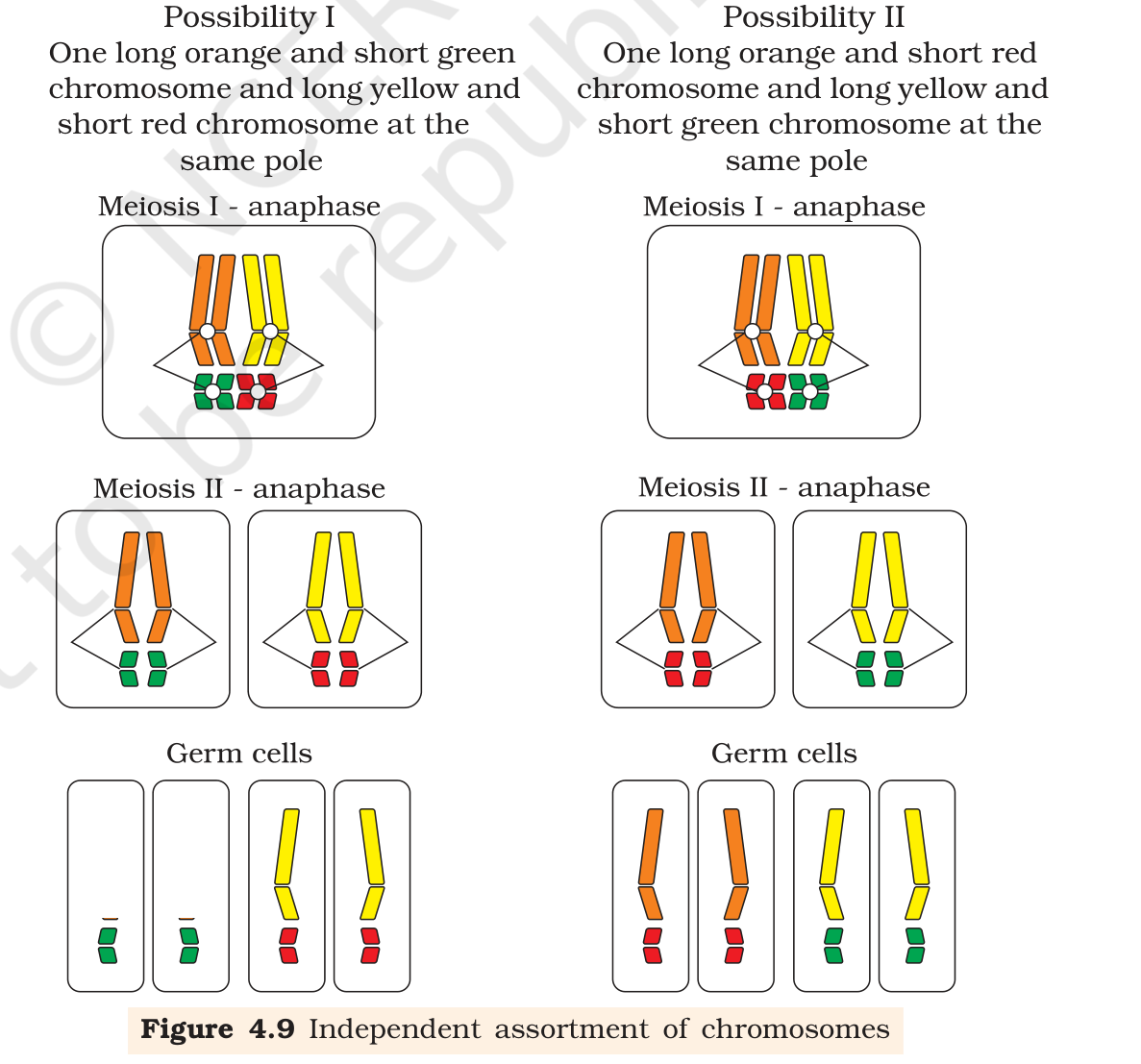
The behaviour of chromosomes at meiosis supplies the physical explanation for both laws. Sutton and Boveri pointed out that the way homologous chromosomes pair and then separate during meiosis is exactly what factor segregation requires. When the two chromosomes of a pair move apart in meiosis I, the two members of a gene pair go to different gametes. The independent orientation of different chromosome pairs at metaphase I gives independent assortment.
2.3 Linkage and recombination
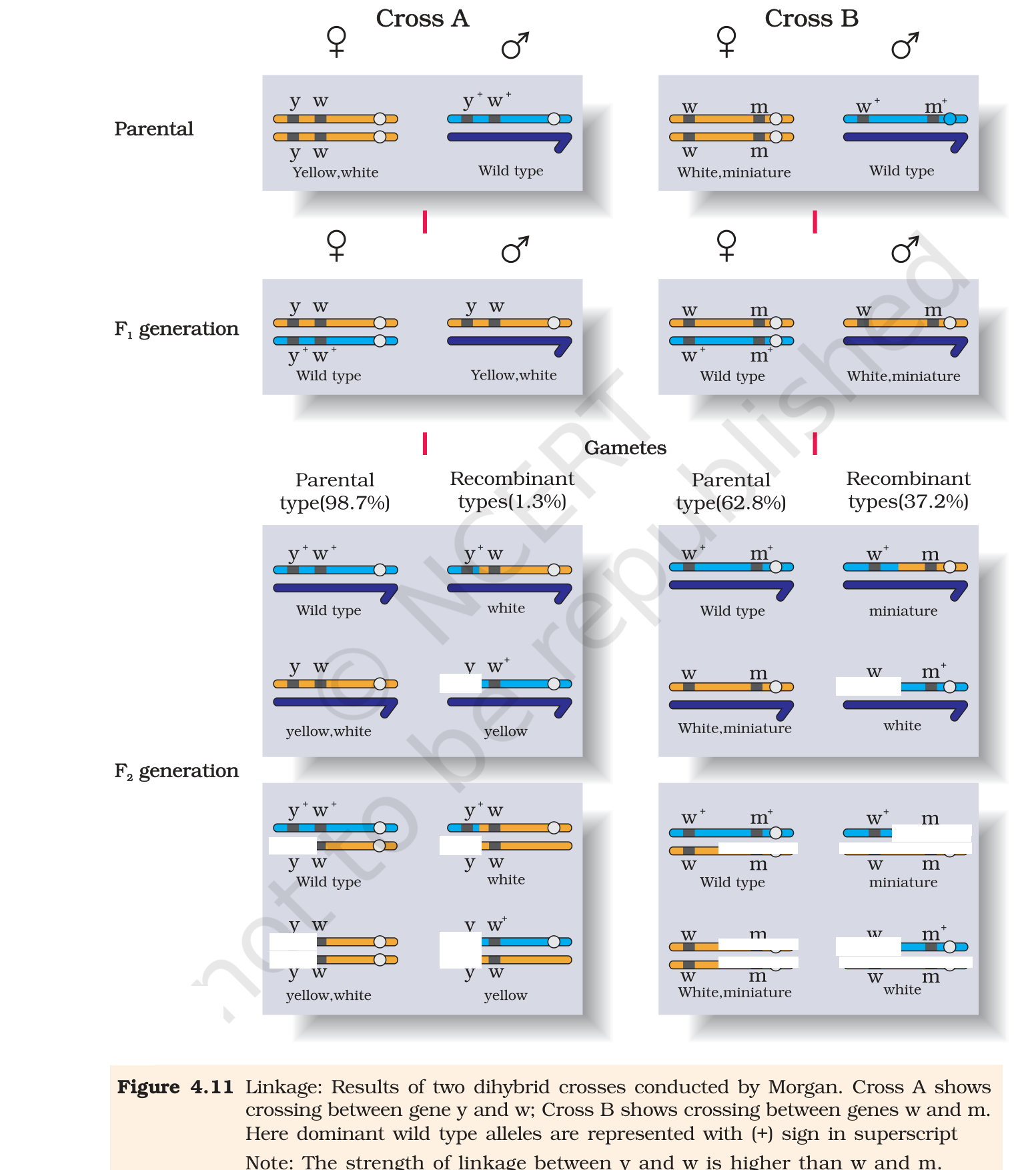
Morgan worked with the fruit fly Drosophila melanogaster, which is easy to grow in the laboratory and has a short life cycle. He found that genes lying on the same chromosome do not always stay together. Some crosses gave the expected parental combinations in large numbers, while the recombinant combinations appeared in smaller numbers. He called this linkage, and the appearance of new combinations is recombination.
Two genes close together on a chromosome are tightly linked and show very little recombination. Two genes far apart on the same chromosome are loosely linked and show more recombination, because a crossover between them is more likely. In one of Morgan's crosses, the genes for white eye and yellow body were very tightly linked and gave only about 1.3 percent recombinants. This showed that the distance between genes on a chromosome could be measured from the recombination frequency.
Linkage is the exception that tests the law of independent assortment. If linked genes gave 9 : 3 : 3 : 1, the law would be universal, but they do not: the parental combinations appear far more often than the recombinant ones. The examiner often asks for this comparison, so write the expected ratio, then state that linkage disturbs it and explain why.
Slideshow, slide 1 of 3. Use the left and right arrow keys to change slides and the space bar to play or pause.
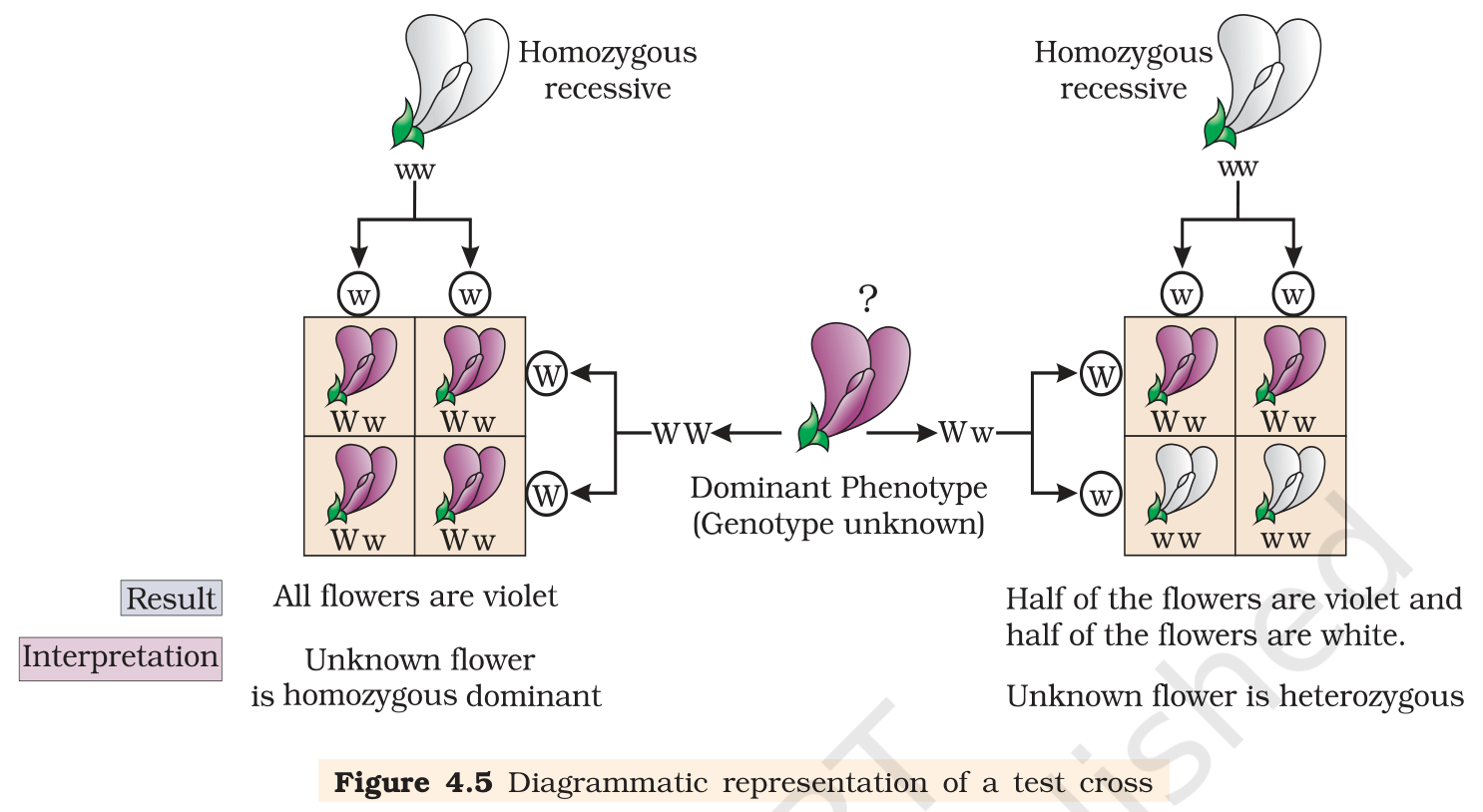
Diagrammatic representation of a test cross between a tall plant of unknown genotype and a dwarf plant, with the two possible outcomes showing whether the tall plant is homozygous or heterozygous.
Warning
Do not write that linked genes violate Mendel's law of segregation; segregation still holds. Linkage disturbs the law of independent assortment, because the two genes are carried on the same chromosome.
2.4 Reading a dihybrid ratio in reverse
The 9 : 3 : 3 : 1 ratio can be used in the other direction too. If the F2 of a dihybrid cross shows 9 : 3 : 3 : 1, the two genes assort independently and both parents were heterozygous for both factors. If the F2 shows a large excess of the parental combinations, the genes are linked. If one class is missing altogether, one gene pair may be lethal. Questions sometimes give the counts and ask you to decide the pattern, and the reasoning is the important part: compare the observed classes with the ratio expected under independent assortment, then state linkage if the parental classes dominate.
2.5 How to choose the gametes
Write the two genes separately before making gametes. For a plant with genotype RrYy, the R pair gives R or r and the Y pair gives Y or y. The gamete must receive one allele from each pair, and the four possible gametes are RY, Ry, rY and ry, all in equal numbers. More than two genes would multiply the gamete types, but board papers stop at two. A common error is to put two alleles of the same gene into one gamete, as in RR or Yy, which cannot happen after meiosis. Checking the gametes first saves the whole square from being wrong.
2.6 Why the ratio needs many offspring
The 9 : 3 : 3 : 1 ratio is a probability statement. Each of the sixteen boxes is equally likely, so the ratio becomes visible only when the sample is large. A cross that yields exactly sixteen seeds can easily give 10 : 3 : 2 : 1 or another split. This is why Mendel counted hundreds and thousands of seeds for each cross, and why a board answer that mentions the large sample gains credit when the question asks why a ratio is close to, but not exactly, the expected values.