

Concepts: sex determination, mutation and genetic disorders
Principles of Inheritance and Variation20 min readLesson 3 of 6
3.1 Sex determination
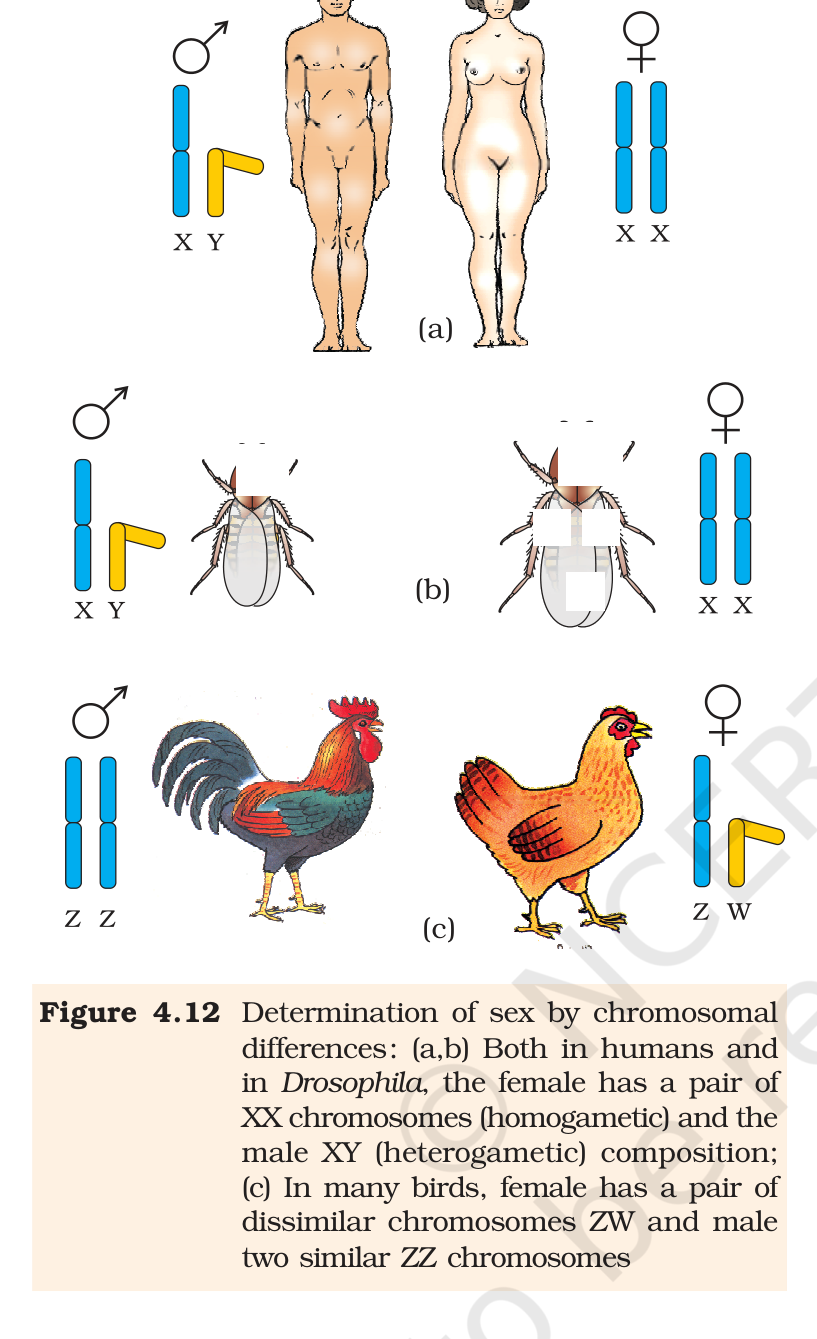
In many animals the sex of an individual is fixed by the chromosomes it inherits. In humans and in Drosophila, females have a pair of X chromosomes and males have one X and one Y. The father therefore decides the sex of the child, because the mother can give only an X while the father can give either X or Y. A child with XX is female and a child with XY is male.
Grasshoppers use the XO type: females have two X chromosomes and males have only one, with no Y at all. Birds use the ZW type: males have two Z chromosomes and females have one Z and one W, so here the mother determines the sex of the offspring. In honey bees sex is decided by the number of chromosome sets rather than by sex chromosomes. A fertilised egg is diploid and becomes a female, while an unfertilised egg develops parthenogenetically into a haploid male, the drone. The drone therefore has no father but can have grandsons through his daughters.
3.2 Mutation
A mutation is a sudden change in the DNA sequence that can be inherited if it occurs in the germ cells. Point mutations change one or a few bases, and can be substitutions, insertions or deletions. A deletion or insertion that shifts the reading frame changes every amino acid after that point, so its effect is usually severe. Chromosomal aberrations change whole segments of chromosomes; they include deletions, duplications, inversions and translocations.
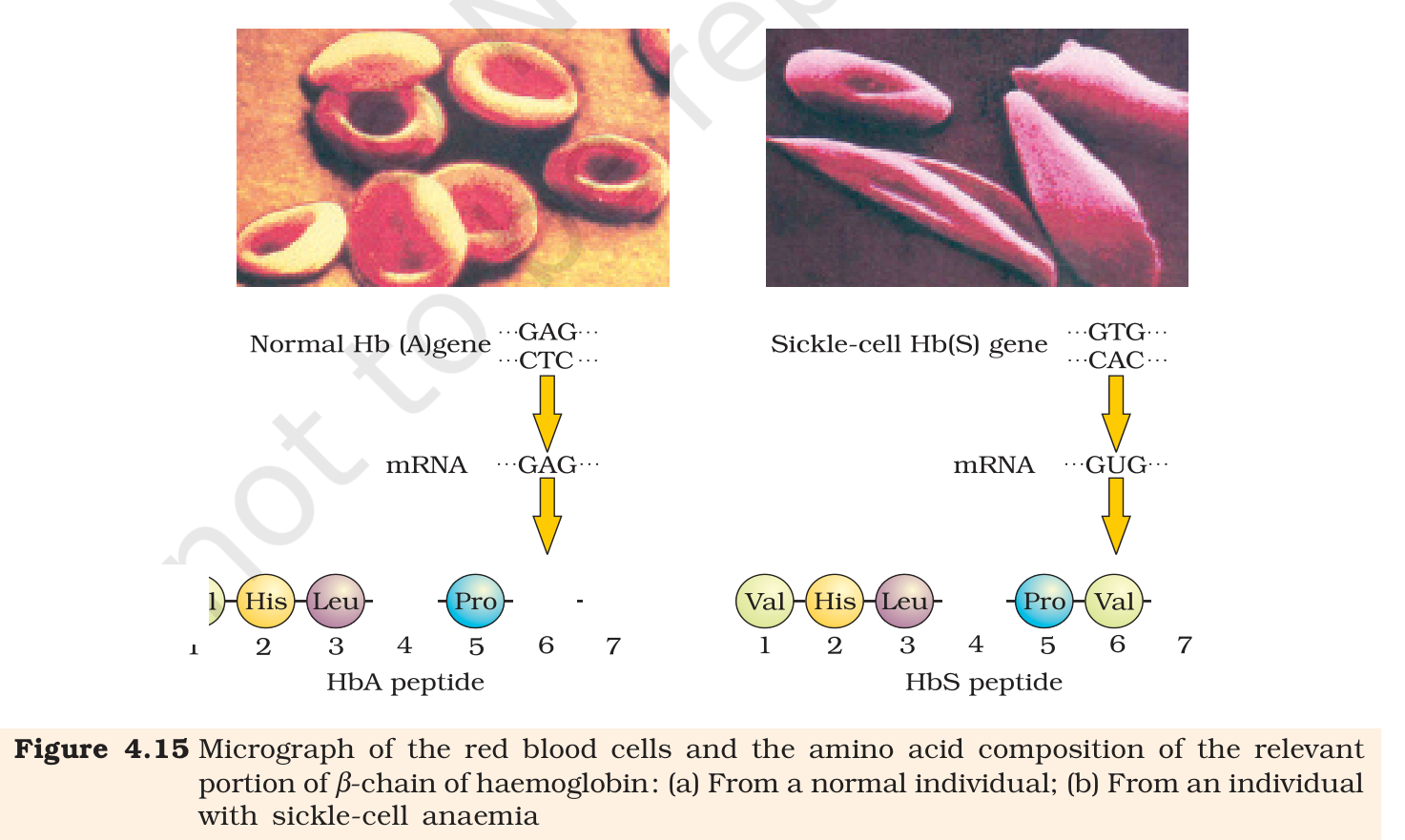
Mutations can be harmful, neutral or occasionally useful. Sickle cell anaemia is the standard example of a point mutation: a single base change in the beta globin gene replaces glutamic acid with valine at the sixth position, and the altered haemoglobin makes red blood cells sickle shaped under low oxygen.
3.3 Mendelian disorders
Haemophilia is a sex linked recessive disorder in which a protein needed for blood clotting is missing, so even a small cut bleeds for a long time. The gene sits on the X chromosome, so a female is affected only if both her X chromosomes carry the allele, while a male is affected with a single copy. Colour blindness is another X linked recessive trait, and it follows the same pattern. A carrier mother can pass the allele to a son who then shows the trait.
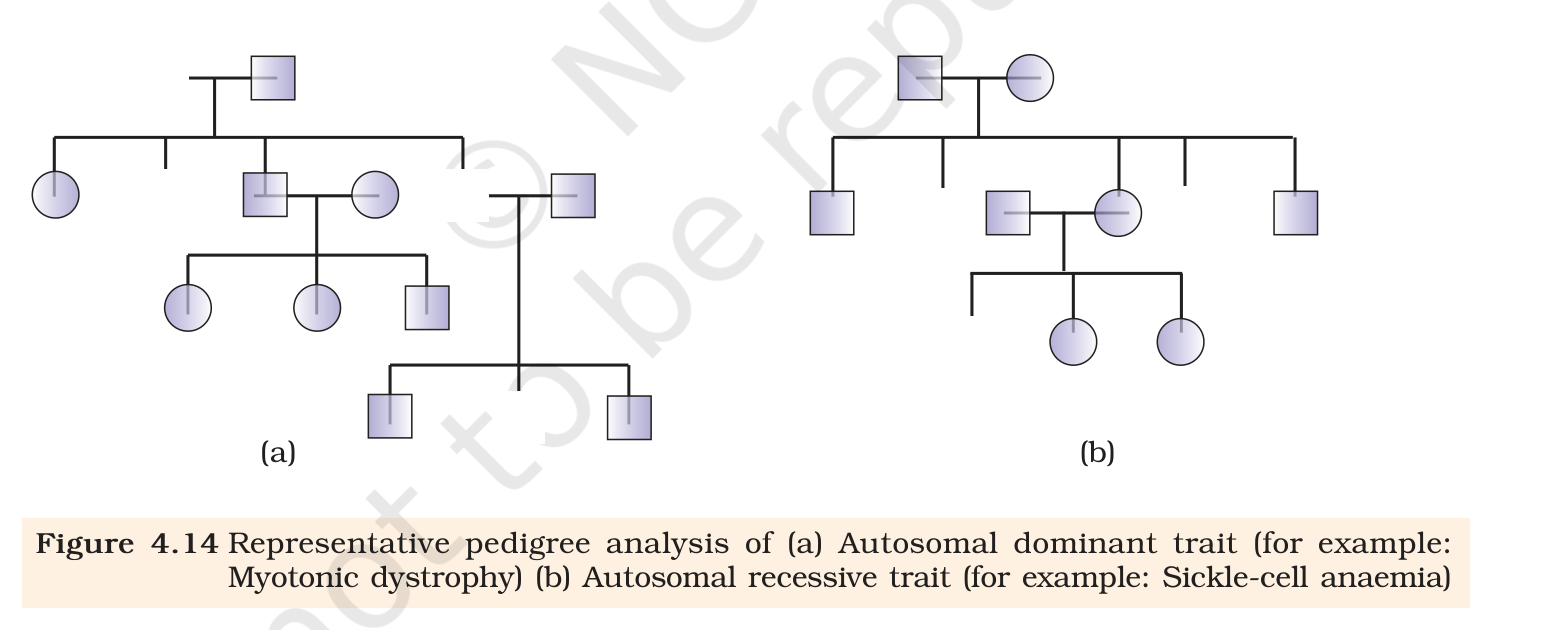
Sickle cell anaemia is autosomal recessive. The allele for normal haemoglobin and the allele for sickle haemoglobin can both be present, and the heterozygote is a carrier with mild symptoms; a homozygous child has the disease. Thalassemia is also autosomal recessive, and it arises because too few globin chains are made, so the red cells are pale and small. Phenylketonuria is an autosomal recessive inborn error of metabolism in which an enzyme needed to break down phenylalanine is missing.
3.4 Chromosomal disorders
Down syndrome is caused by an extra copy of chromosome 21, so the total is 47. The child has a characteristic facial appearance, a single palmar crease, a furrowed tongue and retarded physical and mental development, and the risk rises with the mother's age. Klinefelter syndrome has an extra X in a male, giving a karyotype of 47 XXY; the person has reduced fertility and some breast development. Turner syndrome is the loss of one X in a female, giving 45 X0; such a female has rudimentary ovaries and is usually sterile.
Exam
For each disorder, keep the karyotype or gene location, the affected protein or trait and the inheritance pattern ready. A table with four columns, disorder, gene or chromosome, pattern and main feature, answers most questions in this section.
3.5 Reading a karyotype
A karyotype is a picture of all the chromosomes of a cell arranged in pairs. A normal human karyotype has 46 chromosomes, 22 pairs of autosomes and one pair of sex chromosomes. A female karyotype is written 46, XX and a male 46, XY. Any extra chromosome is written as a plus and any missing one as a minus, so Down syndrome is 47, +21, Klinefelter is 47, XXY and Turner is 45, X0. Questions that give a karyotype expect you to name the syndrome and then state two features. Practise reading the sex chromosome line first, because it separates the sex chromosome disorders from the autosomal ones at a glance.
3.6 Mutation and variation
Not every variation is caused by mutation, and not every mutation is inherited. Crossing over, independent assortment and random fertilisation shuffle existing alleles and produce variation without any change in the DNA sequence. A mutation, by contrast, creates a new allele. A change in a body cell affects only that individual and is lost with it, while a change in a germ cell can pass to children. This distinction matters in a one mark question that asks why most mutations do not appear in the next generation.
3.7 The golden rule for this page
For every disorder, write the karyotype or gene, the inheritance pattern and one clinical feature. That triple answers almost every question in the section.