

Concepts: Microbes in industrial products
Microbes in Human Welfare18 min readLesson 2 of 6
2.1 Growing microbes in large vessels
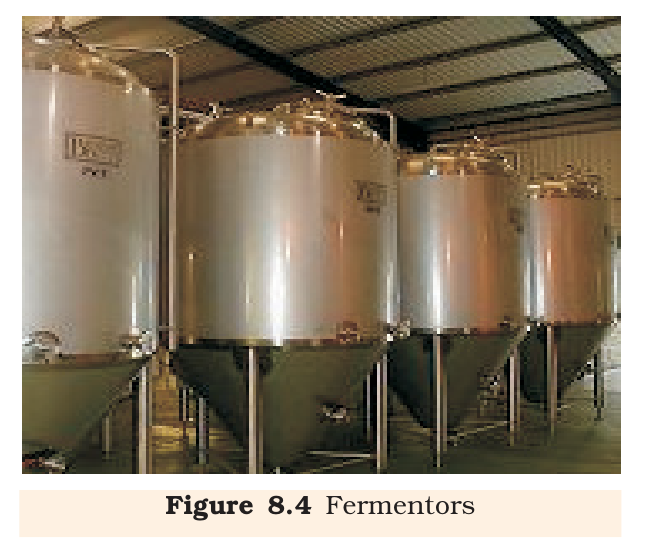
Industry uses microbes to make many products of value, including beverages and antibiotics. A factory cannot run on a flask, so the culture is grown in very large vessels called fermentors (Figure 8.4). Everything needed for industrial production is decided here: the nutrient medium, the temperature, the supply of air, and the time allowed for growth.
2.2 Fermented beverages
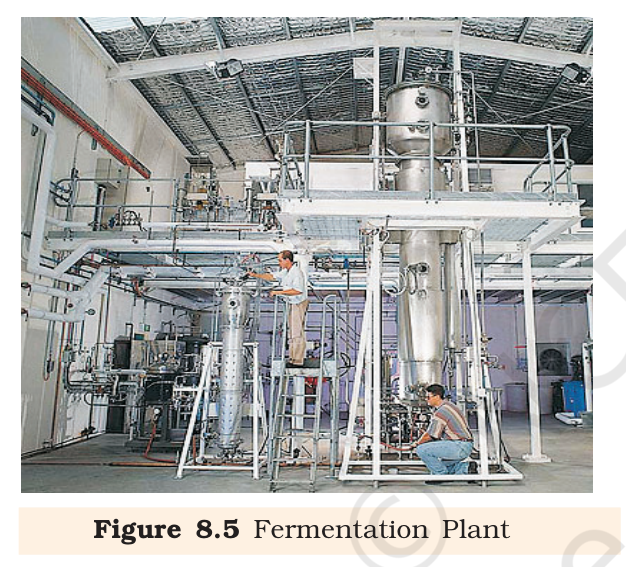
Yeasts have been used for alcoholic drinks since ancient times. Wine, beer, whisky, brandy and rum all start from yeast fermentation. The same organism used for bread, Saccharomyces cerevisiae, works here as brewer's yeast. It acts on malted cereals and fruit juices and yields ethanol. The final drink depends on the raw material and on the processing method. Wine and beer are produced without distillation. Whisky, brandy and rum are made by distilling the fermented broth, which is why their alcohol content is higher. The choice of raw material and the processing step together decide which drink is produced, so a single organism can supply the whole range. A photograph of a fermentation plant appears in Figure 8.5.
2.3 Antibiotics
The term joins anti, Greek for against, with bios, Greek for life. For the disease-causing organism the drug works against life; for the patient the effect is the opposite. Antibiotics are chemicals made by certain microbes that kill or slow the growth of other, disease-causing microbes. Penicillin was the first antibiotic discovered, and the discovery was a chance event. Alexander Fleming was working with Staphylococci bacteria when he noticed a mould growing on an unwashed culture plate. No Staphylococci grew around the mould. The chemical responsible was named penicillin after the mould Penicillium notatum. Its full value as a medicine was established later by Ernest Chain and Howard Florey. Penicillin was used on a large scale to treat wounded American soldiers during the Second World War. Fleming, Chain and Florey shared the Nobel Prize in 1945. Other antibiotics were later purified from other microbes. Together they changed the treatment of plague, whooping cough, diphtheria and leprosy, diseases that once killed millions. Antibiotics act on bacteria, not on viruses, so a viral infection such as the common cold does not respond to penicillin. They also do not replace the immune system; they slow or stop the pathogen long enough for the body to clear it. This is why a course is finished even after the symptoms fade, a point the chapter on human health returns to. Antibiotics work against bacteria, not against viruses, so a viral infection such as the common cold does not respond to penicillin. Antibiotics also do not replace the immune system; they slow or stop the pathogen long enough for the body to clear it.
2.4 Chemicals, enzymes and bioactive molecules
Microbes are used for the commercial production of organic acids, alcohols and enzymes. The table below lists the important organisms and products from the textbook. | Microbe | Product | Use | |---|---|---| | Aspergillus niger (fungus) | Citric acid | Food and industrial chemical | | Acetobacter aceti (bacterium) | Acetic acid | Vinegar and industrial chemical | | Clostridium butylicum (bacterium) | Butyric acid | Industrial chemical | | Lactobacillus (bacterium) | Lactic acid | Food and industrial chemical | | Saccharomyces cerevisiae (yeast) | Ethanol | Commercial alcohol production | | Trichoderma polysporum (fungus) | Cyclosporin A | Immunosuppressive drug for organ transplant patients | | Monascus purpureus (yeast) | Statins | Blood cholesterol lowering agents |
Enzymes from microbes also have everyday uses. Lipases are added to detergent formulations and help remove oily stains from laundry. Bottled fruit juices look clearer than home-made ones because pectinases and proteases clarify them. These are examples of microbial enzymes doing in a factory what a cook cannot do in a kitchen: removing the cloudy pectin and protein while leaving the flavour intact. These are examples of microbial enzymes doing in a factory what a cook cannot do in a kitchen: removing the cloudy pectin and protein without changing the flavour. Streptokinase is made by Streptococcus and then modified by genetic engineering. It works as a clot buster, clearing blocked vessels in patients who have had a myocardial infarction. Statins lower blood cholesterol by competitive inhibition of the enzyme responsible for cholesterol synthesis. Cyclosporin A is an immunosuppressive agent, which means it damps the immune response; that is exactly what a transplant patient needs so the new organ is not rejected. Keep the two apart: cyclosporin A suppresses immunity, statins lower cholesterol.
2.5 Exam pointers
Board questions often test the antibiotic story as a sequence of names and events: Fleming, Penicillium notatum, penicillin, Chain and Florey, Nobel Prize 1945. Write the sequence in order rather than as a paragraph of names. For the product table, one microbe and one product per line is enough. Do not call cyclosporin A an antibiotic; it is an immunosuppressant. In a table question the examiner looks for the exact pair, so write Aspergillus niger and citric acid rather than a fungus and an acid. In a table question, the examiner looks for the exact pair, so write Aspergillus niger and citric acid rather than just a fungus and an acid.
- Name the vessel used for large scale microbial culture and say why industry needs it
- Write the order of events in the discovery of penicillin
- Match five microbes with the industrial product each makes
- Explain why bottled juices are clearer than fresh juice