

Concepts: Sewage treatment and biogas
Microbes in Human Welfare20 min readLesson 3 of 6
3.1 Why sewage must be treated
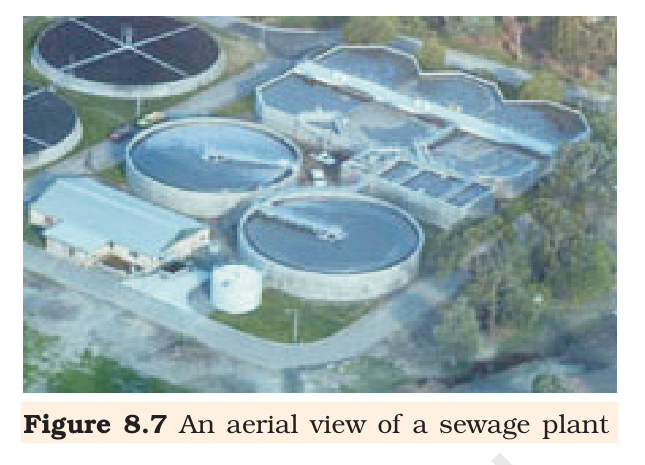
Cities and towns produce large volumes of waste water every day. Human excreta makes up a large share of it. This municipal waste water is known as sewage. It carries much organic matter and huge numbers of microbes, many of them pathogenic. Sewage cannot be emptied into rivers and streams as it is, so it is cleaned in sewage treatment plants, or STPs, before disposal. The cleaning is done by microbes, specifically the heterotrophic microbes already present in the sewage.
3.2 Primary treatment: physical removal
The opening stage is physical. Floating debris leaves the flow through a series of filters, after which grit (soil and small pebbles) settles out. The solids collect as primary sludge; the liquid left above them is the effluent. This effluent goes on to secondary treatment.
3.3 Secondary treatment: the microbial stage
Secondary treatment is the microbial stage. The primary effluent enters large aeration tanks (Figure 8.6), which are stirred mechanically while air is pumped through. This lets aerobic microbes grow vigorously and form flocs, which are masses of bacteria held together with fungal filaments into a mesh-like structure. As the flocs multiply they take up most of the organic matter, and the biochemical oxygen demand, or BOD, of the effluent drops. BOD is the oxygen that bacteria would use up while oxidising all the organic matter present in one litre of the sample. The test measures the rate at which micro-organisms in a sample take up oxygen, so BOD is an indirect measure of the organic matter present. A higher BOD means a greater polluting potential. Sewage is treated until its BOD falls far enough. After the BOD falls, the effluent moves to a settling tank and the flocs settle out. This sediment is activated sludge. A little of it returns to the aeration tank as inoculum, and the rest goes to large anaerobic sludge digesters. There, anaerobic bacteria digest the bacteria and fungi in the sludge and release a mixture of gases, mainly methane along with hydrogen sulphide and carbon dioxide. This mixture is biogas, and it burns, so it is a source of energy. The treated effluent is finally released into natural water bodies. The BOD test takes time because it follows the oxygen uptake of bacteria, but the value it gives is the standard way to compare two effluents. Returning part of the activated sludge also keeps a ready population of microbes in the aeration tank, so the plant does not have to build the community from scratch every day. The Ministry of Environment and Forests started the Ganga Action Plan and the Yamuna Action Plan to reduce pollution in these rivers. Under these plans, many sewage treatment plants are to be built so that only treated sewage reaches the rivers. Untreated sewage is still discharged in many places because the number of plants has not kept pace with the growth of cities.
3.4 Biogas from cattle dung
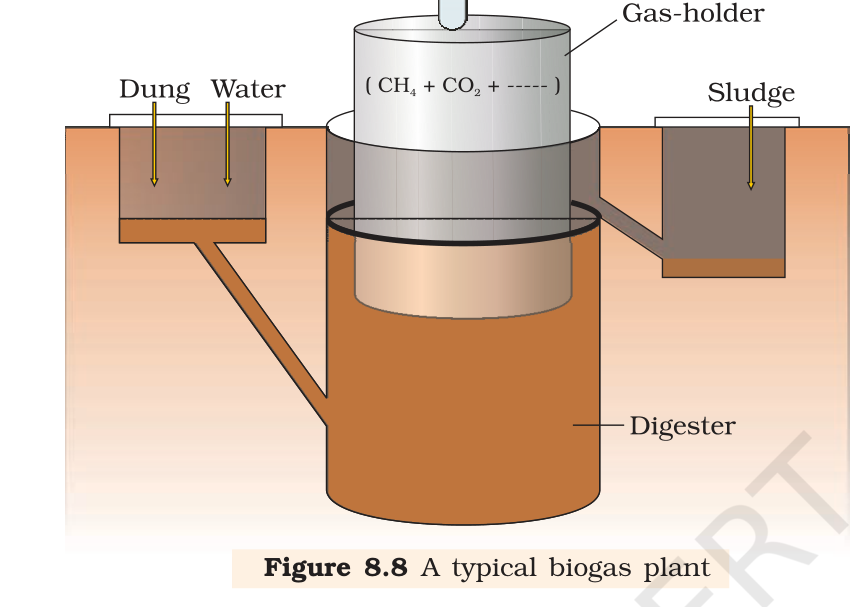
Biogas is a mixture of gases, mostly methane, produced by microbial activity. Methanogens are bacteria that grow anaerobically on cellulosic material and produce large amounts of methane, along with carbon dioxide and hydrogen. A common example is Methanobacterium. These bacteria occur in the anaerobic sludge of sewage treatment plants. They also live in the rumen of cattle, where they break down cellulose and help the animal digest its food. We cannot digest cellulose ourselves, but the bacteria in the cattle rumen can. The dung of cattle, called gobar, is therefore rich in these bacteria, and dung can be used to make biogas, commonly called gobar gas. A biogas plant uses a concrete tank about 10 to 15 feet deep that holds the bio-waste and the dung slurry fed into it. A floating cover rests on the slurry and lifts as gas gathers beneath. An outlet and pipe deliver the gas to houses nearby. The spent slurry leaves through a second outlet and works as fertiliser. Since villages have cattle dung in quantity, plants are usually built in rural areas, and the gas serves for cooking and lighting. The technology was developed in India mainly through the work of the Indian Agricultural Research Institute and the Khadi and Village Industries Commission.
3.5 Comparing the two stages
| Feature | Primary treatment | Secondary treatment |
|---|---|---|
| Nature | Physical | Biological |
| Main actions | Filtration and sedimentation | Aeration, microbial growth as flocs, oxidation of organic matter |
| Removal | Floating debris and grit | Most of the dissolved organic matter |
| Products | Primary sludge and effluent | Activated sludge, biogas from sludge digesters |
| Indicator | Solids settle out | BOD falls significantly |
A frequent mistake is to place the aeration tank in primary treatment. Aeration belongs to secondary treatment. Another is to say BOD falls as pollution rises; the relation is the opposite, a high BOD means a high organic load. Diagram questions on the STP expect you to label the aeration tank, the settling tank, the sludge digester and the gas outlet.
Slideshow, slide 1 of 3. Use the left and right arrow keys to change slides and the space bar to play or pause.
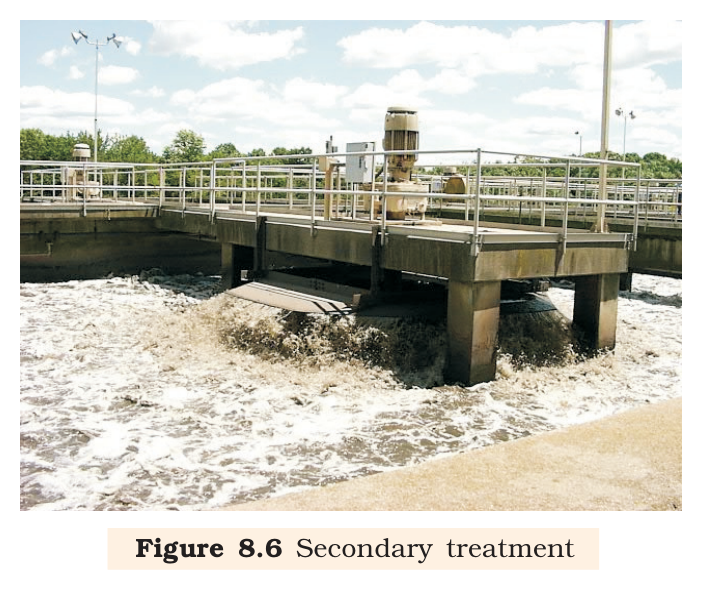
A labelled diagram of the secondary stage of sewage treatment, showing the aeration tank and the settling tank.
Exam
For BOD questions, always define BOD first, then say what a high value means, then link it to organic matter. In a comparison answer, put primary and secondary treatment side by side in a table; examiners give marks for the contrast rather than for two separate paragraphs.