

Concepts: MTP, STIs, infertility and assisted reproduction
Reproductive Health18 min readLesson 3 of 5
3.1 Medical termination of pregnancy
Medical termination of pregnancy, or MTP, is the medical name for an induced abortion. The MTP Act of 1971 made the procedure legal under stated conditions, and the law has been amended since to widen safe access. The question usually asks why MTP was legalised. The answer is that thousands of women died each year after unsafe abortions done by untrained people, and legalising the service brought those women to safe hands.
MTP is relatively safe in the first trimester, up to about 12 weeks, and becomes riskier as pregnancy advances. That is why the law sets a time limit and requires a registered medical practitioner. The procedure is also misused by some families for sex selective abortion, which is why prenatal sex determination is banned.
3.2 Sexually transmitted infections
Sexually transmitted infections spread mainly through sexual contact. The common bacterial ones are gonorrhoea and syphilis, and the common viral ones include genital herpes, genital warts and hepatitis B. Chlamydiasis, trichomoniasis and HIV are also grouped here. The infections may start with mild symptoms that are ignored: a discharge, itching, a sore or a burning sensation while passing urine.
If they are left untreated, the consequences are serious. Both bacterial and viral infections can spread to the pelvic organs and cause pelvic inflammatory disease, which damages the fallopian tubes and leads to infertility. Some infections can also be passed to the child during birth. The early symptoms are easy to miss, so awareness and early testing matter, and condoms reduce the risk. STIs are a good example of a health problem that needs education as much as medicine.
3.3 Infertility
Infertility means the inability of a couple to produce a child even after unprotected sex for a year or more. In the female the common causes are blocked fallopian tubes, hormonal problems and defects of the uterus. In the male the usual cause is a low sperm count or poor sperm motility. Illnesses, infections, surgery and lifestyle can all play a part.
Treatment begins with the easier options first. Fertility drugs stimulate ovulation in the female. Surgery can open a blocked tube. Semen is analysed to find the cause on the male side. If these fail, the couple is offered assisted reproductive technology, or ART.
3.4 Assisted reproductive technologies
The simplest of the techniques is intrauterine insemination. The semen is washed, concentrated and placed in the uterus at the time of ovulation, so sperm have a shorter distance to travel.
In in vitro fertilisation, or IVF, the ovum is collected from the female, the sperm from the male, and fertilisation takes place in a dish. The resulting zygote or early embryo is then transferred into the female. When the embryo is transferred at the eight celled stage the method is called ZIFT. When the transfer happens at a later stage the method is IUT, or intrauterine transfer. IVF with embryo transfer is often written as IVF-ET.
Two more techniques are asked often. Gamete intra fallopian transfer, GIFT, moves an ovum donated by another woman into the fallopian tube of a woman who cannot produce an ovum but can carry a pregnancy. Intracytoplasmic sperm injection, ICSI, injects a single sperm directly into the ovum in the laboratory, and the embryo is later transferred into the uterus. Artificial insemination by a donor, or AI, is used when the male partner cannot provide healthy sperm.
Slideshow, slide 1 of 3. Use the left and right arrow keys to change slides and the space bar to play or pause.
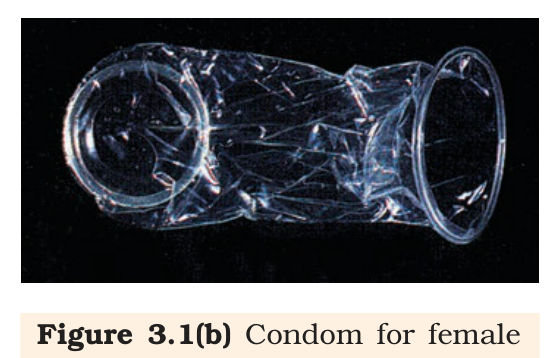
Photograph of a female condom, a loose latex pouch with rings at both ends, which is placed inside the vagina so that semen cannot reach the ovum.
Exam
For MTP answers, give the full form, one line on the 1971 Act, the reason for legalising it and the 12 week safety point. For STI answers, separate bacterial from viral names, and then add PID and infertility as complications.
3.5 Infertility in the two partners
The female side and the male side are usually examined together. In the female, the fallopian tubes may be blocked by an old infection, the ovaries may not release an ovum, or the uterus may have a structural problem. In the male, the sperm count may be low, the sperm may be poorly motile, or a blockage may stop sperm from reaching the semen. Sometimes no clear cause is found, and the couple is advised on timing and lifestyle before any technology is offered.
3.6 ART names that confuse students
Write the full form once and the sentence becomes safe. IVF is in vitro fertilisation, the fertilisation of an ovum by sperm outside the body. ZIFT is zygote intra fallopian transfer, where the zygote is placed in the fallopian tube. IUT is intra uterine transfer, where a later stage embryo is placed in the uterus. GIFT is gamete intra fallopian transfer, where an ovum is placed in the tube. ICSI is intracytoplasmic sperm injection, where one sperm is injected into the ovum. AI or IUI is artificial insemination, where semen is placed in the uterus. The common mistake is to swap ZIFT and IUT, and the difference is only the stage of the embryo that is transferred.
3.7 A final check for the exam
For this section, keep three lists ready: the full forms, the bacterial and viral STI names, and the ART techniques with one line each. Most questions are answered by naming the right item and adding its single key function, so short and precise beats long and vague.