

Concepts: Parasitism, commensalism and mutualism
Organisms and Populations18 min readLesson 4 of 6
4.1 Parasitism
Parasitism offers free board and lodging, so the habit turns up in almost every group, from plants up to higher vertebrates. Host specificity is common: many parasites can use just one host species. Host and parasite then co-evolve: when the host develops a way to reject or resist the parasite, the parasite must develop a counter in order to keep using that host.
Parasites have adapted to their way of life in predictable ways. Unnecessary sense organs are lost, adhesive organs or suckers appear for clinging to the host, the digestive system is often lost, and reproductive capacity rises. Life cycles are frequently complex, with one or two intermediate hosts or vectors needed to reach the primary host. Take the trematode that parasitises the human liver: its cycle passes through two different intermediate animals, a snail first and then a fish. Malaria's parasite relies on a mosquito vector to move between hosts. These detours are not accidents of the life cycle; they are what lets a small number of parasites find their way to the next primary host.
Most parasites harm their host. They may reduce survival, growth and reproduction, and lower the host's population density, or make it weaker and easier for a predator to catch. A harmless parasite would seem ideal, but natural selection has not produced one. The question to think about is why an ideal parasite that thrives without harming its host has not evolved.
Parasites that live on the outside of the host are ectoparasites. Lice on humans and ticks on dogs are familiar examples, and many marine fish carry ectoparasitic copepods. Cuscuta, a parasitic plant common on hedges, lost its chlorophyll and leaves during evolution and draws its food from the host. A female mosquito is not considered a parasite even though it needs blood to reproduce; the reason is that it does not live on or in the host.
Endoparasites live inside the host, in places such as the liver, kidney, lungs or red blood cells. Their life cycles are more complex because of extreme specialisation. Their body form is greatly simplified, while their reproductive output is emphasised.
Brood parasitism in birds is a special case. The parasitic bird leaves its eggs in another bird's nest and that bird does the incubating. Over evolutionary time the parasitic eggs have come to resemble the host's eggs in size and colour, which lowers the chance that the host detects and ejects them. Cuckoo and crow make a familiar pair to watch during the breeding season.
4.2 Commensalism
Commensalism is the interaction in which one species gains and the other feels no effect either way. An orchid living as an epiphyte on a mango branch gains support, and the mango is untouched. Barnacles on the back of a whale gain transport while the whale gains nothing apparent. The cattle egret and grazing cattle are a classic case: the egrets stay near the cattle because the moving animals flush insects out of the vegetation, making them easier to catch. The clown fish living among the stinging tentacles of a sea anemone gets protection from predators that avoid the tentacles, while the anemone appears to gain nothing.
4.3 Mutualism
Mutualism benefits both partners. Lichens pair a fungus with photosynthesising algae or cyanobacteria in a close mutualism. Mycorrhizae join a fungus to the roots of higher plants: the fungus helps the plant absorb essential nutrients from soil, and the plant supplies the fungus with energy-rich carbohydrates.
The most spectacular cases are plant-animal mutualisms. Plants need animals to pollinate flowers and disperse seeds, and the animals have to be paid for the service. The payment is pollen and nectar for pollinators and juicy fruits for seed dispersers. The system must also be guarded against cheaters, animals that take nectar without pollinating. This is why plant-pollinator systems show tight co-evolution.
Fig trees and their wasps form an exclusive pair (Figure 11.4): each fig species has exactly one wasp partner that can pollinate it. The female wasp uses the fruit as a place to lay eggs, and its larvae feed on some of the developing seeds. While searching for a suitable egg-laying site, the wasp pollinates the fig inflorescence, so the fig gives up a few seeds in exchange for pollination.
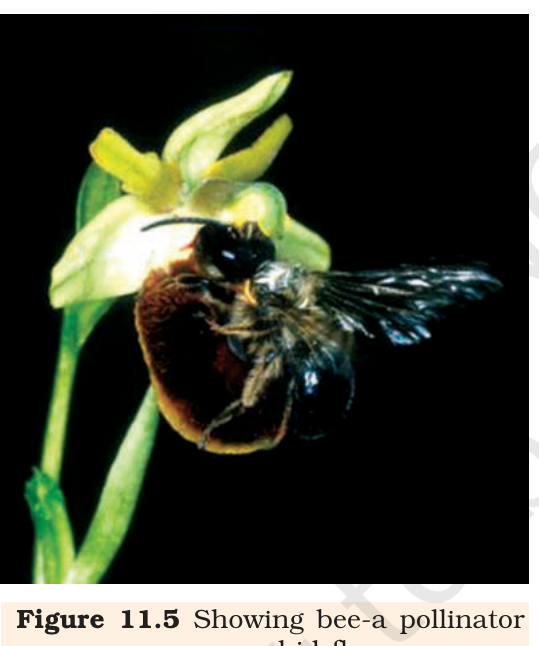
Orchids show a great range of floral patterns that have evolved to attract the right pollinator, usually bees and bumblebees (Figure 11.5). Not every orchid offers a reward. The Mediterranean orchid Ophrys uses sexual deceit: one petal resembles the female bee in size, colour and markings. A male bee is attracted to that petal, attempts to copulate with the flower, and gets dusted with pollen. When the same bee visits another flower, the pollen is transferred. If the female bee's colour pattern changes slightly during evolution, pollination success falls unless the orchid co-evolves to keep the resemblance.
Slideshow, slide 1 of 3. Use the left and right arrow keys to change slides and the space bar to play or pause.
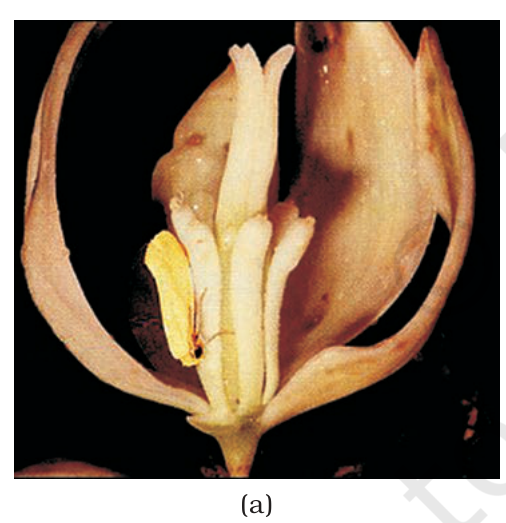
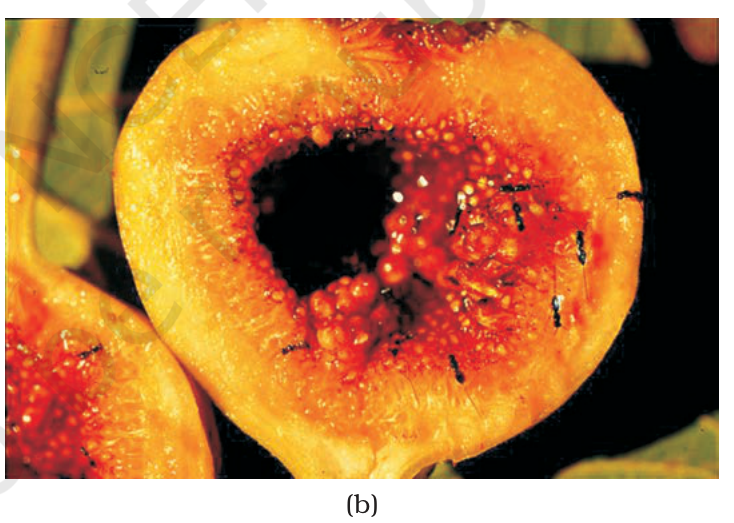
A fig flower with the opening through which its partner wasp enters, labelled (a).