

Immunity: innate and acquired defence
Human Health and Disease26 min readLesson 2 of 5
2.1 The two lines of defence
Immunity is the ability of the body to fight the pathogens that cause disease, and it works at two levels. Innate immunity is present from birth and is not specific to a particular pathogen. Acquired immunity develops during the life of a person after the body meets a pathogen or a vaccine, and it is specific to that pathogen and has memory.
Innate immunity has four kinds of barriers. The physical barriers are the skin and the mucus lining of the respiratory, digestive and genital tracts, which stop the pathogens from entering. The physiological barriers are the acidic gastric juice, the saliva and the tears, all of which create conditions in which pathogens cannot survive. The cellular barriers are the white blood cells such as polymorphonuclear leucocytes, monocytes, natural killer cells and macrophages, which engulf and destroy the microbes. The cytokine barriers are the proteins called interferons, which are released by cells infected by a virus and which protect the neighbouring uninfected cells from the infection. Interferons belong to the cytokine barriers of innate immunity, which is a point that is asked as a short question.
2.2 Acquired immunity
Acquired immunity is pathogen specific, and it has memory. The first time the body meets a pathogen, it produces a primary response, which is of low intensity and takes time to develop. If the same pathogen returns, the body produces a secondary or anamnestic response, which is faster and much stronger. The memory of the first encounter is carried by the lymphocytes, and this is the principle behind vaccination and behind the immunity a person gets after recovering from an infection.
2.3 B cells, T cells and the antibody
The acquired immune response is carried out by two special types of lymphocytes, the B lymphocytes and the T lymphocytes. The B lymphocytes make the antibodies, a family of proteins that enter the blood and attach to the pathogen. Because the antibodies are found in the blood, this is called the humoral immune response or the antibody-mediated response. The T lymphocytes themselves do not secrete antibodies; they help the B cells to produce them and they also attack the cells that the pathogen has infected. This is called the cell-mediated immune response, and it is carried out by the T cells.
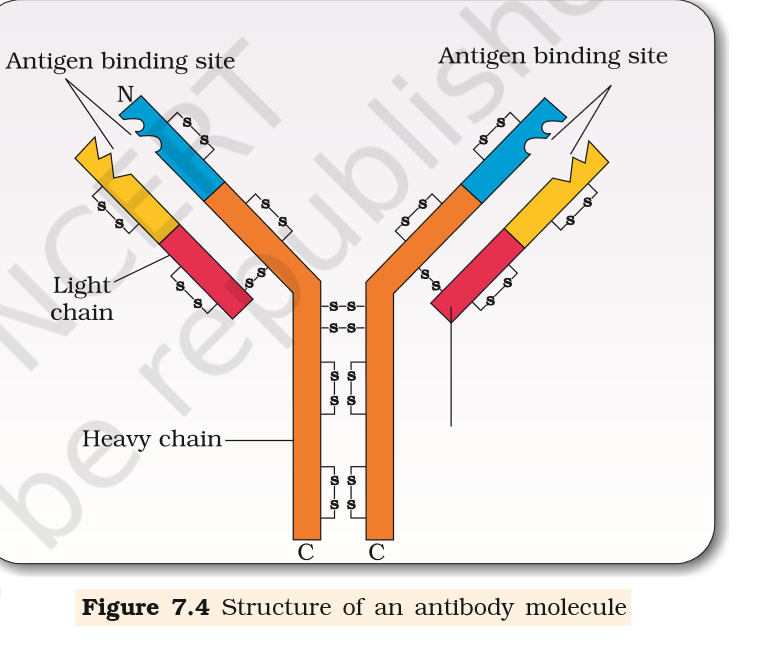
The antibody molecule has four peptide chains, two short chains called the light chains and two long chains called the heavy chains, so it is represented as H2L2. The chains are held together by disulphide bonds in the shape of a Y, and the two arms carry the antigen binding sites, as Figure 7.4 shows. Each antibody has two identical antigen binding sites, which is why one antibody can bind two antigen molecules and clump them together. The human body makes several different classes of antibodies, including IgA, IgM, IgE and IgG, and they differ in their location and in their role. IgA is found in the colostrum and in the secretions of the mucosal surfaces, IgM is the first antibody made in a new infection, IgE is involved in allergic reactions, and IgG is the most abundant antibody and can cross the placenta to protect the foetus.
2.4 Lymphoid organs
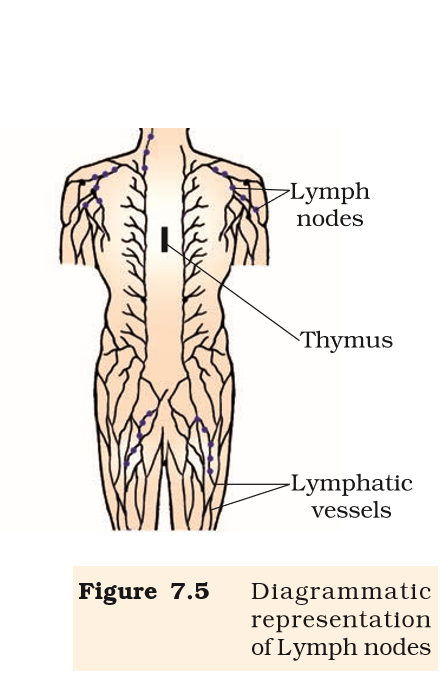
The immune system works through the lymphoid organs, which are divided into primary and secondary organs. The primary lymphoid organs are the bone marrow and the thymus. All the blood cells, including the lymphocytes, are produced in the bone marrow, and the T lymphocytes mature in the thymus, a two-lobed organ that sits near the heart behind the breastbone. It is large in a newborn and shrinks as the person grows, and its degeneration reduces the production of mature T cells, so the immunity of the person is affected. With fewer mature T cells, cell-mediated immunity weakens, which is the answer to the early-atrophy question.
The secondary lymphoid organs are the spleen, the lymph nodes, the tonsils, the Peyer's patches of the small intestine and the appendix. These provide a meeting place for the lymphocytes and the antigen, and the lymphocytes multiply there to become effector cells. The spleen is a large organ that also filters the blood and traps blood-borne microbes, and it is a reservoir of erythrocytes. The lymph nodes trap the microbes and the antigens that get into the lymph and the tissue fluid, and this activation is what makes the nodes swell during an infection. There is also lymphoid tissue in the lining of the respiratory, digestive and urogenital tracts, called the mucosa-associated lymphoid tissue (MALT), and it makes up about half of the lymphoid tissue in the body.
2.5 Active and passive immunity, vaccines and allergy
Acquired immunity can be active or passive. Active immunity is produced when the person's own body makes the antibodies in response to a live or a killed pathogen, as after an infection or a vaccination; it takes time to develop but it lasts a long time because memory cells are formed. Passive immunity is produced when ready-made antibodies are given to a person from outside, as when a child receives antibodies (IgA) in the colostrum from the mother's milk, or when a person is injected with antivenom after a snake bite; it gives protection at once but it lasts only for a short time because no memory cells are formed. The antibody in the antivenom is made in another animal, and it neutralises the venom directly.
A vaccine works on the principle of the secondary response. It contains antigens of the pathogen, killed or weakened, so the body makes antibodies and memory cells without developing the disease. If the real pathogen then attacks, the memory cells produce a rapid and strong secondary response, and the person does not fall ill. This is the basis of the time-bound vaccination programme that is followed for children up to ten years of age in our country.
The immune system can also cause problems. An allergy is a hypersensitivity to substances such as pollen, dust, animal dander and some foods, in which the body makes IgE antibodies and the mast cells release histamine and other chemicals, producing sneezing, watery eyes, a running nose and difficulty in breathing. The substances that cause the allergy are called allergens, and the medication given is an antihistamine. In autoimmune diseases such as rheumatoid arthritis and many forms of diabetes, the immune system attacks the body's own cells. In an organ transplant the body may reject the graft, so a donor is matched for the antigens of the graft; the closer the match, the longer the graft survives.