

Concepts: batteries, fuel cells and corrosion
Electrochemistry18 min readLesson 4 of 7
4.1 Turning chemistry into power
A battery is a galvanic cell or a group of them arranged to supply electrical energy. A practical battery should be light, compact and should keep its voltage steady while it is used. Batteries fall into two families. Primary cells are used once and then discarded, because their reaction cannot be reversed by charging. Secondary cells are rechargeable: the products of discharge can be converted back into the original reactants by passing current in the opposite direction.
4.2 The lead storage battery
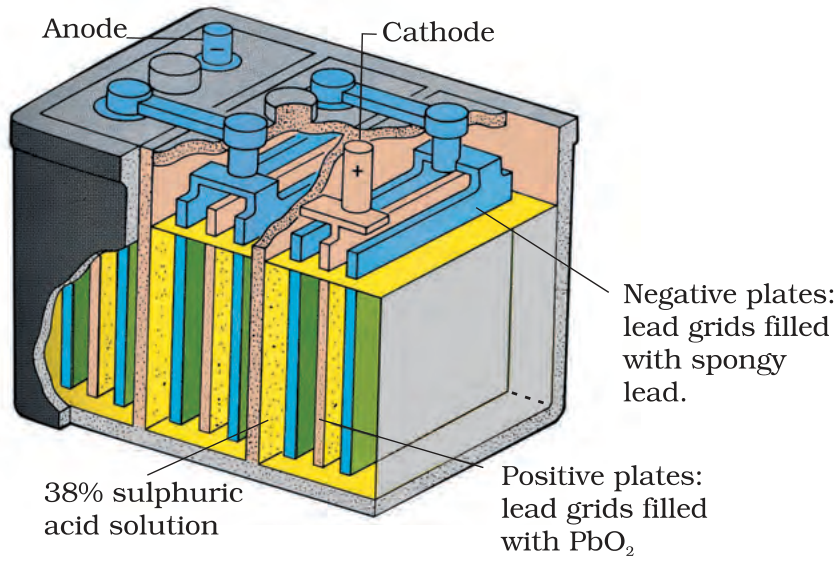
This is the battery in cars and inverters. The anode is spongy lead and the cathode is lead dioxide packed on lead grids, with dilute sulphuric acid as electrolyte. On discharge, the anode lead is oxidised to lead sulphate and the cathode lead dioxide is reduced to lead sulphate as well. The overall reaction consumes sulphate ions and produces water, and the same reactions reverse on charging. One reason the voltage stays near 2 V per cell is that the electrolyte concentration changes only slowly.
4.3 Dry cell and mercury cell
The common dry cell uses a zinc container as the anode, a carbon rod as the cathode, manganese dioxide and carbon as the cathode mix and a moist paste of ammonium chloride and zinc chloride as electrolyte. The potential is about 1.5 V and the cell cannot be recharged. The mercury cell has a zinc anode and a mercury(II) oxide cathode in an alkaline electrolyte. Its voltage is a steady 1.35 V because the electrolyte concentration does not change during use, which makes it suitable for small devices such as hearing aids and watches.
4.4 Fuel cells
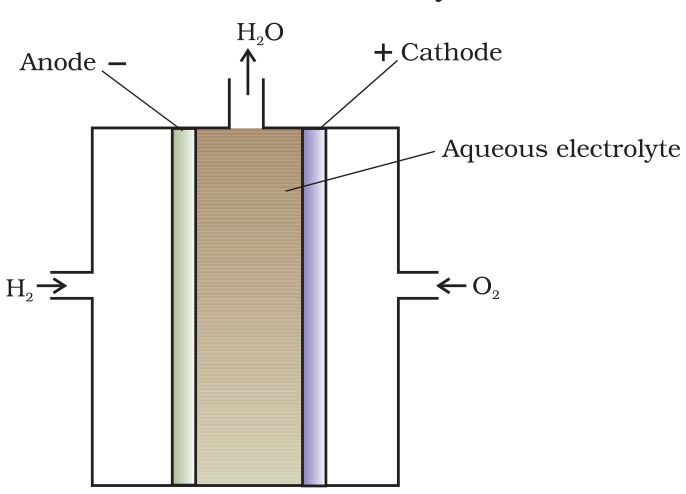
A fuel cell converts the chemical energy of a continuously supplied fuel directly into electrical work. In the hydrogen oxygen fuel cell, hydrogen is oxidised at the anode and oxygen is reduced at the cathode in an alkaline or acidic electrolyte, and the only product is water. Fuel cells are more efficient than thermal power production and were used in the Apollo space programme. Their practical problem is the storage of hydrogen.
4.5 Corrosion as a cell
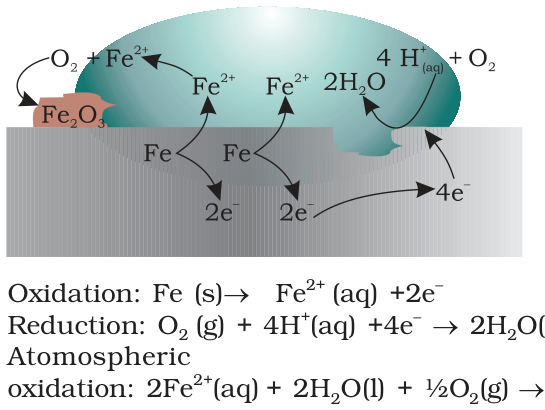
Rusting of iron is an electrochemical process. At an anodic region of the iron surface, iron atoms lose electrons and enter the water film as Fe2+. At a cathodic region, oxygen dissolved in the water film gains electrons and forms hydroxide ions. The Fe2+ and OH- ions meet and form hydrated iron(III) oxide, the rust. Because the two half reactions occur at different points of the same piece of metal, the metal acts as a short circuited cell. Galvanising with zinc protects iron in two ways: the zinc layer is a barrier, and zinc is more easily oxidised than iron, so it acts as a sacrificial electrode even where the coating is scratched.
Slideshow, slide 1 of 4. Use the left and right arrow keys to change slides and the space bar to play or pause.
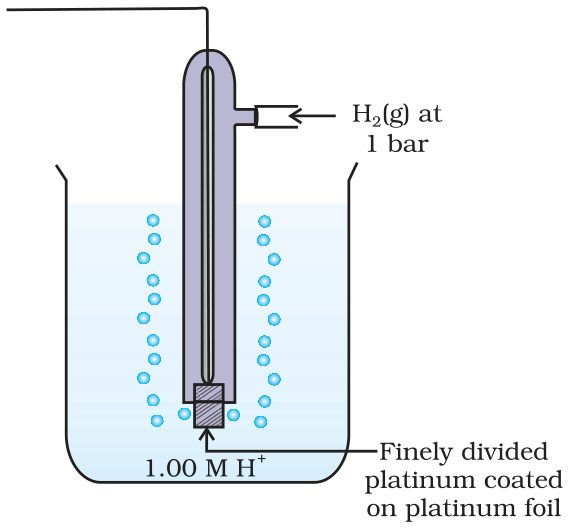
Standard hydrogen electrode: platinum foil coated with platinum black, dipped in 1 M acid with hydrogen gas at 1 bar.
4.6 Exam pointers
Questions on batteries usually ask for the electrode reactions and then one qualitative point such as why the voltage stays constant. Questions on corrosion usually ask for the anode and cathode reactions and one method of prevention. In both cases the marks are in the equations and the reason, not in a description of the device.
4.7 Choosing the right cell
The choice of cell follows the job. A dry cell is cheap and suited to intermittent use in torches and clocks. The mercury cell gives a small, steady voltage for hearing aids and watches but contains mercury, so disposal is a problem. The lead storage battery delivers a large current and can be recharged many times, which is why it starts engines and backs up power supplies, although lead and acid make recycling essential. Fuel cells are suited to continuous operation in remote locations and in space, where a steady supply of fuel matters more than storage.
4.8 Why fuel cells are efficient
A thermal power plant burns fuel to make heat, turns heat into mechanical work and then into electricity, and each conversion step loses energy. A fuel cell skips those steps and takes electrons directly from the fuel at the anode, so a larger share of the chemical energy becomes electrical energy. The hydrogen oxygen cell leaves only water as the product, which is why it is called clean when the hydrogen itself is made without carbon emissions.
4.9 Inside the dry cell
The dry cell is cheap and familiar: a zinc container is the anode, a carbon rod in the centre is the cathode, and the paste around the rod contains manganese dioxide and ammonium chloride. The zinc is oxidised and the manganese dioxide is reduced while the ammonium ion helps to keep the charge balanced. The potential is about 1.5 V. The cell cannot be recharged because the reduction products cannot be converted back easily, so it is a primary cell and ends up as waste once the zinc is consumed.
4.10 Why corrosion matters
Iron and steel structures rust because a thin film of water on the surface allows an electrochemical cell to form. The economic cost of corrosion is large, so protection methods are part of the same chapter. Painting and greasing cut the metal off from water and oxygen. Galvanising adds a zinc coating that both blocks the surface and acts as a sacrificial anode. Alloying with chromium produces stainless steel, whose oxide layer protects the bulk metal. Each method attacks one of the two requirements of the corrosion cell, either the water film or the easily oxidised iron.