

Concepts: conductance, Kohlrausch law and electrolysis
Electrochemistry18 min readLesson 3 of 7
3.1 Conductivity and molar conductivity
An electrolyte conducts because its ions move. How much resistance a solution offers depends on how far apart its electrodes sit and how large their surfaces are. A cell constant is therefore measured once using a solution of known conductivity and then reused. Conductivity is the inverse of resistivity and has the unit S cm^-1. Molar conductivity normalises for concentration so that solutions of different strength can be compared, and its unit is S cm^2 mol^-1.
When a solution is diluted, the number of ions per unit volume falls, so the conductivity falls. The molar conductivity, however, rises, because the ions are further apart and move more freely and because a weak electrolyte dissociates more at greater dilution.
3.2 Strong and weak electrolytes
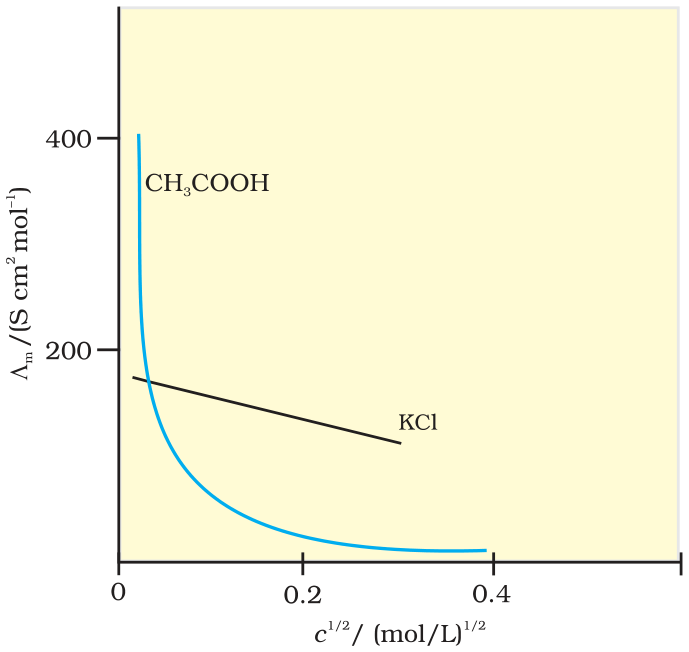
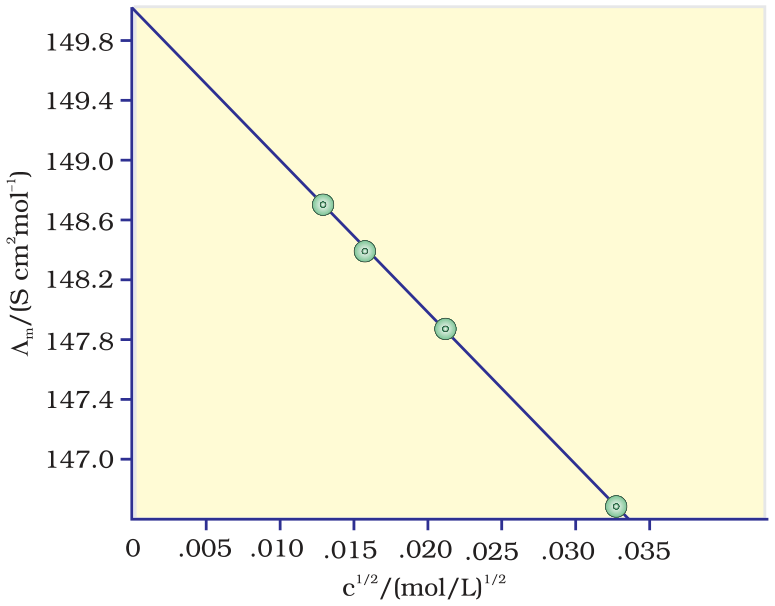
For a strong electrolyte the graph of molar conductivity against the square root of concentration is a straight line, and extrapolation to c = 0 gives the limiting molar conductivity. For a weak electrolyte the graph curve turns sharply near the axis and extrapolation is not reliable. Kohlrausch's law solves this: the limiting molar conductivity of any electrolyte is the sum of the limiting ionic conductivities of its ions, each multiplied by the number of ions in the formula. The limiting values of strong electrolytes can therefore be combined to obtain the value for a weak electrolyte.
The degree of dissociation of a weak electrolyte is the ratio of its molar conductivity at a concentration to the limiting value. With the degree of dissociation known, the acid dissociation constant follows from the standard weak acid expression.
3.3 Worked examples
Example 1: potassium chloride. A 0.2 M solution of KCl has conductivity 2.48 times 10^-2 S cm^-1. Molar conductivity is 1000 times 2.48 times 10^-2 divided by 0.2, which is 124 S cm^2 mol^-1. The limiting values of the ions are 73.5 and 76.5, so the limiting molar conductivity is 150. The degree of dissociation is 124 divided by 150, which is 0.827, and the solution is a strong electrolyte that is almost fully dissociated.
Example 2: acetic acid. A 0.00241 M acetic acid solution has conductivity 7.896 times 10^-5 S cm^-1. Molar conductivity is 1000 times 7.896 times 10^-5 divided by 0.00241, which is 32.8 S cm^2 mol^-1. With a limiting value of 390.5, the degree of dissociation is 0.0840. Substituting into the weak acid expression gives Ka = 0.00241 times 0.0840 squared divided by 0.916, which is about 1.85 times 10^-5.
Example 3: cell constant. A cell has resistance 1000 ohm and cell constant 0.146 cm^-1. Conductivity is 0.146 divided by 1000, which is 1.46 times 10^-4 S cm^-1.
3.4 Faraday's laws and electrolysis
Electrolysis uses electrical work to drive a non-spontaneous reaction. The amount of substance changed at an electrode is proportional to the charge passed, and the charge is current multiplied by time. One mole of electrons carries one Faraday, 96500 C, so the number of moles of a species is the charge divided by the product of the number of electrons in its half reaction and F.
The products of electrolysis depend on the relative electrode potentials, on the concentrations and on the electrode material. In aqueous solution, water itself can be oxidised to oxygen or reduced to hydrogen, so two competing reactions are present at each electrode. Inert platinum electrodes favour the gases, while a copper or silver anode dissolves when its own oxidation is easier than the oxidation of water.
Exam
Answers about products of electrolysis must name the species, the electrode and the reason. A bare list of formulas loses the reasoning marks.
3.5 What changes conductivity
Conductivity rises when the number of ions per unit volume rises, when the ions move faster and when the viscosity of the solvent falls. Temperature increases ion mobility, so the conductance of an electrolyte increases with heating. The nature of the solvent matters as well: a solvent of high dielectric constant weakens the attraction between oppositely charged ions and allows them to move more freely. Interionic attractions act in the opposite direction, which is why conductivity is not simply proportional to the amount of electrolyte dissolved.
3.6 Uses of conductivity data
Conductivity measurements give the degree of dissociation of a weak electrolyte, the dissociation constant of a weak acid, the solubility of a sparingly soluble salt and the ionic product of water. Industrial water quality checks use conductivity as a quick measure of dissolved ions. In titration, the change of conductivity with added titrant marks the end point because the ionic composition of the solution changes at that point.
3.7 Conductivity and concentration together
Conductivity and molar conductivity move in opposite directions on dilution, and the reason is worth stating in an answer. Conductivity counts the ions in a fixed volume and falls when that volume now contains fewer ions. Molar conductivity counts the conduction delivered by one mole of electrolyte, so it rises as the ions spread apart. The limiting value at zero concentration is reached only by extrapolation for a strong electrolyte. For a weak electrolyte, dilution also increases the degree of dissociation, so the rise is much steeper and the extrapolation fails.
3.8 A practical conductivity check
A conductivity cell is calibrated with potassium chloride because its conductivity at a stated concentration and temperature is known accurately. The cell constant obtained from that measurement is a property of the glassware, not of the solution, so it can be reused for every later measurement in the same cell. If the cell is damaged or the electrodes are replatinised, the constant must be found again.