

Concepts: electrochemical cells and electrode potentials
Electrochemistry20 min readLesson 2 of 7
2.1 A cell that makes electricity
A galvanic cell turns a spontaneous redox reaction into an electric current. In the Daniell cell a zinc rod dips into zinc sulphate solution and a copper rod dips into copper sulphate solution. Zinc loses electrons at the anode and becomes Zn2+, and Cu2+ gains electrons at the cathode and deposits as copper. The two solutions are joined by a salt bridge, which keeps the solutions electrically neutral by letting ions move without mixing the solutions. Electrons travel through the external wire from the anode to the cathode, so conventional current flows the other way.
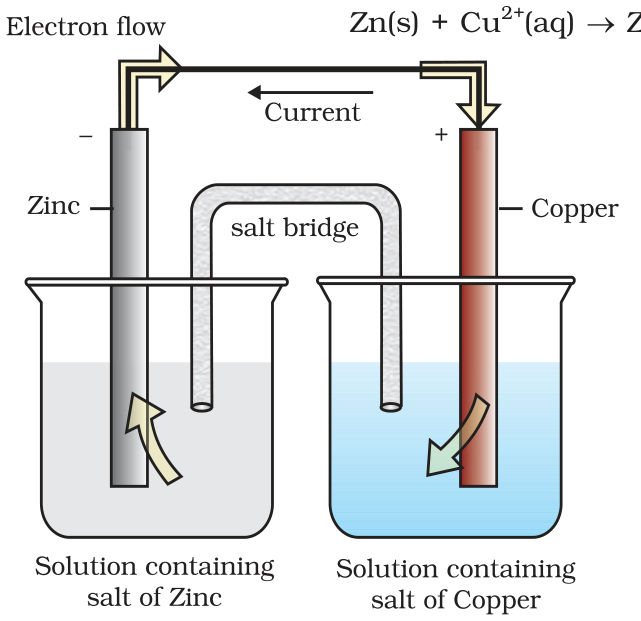
2.2 Standard electrode potentials
A single electrode has no absolute potential, so potentials are measured against the standard hydrogen electrode, whose potential is set at zero at all temperatures. The hydrogen electrode uses a platinum electrode dipped in 1 M acid over which hydrogen gas at 1 bar is passed. Connecting an unknown half cell to it gives a standard electrode potential. The values build the electrochemical series, which orders the oxidisers by strength: a species higher in the series can oxidise one below it.
For a full cell, the standard cell potential is the standard reduction potential of the cathode minus that of the anode. A positive value means the reaction as written is feasible, and the corresponding Gibbs energy change is negative.
2.3 The Nernst equation
Real cells do not run at standard conditions. The Nernst equation corrects the potential for the actual concentrations or partial pressures. It is written once for a half cell and once for the full cell. At 298 K the constant 2.303RT/F has the value 0.0591 V, so the whole temperature dependence of the entropy term is packed into that number for room temperature calculations.
The reaction quotient Q is built from the products over the reactants, each raised to its coefficient. Pure solids and pure liquids do not appear in Q, which is why the electrodes themselves never enter the logarithm.
2.4 Three worked steps
Example 1: Daniell cell at non-standard conditions. For a cell with zinc at 0.1 M and copper at 0.01 M and E°cell equal to 1.10 V, Q is [Zn2+]/[Cu2+] which is 10. E = 1.10 minus 0.0591/2 times log 10, which is 1.10 minus 0.0296, so E is about 1.07 V. The cell potential is slightly lower than the standard value because the reactant copper ions are more dilute than the product zinc ions.
Example 2: equilibrium constant from potential. If E°cell is 1.10 V for a two electron reaction, log Kc = 2 times 1.10 divided by 0.0591, which is 37.2, so Kc is about 1.6 times 10^37. Such a large constant is typical of a cell with a high positive potential.
Example 3: feasibility. Standard potentials of Zn2+/Zn and Cu2+/Cu are -0.76 V and +0.34 V. The cell Cu2+ with Zn gives E°cell = 0.34 - (-0.76) = 1.10 V, so the reaction is feasible. The reverse reaction would have E°cell = -1.10 V and is not feasible.
2.5 Common mistakes
Subtracting the potentials in the wrong order flips the sign of the answer, so write the anode first and the cathode second every time. Multiplying the cathode potential by the number of electrons is also wrong: electrode potentials are intensive properties and do not scale with the coefficients when the half reaction is doubled. Reversing the reaction reverses the sign of E°, but multiplying it does not.
2.6 Exam tip
When a question gives standard potentials and asks for feasibility, calculate E°cell and also state the sign of ΔG°. When it asks for the effect of concentration, use the Nernst equation and say which direction the reaction quotient moves the potential.
2.7 Cell notation and concentration cells
A cell diagram lists the phases in order, with a single vertical bar for an interface and a double bar for the salt bridge. A concentration cell uses the same electrode material on both sides, and its potential arises only from the difference in ion concentration between the two solutions. For two copper electrodes dipping in 0.1 M and 0.01 M copper sulphate, the Nernst equation gives E equal to 0.0591 divided by 2 times log of the ratio, which is 0.0296 V, with the dilute side acting as the anode. Potentials are measured with a high resistance voltmeter or a potentiometer so that almost no current flows, because a current would change the concentrations and polarise the electrodes. A salt bridge does two jobs: it completes the circuit and it prevents the two solutions from mixing while keeping each of them neutral.
2.8 Standard potentials are intensive
Electrode potentials do not add up with the coefficients of a reaction. Doubling a half reaction does not double its potential, because potential is energy per unit charge and the charge doubles with the amount. This is why a cell potential is computed only once from the two half reactions, after the electrons are balanced. In contrast, the Gibbs energy of the cell does scale with n, so ΔG° doubles when the whole reaction is doubled while E°cell stays the same.
2.9 Using the electrochemical series
The series orders the reduction half reactions by potential. A species on the left of a suitable pair can oxidise a species below it, so a reaction is feasible when the oxidising agent lies above the reducing agent in the series. The same table tells which metal will displace another from a salt solution, which ion will be reduced first during electrolysis and which metal makes a better sacrificial electrode. Reading the series is faster than computing a full cell whenever the question only asks which of two reactions can occur.