

Concepts: colligative properties and the van't Hoff factor
Solutions22 min readLesson 5 of 8
5.1 One origin, four properties
All four colligative properties come from the same cause: a solute lowers the vapour pressure of the solvent, and that changes the temperatures at which the solution boils and freezes and creates a pressure difference across a semipermeable membrane. The word colligative means that the size of the effect depends on the number of solute particles present and not on what those particles are. One mole of glucose has the same effect as one mole of urea, while one mole of sodium chloride gives two moles of ions and therefore roughly twice the effect.
5.2 Elevation of boiling point
A solution boils at a higher temperature than the pure solvent because its vapour pressure has to be raised to atmospheric pressure at a higher temperature. The elevation is proportional to the molality of the solute. The proportionality constant K_b, called the ebullioscopic constant or the boiling point constant, is a property of the solvent and has the unit K kg mol^-1.
5.3 Depression of freezing point
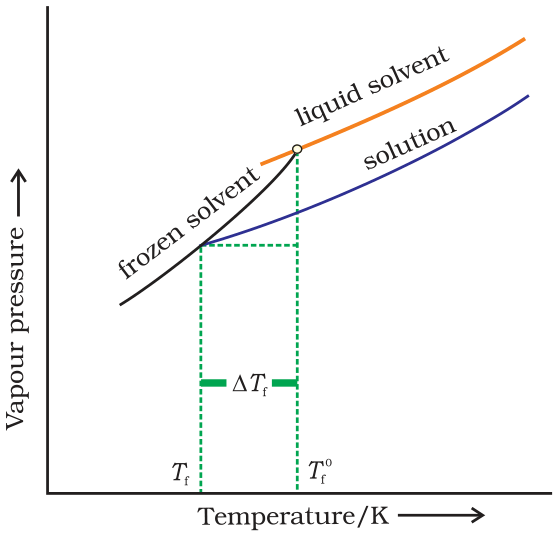
The vapour pressure curve of the solution meets the solid solvent curve at a lower temperature, so the solution freezes below the freezing point of the pure solvent. The depression is proportional to molality and the constant K_f is the cryoscopic constant, also in K kg mol^-1. Water has K_f equal to 1.86, so a one molal aqueous solution freezes near 271.28 K instead of 273.15 K. This property is used to decide the antifreeze needed in a car radiator and to melt ice on roads, because a salt solution freezes well below zero.
5.4 Osmosis and osmotic pressure
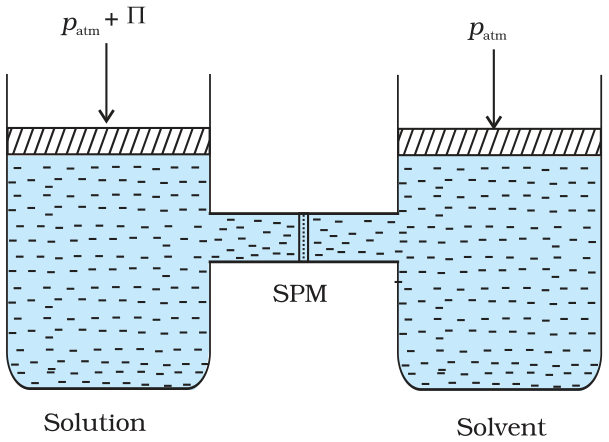
Osmosis is the movement of solvent molecules through a semipermeable membrane from the more dilute solution to the more concentrated one. The pressure that must be applied to the solution side to stop this flow is the osmotic pressure of the solution. Osmotic pressure is larger than the other colligative effects and can be measured at ordinary temperatures, so it is useful for fragile solutes such as proteins. Two solutions with the same osmotic pressure are isotonic; a cell placed in a hypertonic solution loses water and shrinks, while in a hypotonic solution it gains water. Intravenous fluids are therefore made isotonic with blood.
5.5 The van't Hoff factor
The equations above count formula units. An electrolyte breaks into ions, so the number of particles is larger than the number of formula units, and every colligative effect is larger than the calculation predicts. The van't Hoff factor i corrects for this. It is greater than one for a dissociating solute and less than one for an associating solute such as benzoic acid in benzene, where pairs of molecules join into a dimer and the particle count falls. The observed molar mass from a colligative measurement is correspondingly smaller than the true molar mass for dissociation and larger for association.
5.6 Worked example
A one molal aqueous solution of potassium ferricyanide, K3[Fe(CN)6], is 85.2 percent dissociated. One formula unit gives four ions, so n is four and i is 1 plus 3 times 0.852, which is 3.556. The boiling point elevation is therefore 3.556 times 0.52 times 1, or 1.85 K, and the solution boils at 373.15 plus 1.85, which is 375.0 K. The same i would be used with the freezing point and osmotic pressure formulas.
Slideshow, slide 1 of 4. Use the left and right arrow keys to change slides and the space bar to play or pause.
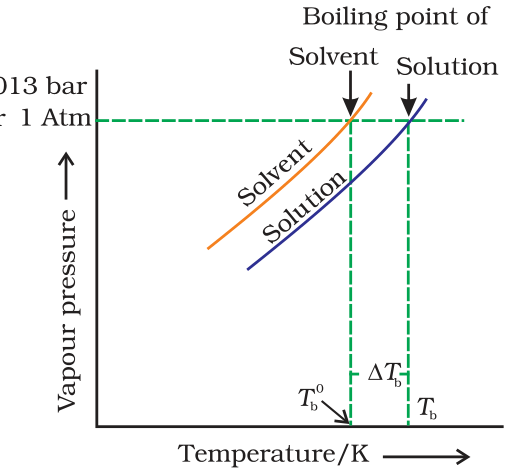
Vapour pressure against temperature for a solvent and its solution, showing the elevation of boiling point.
5.7 Where these properties are used
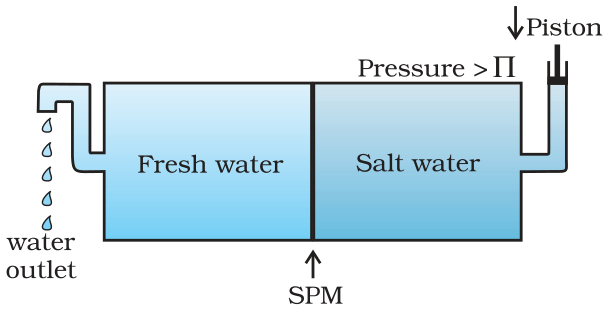
The molar masses of unknown solutes are found from the four properties, with the freezing point method preferred for small amounts of material and osmotic pressure preferred for large molecules. Ethylene glycol is added to water in radiators because a solution with a lower freezing point remains liquid in winter. Salt is spread on icy roads to melt the ice and prevent refreezing. Reverse osmosis, in which an applied pressure larger than the osmotic pressure pushes water back through the membrane, is used to desalinate seawater.
5.8 Common mistakes
Forgetting i for an electrolyte is the most frequent error. A second is using the mass of solution in place of the mass of solvent in molality. A third is assuming that a large colligative effect always means more solute; a small amount of a salt that dissociates into many ions can give a bigger effect. The van't Hoff factor answers the question for a real solution, but it is close to the theoretical value only when the degree of dissociation is near one.
Exam
If a question gives the mass of solute and asks for the molar mass, write the rearranged molality formula before substituting. If the solute is an electrolyte, write i in the formula, calculate the theoretical value from n, and say whether the measured value is expected to be higher or lower.
5.9 Choosing the right property for a measurement
The choice of colligative property depends on the solute. Elevation of boiling point and depression of freezing point need the solvent to be heated or cooled, which can damage a fragile solute, so osmotic pressure is preferred for macromolecules such as proteins because it is measured at room temperature and produces a measurable pressure even at low concentration. For small molecules with a normal melting point, a freezing point measurement gives a sharp and reproducible result. Whatever the method, the measured molar mass is a number average of the dissolved species, and it differs from the true molar mass whenever the solute dissociates, associates or contains more than one component.
For a solution of an unknown non-electrolyte, the freezing point method is usually the most precise because a small concentration gives a large and easily measured temperature change, and the solvent can be chosen to keep the freezing point in a convenient range. The same formula rearranged gives the molar mass, so a single measurement answers the question.