

Concepts: Raoult's law, ideal solutions and azeotropes
Solutions20 min readLesson 4 of 8
4.1 Vapour pressure
In a closed container a liquid evaporates until the rate of evaporation equals the rate of condensation. The pressure of the vapour at that stage is the vapour pressure of the liquid at that temperature. It depends on the temperature and on the strength of the forces holding the molecules in the liquid, so a liquid with weak intermolecular forces has a higher vapour pressure and boils at a lower temperature.
4.2 Raoult's law with one non-volatile solute
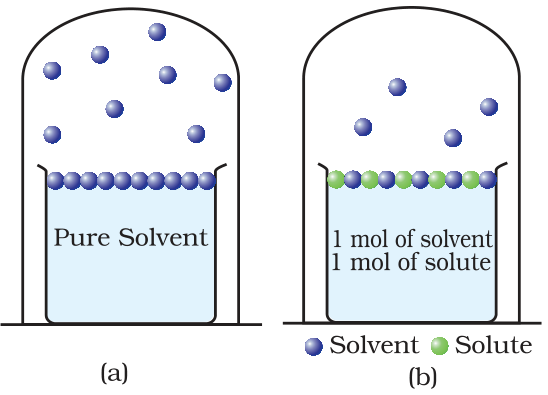
When a non-volatile solute is dissolved in a volatile solvent, the solute occupies part of the surface and some solvent molecules are replaced by solute particles. Fewer solvent molecules escape, so the vapour pressure of the solution is lower than that of the pure solvent. Raoult's law states that the partial vapour pressure of the solvent is its mole fraction in the solution multiplied by the vapour pressure of the pure solvent.
4.3 Two volatile liquids
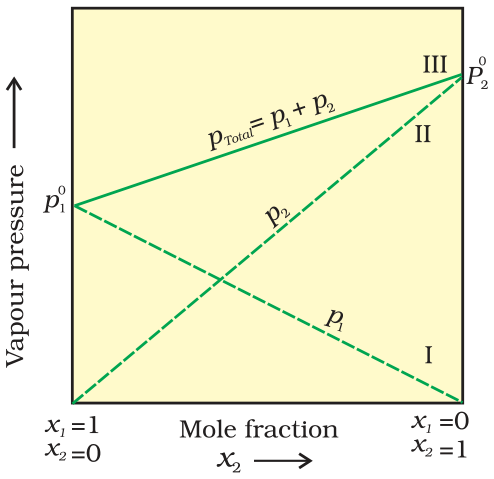
When both components are volatile, each contributes a partial pressure given by the same law, and the total pressure of the solution is the sum of the two partial pressures. The composition of the vapour is not the same as the composition of the liquid, because the more volatile component has a larger share in the vapour. The mole fraction of component 1 in the vapour is its partial pressure divided by the total pressure.
4.4 Ideal solutions
A solution that obeys Raoult's law over its entire range of composition is called an ideal solution. In an ideal solution the forces between unlike molecules are about as strong as those between like molecules, so mixing neither releases nor absorbs much heat, the volume does not change noticeably, and the enthalpy and volume of mixing are both zero. Solutions of benzene and toluene, or of n-hexane and n-heptane, come close to this description.
4.5 Deviations from Raoult's law
Most real mixtures deviate. When the forces between unlike molecules are weaker than the forces between the pure components, the molecules escape more easily and the vapour pressure is higher than Raoult's law predicts. This is a positive deviation, mixing is endothermic, heat is absorbed, and the volume of the mixture is usually larger than the sum of the volumes. When the unlike forces are stronger, the vapour pressure is lower than predicted, mixing is exothermic, and the volume contracts. A classic negative deviation comes from a mixture of chloroform and acetone, where the hydrogen atom of chloroform forms a hydrogen bond with the oxygen of acetone.
| Property | Positive deviation | Negative deviation |
|---|---|---|
| Solute-solvent forces | weaker than in the pure components | stronger than in the pure components |
| Vapour pressure | higher than Raoult's law | lower than Raoult's law |
| Enthalpy of mixing | positive, endothermic | negative, exothermic |
| Volume of mixing | expands | contracts |
| Example | ethanol and acetone | chloroform and acetone |
4.6 Azeotropes
A very large deviation produces an azeotrope, a mixture that boils at a fixed temperature and distils without changing its composition. Its vapour has the same composition as its liquid. A mixture showing positive deviation forms a minimum boiling azeotrope, which boils below both components. The familiar example is ethanol and water, which forms an azeotrope at about 95 percent ethanol that boils near 351 K. A mixture showing negative deviation forms a maximum boiling azeotrope, which boils above both components, as in the nitric acid and water system. This is why fractional distillation cannot give absolute ethanol from a water mixture.
4.7 Worked example
The vapour pressure of pure water at a given temperature is 23.80 mm Hg. One mole of a non-volatile, non-electrolyte solute is dissolved in 100 g of water. The water is 100 divided by 18, or 5.556 mol. The total amount of particles is 6.556 mol, so the mole fraction of solute is 1 divided by 6.556, or 0.1525. The vapour pressure of the solution is 23.80 multiplied by the water mole fraction 0.8475, which is 20.17 mm Hg. The relative lowering, 0.1525, should also equal the mole fraction of the solute.
4.8 Common mistakes
Using the mole fraction of solvent in the relative lowering formula is wrong; the lowering equals the mole fraction of the solute. Treating every two-liquid mixture as ideal leads to errors when hydrogen bonding or dipole forces act between unlike molecules. Azeotropic mixtures cannot be separated by ordinary distillation, so writing distillation as the method to separate ethanol and water completely costs marks.
Exam
For a deviation question, name the intermolecular force first, then the vapour pressure behaviour, then the sign of the enthalpy of mixing. The examiner wants the reason, not only the label positive or negative.
4.9 Reading the vapour pressure diagram
In the diagram of vapour pressure against composition, the two straight lines meet the pure component values at the ends. The upper line in a positive deviation curve lies above the ideal line, so the mixture releases vapour more easily than either component suggests, and the boiling point of that mixture is lower than expected. A mixture like this forms a minimum boiling azeotrope, which cannot be purified further by distillation. In a negative deviation curve the line lies below the ideal one and the mixture forms a maximum boiling azeotrope. Reading the position of the curve is therefore enough to predict the type of azeotrope before any numerical calculation.
Partial pressure is the pressure that one component would exert alone in the same volume. The total vapour pressure of a mixture is the sum of the partial pressures, and the mole fraction in the vapour is the partial pressure divided by that total. This vapour composition is what makes fractional distillation work for an ideal mixture and what makes an azeotrope resistant to it.