

Concepts: solubility, Henry's law and gases in liquids
Solutions18 min readLesson 3 of 8
3.1 Solubility of a solid in a liquid
At a fixed temperature, every solute has a ceiling on how much of it a given quantity of solvent can take up. That ceiling is its solubility. It depends on the nature of the solute and the solvent, because particles have to be pulled apart and solvated, and it depends on temperature. Pressure has almost no effect on the solubility of a solid, since a solid and a liquid are both nearly incompressible.
For solids, the direction of the temperature effect follows the energy balance. When the solute absorbs heat while dissolving, the dissolution is endothermic and a higher temperature shifts the dissolution equilibrium forward, so solubility rises. When the process releases heat, the opposite happens and solubility falls as the solution gets warmer. This is the same Le Chatelier reasoning that will be used for equilibria later in the course.
3.2 Solubility of a gas in a liquid
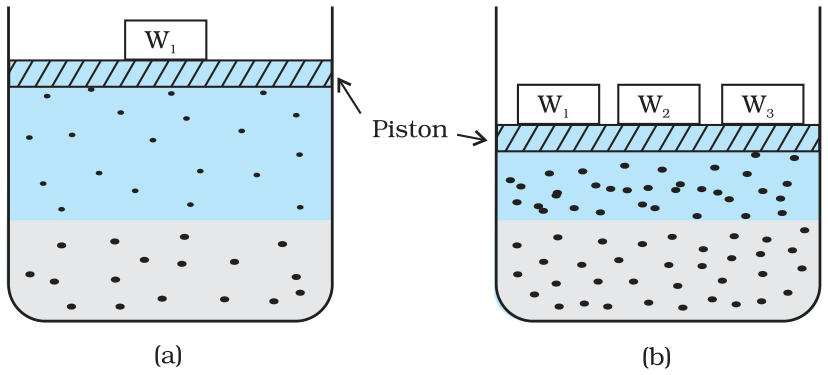
A gas dissolves until the rate at which gas molecules enter the liquid equals the rate at which they leave. Increasing the pressure above the solution pushes more molecules into the liquid per second and the equilibrium shifts to the dissolved state, so the solubility of a gas rises with pressure.
3.3 Henry's law
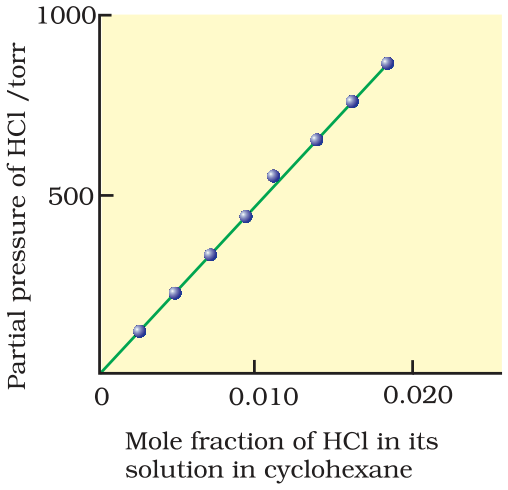
Henry's law turns that pressure dependence into an equation. Keep the temperature constant and raise the gas pressure above the liquid; the mole fraction of gas inside the liquid climbs with it. The constant that links the two is written K_H and carries units of pressure. If the gas is written as solute B, then p_B equals K_H multiplied by x_B.
3.4 Reading the Henry constant
The value of K_H belongs to a particular gas and a particular solvent at a stated temperature. A larger K_H means that a given partial pressure produces a smaller mole fraction, so the gas is less soluble. The values in the table are in kilobar at 298 K.
| Gas | K_H / kbar at 298 K |
|---|---|
| N2 | 76.48 |
| O2 | 34.86 |
| CO2 | 1.67 |
| Ar | 40.3 |
The small constant of carbon dioxide explains why soda water can hold so much carbon dioxide at moderate pressure. The large constant of nitrogen means that nitrogen is only slightly soluble under ordinary air, and its solubility falls further when the water is warm.
3.5 Temperature and gas solubility
Dissolving a gas in a liquid releases heat, because the molecules lose kinetic energy as they become surrounded by solvent. Warming the solution therefore drives the gas out, so the solubility of a gas falls with a rise in temperature. At the same time the Henry constant rises. In a river this matters: warm water holds less dissolved oxygen, which is why discharging hot water into a river is harmful to fish.
3.6 Where Henry's law is used
Scuba divers breathe air diluted with helium. At depth, the diver's lungs are under high pressure and a large amount of nitrogen would dissolve in the blood. Nitrogen is not very soluble, but it is soluble enough, and on a rapid ascent the dissolved gas forms bubbles, which causes decompression sickness. Helium has a much larger Henry constant than nitrogen, 144.97 kbar against 76.48 kbar, so helium is far less soluble; replacing part of the nitrogen with helium therefore keeps the amount of dissolved gas low. Bottling soft drinks works in the opposite direction: the bottle is closed under a high pressure of carbon dioxide, so a large mole fraction dissolves, and the drink fizzes when the pressure is released. Oxygen cylinders for high-altitude climbing and for patients follow the same law.
Exam
In a Henry's law numerical, use the partial pressure of the gas and not the total pressure of the gas mixture. If the gas is one component of air, multiply the total pressure by its mole fraction first, and keep K_H and p in the same pressure unit.
3.7 What decides whether a gas will dissolve
A gas dissolves only if its molecules are attracted to the solvent strongly enough to make the dissolved state more stable than the gas phase at that pressure. The nature of the gas and of the solvent both matter: gases such as ammonia and hydrogen chloride are extremely soluble in water because they react with it or form hydrogen bonds, while gases such as nitrogen and helium are sparingly soluble because they interact only weakly with water. Pressure decides how much of a slightly soluble gas is present, and temperature decides whether a given amount stays dissolved. That is why a sealed bottle holds carbon dioxide under pressure and why the same drink loses fizz quickly once it is warm and open.
3.8 Reading the Henry constant table
The table of Henry constants is a ranking of solubility, not a ranking of chemical reactivity. Carbon dioxide has the smallest constant in the table, so a small pressure gives a large mole fraction in the liquid, while helium has the largest and needs a very high pressure to dissolve appreciably. The unit of K_H is the unit of pressure, so a constant quoted in kbar must be used with a pressure in kbar or converted first. A useful check is that a larger K_H at fixed pressure always gives a smaller mole fraction, which is the same statement as a lower solubility.
3.9 Solubility and everyday pressure changes
The same law explains why a diver must ascend slowly and why a sealed aerated bottle hisses when opened. When the external pressure drops quickly, the gas that was dissolved at the higher pressure comes out of solution faster than it can escape through the liquid, and bubbles form. In the body these bubbles block small blood vessels; in a bottle they escape as foam. The amount dissolved is set by the partial pressure and by the Henry constant at the temperature of the liquid, so both the pressure change and the temperature change matter.