

Concepts: integrated rate equations and half-life
Chemical Kinetics20 min readLesson 3 of 7
3.1 Zero order reactions
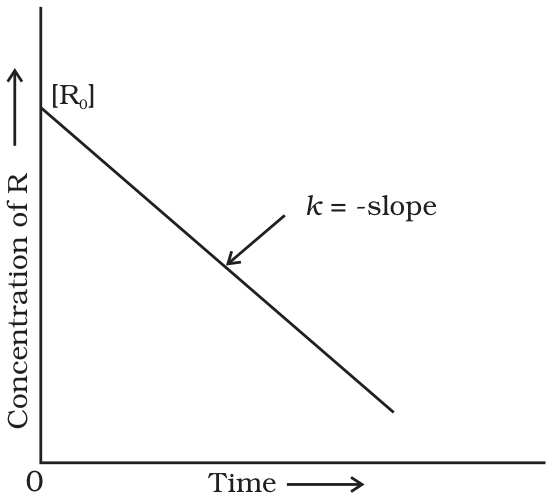
In a zero order reaction the rate does not depend on the concentration of the reactant, which happens when a surface or a catalyst is saturated. The rate equals the rate constant, so the concentration falls linearly with time. The half-life is proportional to the initial concentration and inversely proportional to the rate constant, so a zero order reaction takes twice as long to fall from 1 M to 0.5 M as it does from 0.5 M to zero. A common example is the decomposition of ammonia on a hot platinum surface.
3.2 First order reactions
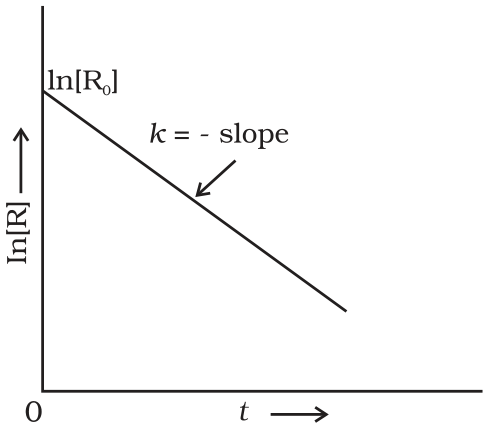
In a first order reaction the rate is proportional to the concentration of one reactant. The integrated form gives the rate constant from the initial concentration, the concentration at time t and the time. A plot of the natural logarithm of concentration against time is a straight line with slope minus k. The half-life is independent of the starting concentration, which is the signature of first order behaviour, and it is the basis of radioactive dating. Successive half-lives leave one half, one quarter, one eighth and so on, and after n half-lives the fraction left is one over two to the power n.
3.3 Second order reactions
For a second order reaction the rate depends on the square of one concentration or on the product of two. The integrated form gives a straight line when the reciprocal of concentration is plotted against time. If two reactants are involved and both are first order, the overall order is two but the integrated form is different unless the initial concentrations are equal. Second order half-life is inversely proportional to the initial concentration.
3.4 Deciding the order from data
Three routes work in an exam. First, use the units of the rate constant: s^-1 means first order, mol L^-1 s^-1 means zero order and L mol^-1 s^-1 means second order. Second, test linearity: plot concentration against time for zero order, log concentration against time for first order and reciprocal concentration against time for second order, and see which plot is straight. Third, use the method of initial rates: change one concentration at a time and compare how the rate changes. The ratio of the two rates gives the order in that reactant directly.
3.5 Worked examples
Example 1: first order half-life. Take a first order reaction whose rate constant is 1.2 times 10^-2 s^-1. Its half-life is 0.693 divided by this value, which is 57.8 s. Three half-lives later the amount left is one eighth of the start.
Example 2: radioactive dating. Carbon-14 has a half-life of 5730 years. A wooden artifact has 80 percent of the carbon-14 of a living tree. The fraction left gives k equal to 0.693 divided by 5730, which is 1.21 times 10^-4 per year, and t equals 2.303 divided by k times log of 100 over 80. The logarithm is 0.0969, so t is about 1843 years.
Example 3: zero order rate constant. A substance falls from 1.5 M to 0.75 M in 120 s. The change is 0.75 M, so k is 0.75 divided by 120, which is 6.25 times 10^-3 mol L^-1 s^-1. For a zero order reaction the half-life is the initial concentration divided by twice the rate constant.
3.6 Where the first order equation comes from
Starting from the differential form, rate equals minus the change of concentration with time and also equals k times concentration, separation of the variables puts all the concentration terms on one side and all the time terms on the other. Integrating from the start to time t gives the logarithm of the ratio of the initial concentration to the concentration at time t, equal to kt. The constant 2.303 converts between natural and common logarithms, and this is why the equation is often written with 2.303 divided by t. The derivation also shows why the equation contains a ratio: the unit of concentration cancels, so masses or volumes can be used in place of concentrations.
3.7 A summary of the three orders
For zero order, the concentration against time plot is straight, the slope is minus k and the half-life grows with starting concentration. For first order, the log concentration against time plot is straight, the slope is minus k and the half-life is fixed. For second order, the reciprocal concentration against time plot is straight, the slope is k and the half-life falls as the starting concentration rises. A question that gives three graphs and asks which order fits can be answered by checking which integrated form is linear, without any calculation.
3.8 Fractional conversion and time
Many exam questions speak of the fraction decomposed rather than the concentration. If 25 percent has decomposed, 75 percent remains and the ratio of initial to remaining amount is 4/3. For a first order reaction the time to reach a fixed fraction is the same at any starting level, while for other orders it depends on the starting concentration. Converting percentages into ratios first, and only then applying the integrated equation, avoids the common error of taking the decomposed fraction as the remaining fraction.
The same integrated equations describe the decay of a radioactive sample and the decomposition of a drug in solution, which is why first order kinetics appears in nuclear dating and in shelf life calculations. In both cases a constant fraction is lost in each equal time interval, and the half-life is the natural measure of how fast the sample changes.