

Concepts: rate of reaction, rate law and order
Chemical Kinetics18 min readLesson 2 of 7
2.1 What kinetics measures
Thermodynamics tells whether a reaction can happen, and kinetics tells how fast it does. Two reactions can have the same large equilibrium constant and wildly different rates. Kinetics measures the change of concentration with time, works out the rate law from experimental data, and then proposes a mechanism whose slowest step controls the overall rate.
For the general reaction in which reactants become products, the rate of disappearance of a reactant is defined with a minus sign so that it stays positive, and the rate of appearance of a product is positive. When stoichiometric coefficients differ, the rates of change of different species are divided by their coefficients so that each gives the same reaction rate.
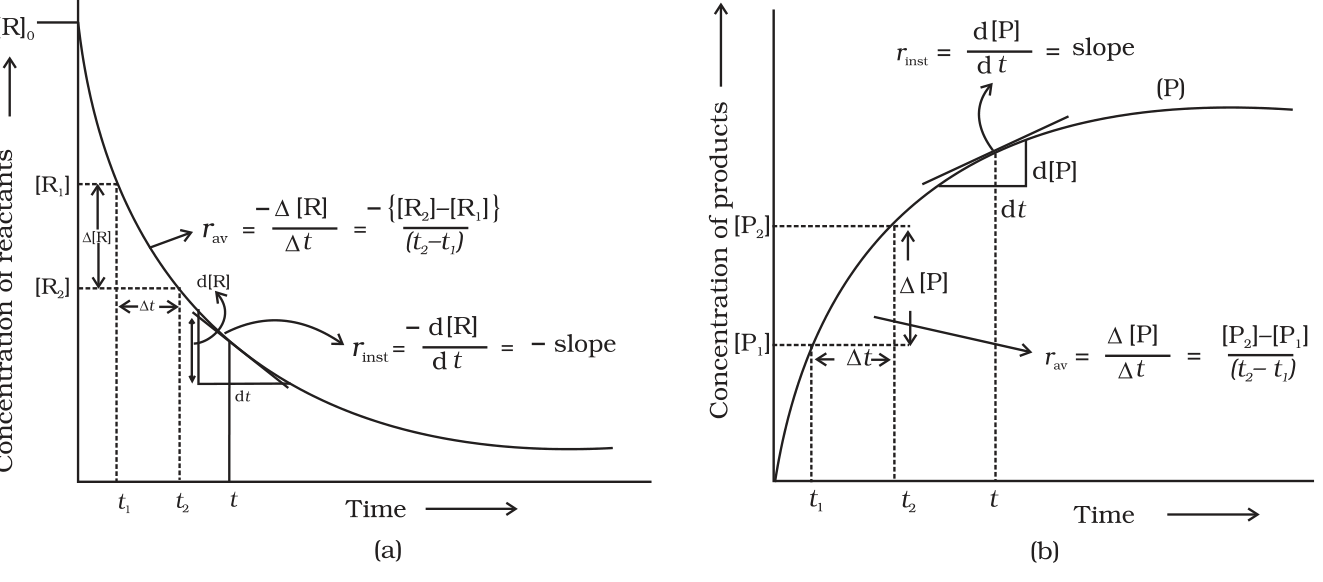
2.2 Average and instantaneous rate
The average rate over an interval is the change in concentration divided by the time, and it is the slope of a chord on the concentration time graph. The instantaneous rate at one moment is the slope of the tangent at that point. Because reactant concentration falls quickly at first and then more slowly, the instantaneous rate decreases as the reaction proceeds and the tangent becomes less steep. Rate cannot be measured at time zero by a chord that starts at zero, so the initial rate is found from the tangent near the start.
2.3 Rate law and the rate constant
The rate law is an equation of the form rate equals k times the concentrations raised to powers. The constant k is called the rate constant and its value is fixed for a given reaction at a given temperature. The powers are the orders and are determined by experiment. For an elementary step the powers do equal the coefficients of that step, but for a multi-step reaction the overall rate law follows from the mechanism and usually differs from the balanced equation.
2.4 Order and molecularity
Order is an experimental property of the whole reaction. It can be zero, a fraction or even negative. Molecularity is a property of an elementary step, it is always a small whole number, and it counts the reacting species that come together in that step. A reaction can be first order but bimolecular when one reactant is present in large excess, as in the acid catalysed hydrolysis of an ester, where the concentration of water hardly changes and the reaction is called pseudo first order.
2.5 Factors that change the rate
Concentration increases the frequency of collisions, so the rate usually rises with concentration unless the reaction is zero order. Temperature increases the number of molecules with energy above the activation barrier, so the rate constant rises. A catalyst provides a new pathway of lower activation energy and increases both the forward and backward rates without changing the equilibrium constant. The surface area of a solid catalyst or reactant speeds up heterogeneous reactions, and light can start photochemical reactions.
2.6 An example with data
Suppose doubling the concentration of NO while keeping bromine constant multiplies the rate by four, and tripling bromine while keeping NO constant multiplies the rate by three. The order in NO is two because four equals two squared, and the order in bromine is one. The rate law is rate equals k times the square of the NO concentration times the bromine concentration, with an overall order of three. The rate constant follows by substituting one set of measured values, and its units are L^2 mol^-2 s^-1. With the rate constant known, the rate at any other pair of concentrations follows directly.
2.7 Methods of following a reaction
A rate can be followed by a physical property that changes in step with concentration, such as pressure for a gas reaction, conductivity for an ionic reaction, absorption of light for a coloured species or optical rotation for a chiral one. A chemical method withdraws small samples at fixed times, stops the reaction by cooling or dilution and then titrates the sample. Physical methods are faster and do not disturb the mixture, so they are preferred when the reaction is fast. Whichever method is used, the measurement gives concentration against time, and the rate is extracted from the slope of that curve.
2.8 Comparing rates across a reaction
The rates of change of different species are not numerically equal when the stoichiometric coefficients differ. For a reaction in which two moles of A give one mole of B, the rate of disappearance of A is twice the rate of appearance of B. Dividing each rate by its coefficient makes them equal and gives a single reaction rate that can be quoted without ambiguity. This single rate is what appears in the rate law and what is compared with the rate constant, so the coefficients must be settled before any data are substituted.
2.9 Pseudo first order and excess reagents
When one reactant is present in large excess, its concentration hardly changes during the reaction and can be folded into the rate constant. The observed rate law then looks first order even though two species take part in the slow step. Hydrolysis of an ester in water and the inversion of cane sugar in acid solution are standard examples. The trick is to state clearly which reactant is in excess and why its concentration is treated as constant; without that statement the answer looks like a mistake.
The rate of a reaction also depends on the physical state of the reactants. A powdered solid reacts faster than a single lump because the surface area exposed to the other reactant is larger, and a gas reaction in a small volume is faster because the molecules collide more often. These effects do not change the order; they change the rate constant and the collision frequency.