

Concepts: temperature dependence, collision theory and catalysis
Chemical Kinetics20 min readLesson 4 of 7
4.1 Why heating speeds up a reaction
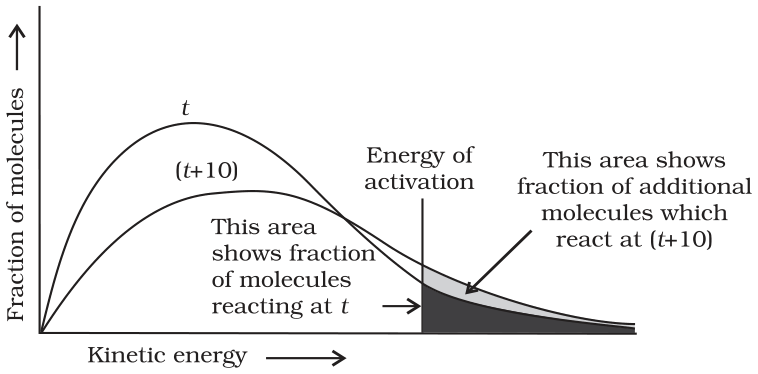
A reaction happens when molecules collide with enough energy and with the right orientation. Most collisions are ineffective because the molecules do not have enough energy to cross the barrier that leads from reactants to products. That barrier is the activation energy, the minimum extra energy a collision must supply. Raising the temperature increases both the average kinetic energy and the fraction of molecules above the barrier, and because the fraction depends exponentially on temperature, the rate constant rises steeply.
The Arrhenius equation expresses this dependence with a pre-exponential factor A that counts the frequency and orientation of collisions and an exponential term for the fraction with enough energy. Taking logarithms gives a straight line whose slope is minus the activation energy divided by 2.303R.
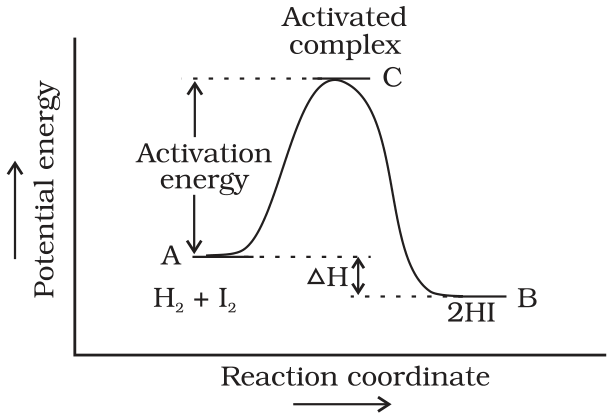
4.2 Reading the energy profile
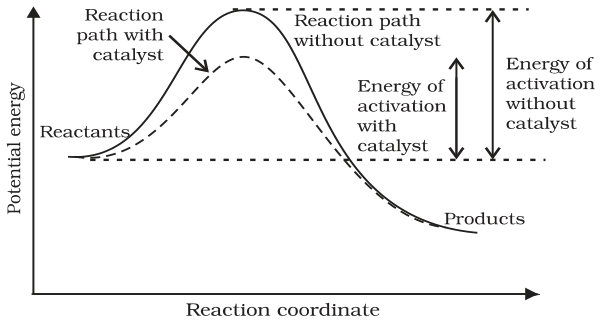
In a potential energy diagram the reactants sit at one level, the products at another, and the top of the barrier is the activated complex. The forward activation energy is measured from the reactants to the top, and the backward activation energy from the products to the top. Their difference is the enthalpy change of the reaction. For an endothermic reaction the products lie above the reactants, so the forward barrier is larger than the backward one. Adding a catalyst lowers the top of the barrier for both directions by the same amount, so it speeds both the forward and the reverse reactions and leaves the enthalpy change and the equilibrium constant unchanged.
4.3 Collision theory and the distribution
Collision theory treats a reaction as a successful collision. The rate is proportional to the collision frequency, to the fraction of collisions with energy above the activation energy and to a steric factor for orientation. The fraction with enough energy is read from the Maxwell-Boltzmann distribution: the curve peaks at the most probable kinetic energy and falls away slowly on the high energy side. Warming the gas moves the peak to the right and broadens the tail, so the area under the curve beyond the activation energy grows quickly. This is why a modest temperature rise can multiply the rate.
Slideshow, slide 1 of 3. Use the left and right arrow keys to change slides and the space bar to play or pause.
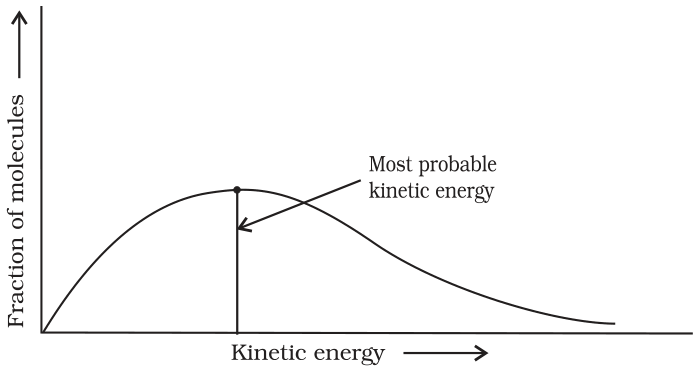
Maxwell-Boltzmann distribution of molecular kinetic energies, with the most probable kinetic energy marked.
4.4 Catalysis
A catalyst increases the rate by providing an alternative pathway with lower activation energy. It is not used up, and a small amount can convert a large amount of reactant. In homogeneous catalysis the catalyst and reactants are in the same phase, as when hydrogen ions catalyse the hydrolysis of an ester. In heterogeneous catalysis the catalyst is a solid and the reactants are gases or liquids; the reactants are adsorbed on the surface, where bonds are weakened and the reaction occurs. Iron in the Haber process, vanadium pentoxide in the contact process and nickel in hydrogenation are standard examples. Enzymes are biological catalysts that are highly specific to one substrate and work at mild temperatures and pH.
A promoter raises the activity of a catalyst, while a poison lowers it by occupying active sites. The equilibrium constant stays the same with or without a catalyst; what changes is how quickly equilibrium arrives, so a catalyst choice affects the time and energy cost of a process but not its final yield.
4.5 Finding activation energy from data
The Arrhenius plot gives the activation energy from experimental rate constants at several temperatures. Plot log k on the vertical axis against 1/T on the horizontal axis; the points should lie on a straight line. The slope is minus Ea divided by 2.303R, so Ea is minus the slope times 2.303R. The intercept is log A, and from the intercept the pre-exponential factor follows. With just two temperatures the same result comes from the two point form. An activation energy of a few tens of kilojoules per mole is typical of many reactions, while reactions with very high values are slow even at elevated temperature.
4.6 Catalysts in practice
Industrial chemistry depends on catalysts: iron with promoters in ammonia synthesis, vanadium pentoxide in the oxidation of sulphur dioxide, nickel in the hydrogenation of oils, and zeolites in cracking. In each case the catalyst lowers the activation energy, so the plant can run at a lower temperature and with less energy input. Heterogeneous catalysts work through adsorption, so their activity depends on surface area and on poisons in the feed. Enzymes are extremely selective catalysts, and a change of pH or temperature can unfold them and destroy their activity. A catalyst is never shown as a reactant or product in the overall equation because it is regenerated at the end of the cycle.
4.7 Catalysts and equilibrium
A catalyst cannot shift the position of equilibrium because it lowers the activation energy of the forward and backward reactions equally. What it changes is the time taken to reach equilibrium and the temperature at which a useful rate is obtained. This is why a catalyst is not shown in the overall equation and why adding more of it does not increase the final yield. In an exam answer, state both points: the rate increases and the equilibrium constant stays the same.
The activation energy is measured in the laboratory by finding the rate constant at several temperatures and plotting log k against the reciprocal of temperature. A straight line confirms the Arrhenius behaviour, its slope gives the activation energy and its intercept gives the pre-exponential factor. A curved plot means the mechanism changes with temperature or the reaction is diffusion controlled.