

Concepts: classification, naming and physical properties
Haloalkanes and Haloarenes22 min readLesson 2 of 8
2.1 What a haloalkane and a haloarene are
Replacing one or more hydrogen atoms of a hydrocarbon with halogen atoms gives two families. A haloalkane has the halogen on an sp3 carbon of an alkyl group. A haloarene has the halogen on an sp2 carbon of an aromatic ring. The hybridisation matters later, because the sp2 carbon holds its electrons more tightly and that makes the aryl halogen bond harder to break.
Compounds with one halogen are monohalogen derivatives. With two, three or more they become dihalo and polyhalo derivatives. The mono derivatives are then sorted by the carbon that carries the halogen:
- Alkyl halides: halogen on an sp3 carbon of a saturated chain, formula CnH2n+1X.
- Allylic halides: halogen on an sp3 carbon next to a carbon carbon double bond.
- Benzylic halides: halogen on an sp3 carbon attached to an aromatic ring.
- Vinylic halides: halogen on an sp2 carbon of a double bond.
- Aryl halides: halogen attached directly to an aromatic ring.
Alkyl halides are also labelled primary, secondary or tertiary by the number of carbon atoms joined to the halogen-bearing carbon. A primary halide has one such neighbour, a secondary halide has two, and a tertiary halide has three.
2.2 Naming
Common names put the alkyl group first and the halide second: ethyl bromide, tert-butyl chloride, allyl bromide. IUPAC names treat the halogen as a substituent on the parent hydrocarbon and number the chain to give the substituent the lowest possible locant: 1-bromobutane, 2-chloropropane, 1-bromo-2,2-dimethylpropane.
Two special cases appear in the textbook table. Monohalogen derivatives of benzene have the same common and IUPAC names, for example chlorobenzene. Dihalobenzenes use o-, m- and p- in common names but 1,2, 1,3 and 1,4 in IUPAC names. Other traps to watch: vinyl chloride is chloroethene, allyl bromide is 3-bromopropene, chloroform is trichloromethane, and benzyl chloride is chlorophenylmethane.
When two halogens sit on the same carbon the compound is a gem-dihalide; when they sit on neighbouring carbons it is a vic-dihalide. In IUPAC naming both become dihaloalkanes, and the numbering decides the rest.
2.3 The carbon halogen bond
The table at the top of the chapter is worth memorising because exam questions ask for the trend, not the number. Shorter bonds are stronger. Fluorine gives the shortest and strongest carbon halogen bond, and iodine gives the longest and weakest. A weak bond is an advantage during substitution because the leaving group can depart easily, and a disadvantage during elimination for the same reason.
The polarity of the bond comes from the electronegativity difference. Carbon carries a partial positive charge and the halogen a partial negative charge, so the carbon is electrophilic. This single fact explains the whole reaction chemistry of haloalkanes: nucleophiles attack the carbon, bases pull the neighbouring hydrogen, and metals insert into the bond.
2.4 Physical properties
Haloalkanes are polar, and they have a higher molecular mass than the parent hydrocarbon, so dipole dipole forces and van der Waals forces are both stronger. The result is a boiling point well above that of the alkane with the same number of carbons. Within the halides, boiling point rises with the size and mass of the halogen: iodide highest, fluoride lowest.
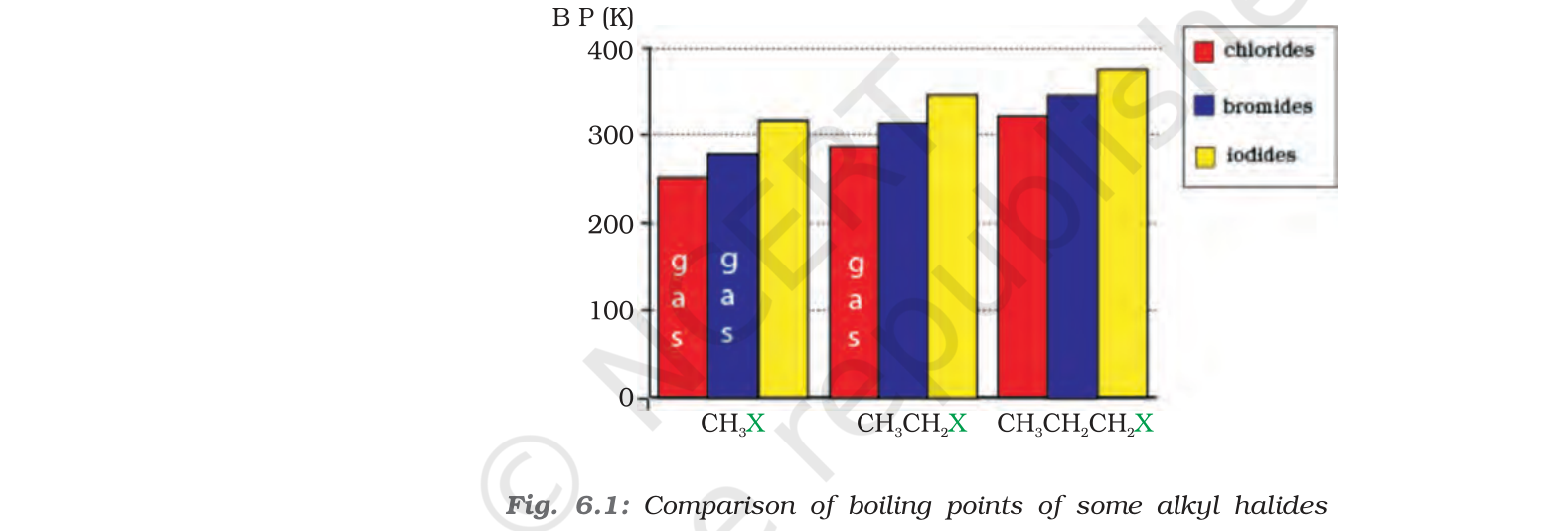
Branching lowers the boiling point because the molecule becomes more compact and the surface available for van der Waals contact shrinks. Among the isomeric bromobutanes, 1-bromobutane boils highest and 2-bromo-2-methylpropane boils lowest. Isomers of dihalobenzene boil at almost the same temperature, yet the para isomer melts much higher because its symmetry lets it pack into the crystal lattice more neatly.
Solubility follows the usual rule about like dissolving like. Haloalkanes dissolve readily in organic solvents because the new attractions are about as strong as the ones they replace. Water is a different story: dissolving a haloalkane means breaking hydrogen bonds between water molecules, and the weak attractions that form in their place release too little energy to pay for that. So haloalkanes stay almost insoluble in water.
Density rises with the number of carbon atoms, the number of halogen atoms and the mass of the halogen. Bromo, iodo and polychloro compounds are heavier than water, while the light monochloro compounds float on it. Liquid halides are colourless when pure, though bromides and iodides slowly pick up colour in light, and many of them have a sweet smell.
- Can I place a halogen compound in the right class from its structure alone?
- Can I convert a common name such as tert-butyl bromide into the IUPAC name?
- Do I know why the carbon halogen bond is polar and which end a nucleophile attacks?
- Can I explain the boiling point order using intermolecular forces?
Two practical habits help with this page. First, when you are given a structure and asked for its class, find the halogen before anything else and look at the carbon that carries it; the number of carbon neighbours decides primary, secondary or tertiary, and the hybridisation decides alkyl, allylic, benzylic, vinylic or aryl. Second, when the question asks about physical properties, name the force that changes rather than quoting a trend. For the dihalobenzenes the boiling points sit within a few degrees of each other, so a question that looks like a boiling point question usually turns on melting point, symmetry and crystal packing.