

Stereochemistry, elimination and organometallic reagents
Haloalkanes and Haloarenes22 min readLesson 4 of 8
4.1 Why stereochemistry appears here
A substitution at a chiral carbon can change the three dimensional arrangement of the molecule while leaving its connectivity alone. To describe that change, the chapter revises four ideas: optical activity, chirality, enantiomers and racemic mixtures. A compound is optically active when a solution of it rotates the plane of plane polarised light, measured in a polarimeter. Clockwise rotation gives the dextrorotatory form, written with a plus sign, and anticlockwise rotation gives the laevorotatory form, written with a minus sign.
A carbon atom with four different groups attached is a stereocentre. Its mirror image cannot be placed on top of the original, just as a left hand does not fit a right hand when both are held flat. Molecules with this property are chiral, and a pair of non-superimposable mirror images are enantiomers. Enantiomers agree on almost every physical property, melting point, boiling point and refractive index included, and differ only in the direction and size of optical rotation. An equal mixture of the two is optically inactive, because one rotation cancels the other, and that mixture is called racemic. The prefix dl or the symbol plus minus marks it.
Slideshow, slide 1 of 4. Use the left and right arrow keys to change slides and the space bar to play or pause.
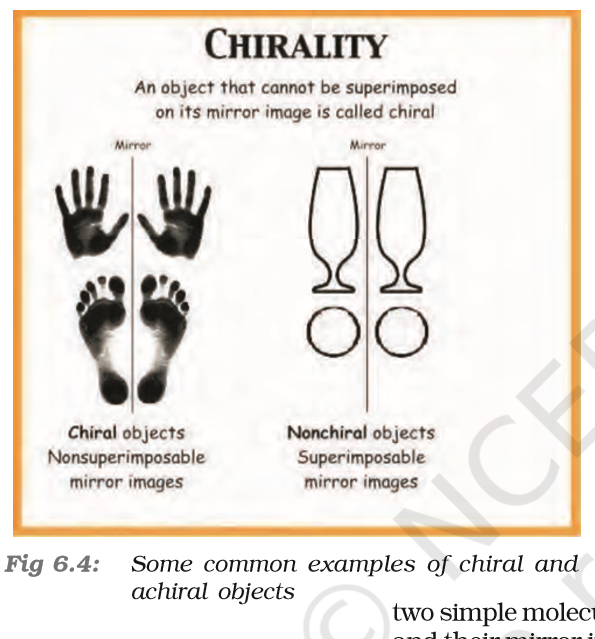
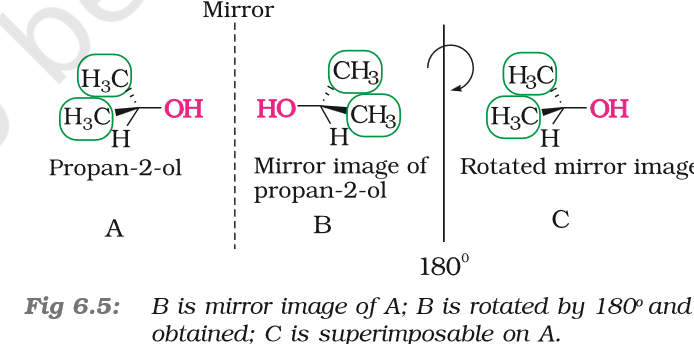
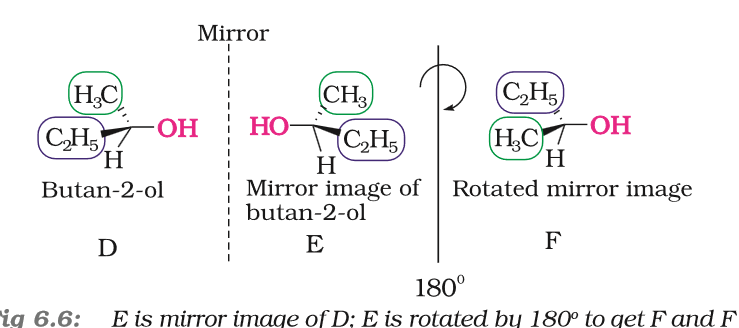
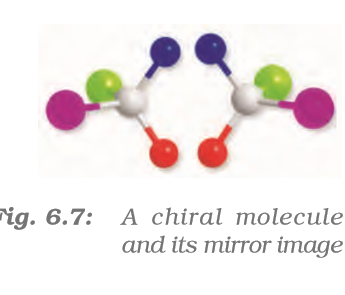
Photographs of hands, feet and wine glasses placed beside their mirror images to show chiral and achiral objects.
4.2 Three outcomes at a chiral centre
When a bond to a stereocentre breaks, the product can come out in one of three ways. If the groups keep their arrangement and only the group attached to the centre is swapped in the same place, the reaction has gone with retention of configuration. If the arrangement turns inside out, it has gone with inversion. If both forms appear in equal amounts, the reaction has racemised and the product is optically inactive.
The mechanism decides which outcome appears, and this is where the mechanism pays off. SN2 puts the nucleophile on the face opposite the halogen, so a single chiral product is formed with inverted configuration. The textbook example is the reaction of one enantiomer of 2-bromooctane with sodium hydroxide, which gives the enantiomer of octan-2-ol with the OH on the opposite side to the old bromine. SN1 goes through a flat, sp2 hybridised carbocation. That flat cation can be attacked from either face with equal chance, so the product is a roughly equal pair and the reaction racemises. Hydrolysis of optically active 2-bromobutane therefore gives the racemic alcohol.
4.3 Elimination and the Zaitsev rule
Heating a haloalkane with alcoholic KOH removes a hydrogen from the beta carbon and the halogen from the alpha carbon, and a double bond forms between those two carbons. The carbon holding the halogen is the alpha carbon and its neighbour is the beta carbon. If several beta hydrogens are available, more than one alkene can form. Zaitsev's rule, published in 1875, says the major product is the alkene carrying the larger number of alkyl groups on the double bond, because the more substituted alkene is more stable. Dehydrohalogenation of 2-bromopentane therefore gives pent-2-ene as the major alkene rather than pent-1-ene.
4.4 Reactions with metals
Most chlorides, bromides and iodides react with metals to form compounds with a carbon metal bond. The most important example is the Grignard reagent, RMgX, discovered by Victor Grignard in 1900 and worth a Nobel Prize in 1912. It forms when a haloalkane reacts with magnesium in dry ether. The carbon magnesium bond is covalent but strongly polar, with carbon drawing electrons away from the electropositive metal, and the magnesium halogen bond is ionic.
This makes the Grignard reagent both a strong base and a strong nucleophile. It reacts with any proton source, including water, alcohols and amines, and turns back into the corresponding hydrocarbon. That is why the preparation runs in dry ether and why every glassware must be dry. The same sensitivity makes it useful: a Grignard reagent can be used to build a hydrocarbon by quenching it with water, and it can be used to form carbon carbon bonds with aldehydes, ketones and other electrophiles in later chapters.
Sodium in dry ether joins two alkyl halide molecules and doubles the carbon count, which is the Wurtz reaction. Two aryl halide molecules join the same way in the Fittig reaction, and an alkyl halide with an aryl halide gives an alkylbenzene in the Wurtz-Fittig reaction.
Exam
For a stereochemistry question, draw the reactant, mark the chiral carbon, then say whether the mechanism inverts, retains or racemises. Retention and enantiomer are different claims: retention keeps the arrangement, racemisation destroys the optical activity.
A reliable routine for a stereochemistry question is to mark the stereocentre, draw the three dimensional arrangement, and then state the mechanism before the outcome. For SN2 the nucleophile must arrive from the face opposite the halide, so a single inverted product forms. For SN1 the flat cation can be attacked from either face, so a racemic pair forms and the optical activity is lost. Retention is the third outcome, and it belongs to reactions where the bond to the stereocentre is never broken. Exams often ask for the outcome with a reason, so write the mechanism name and the geometry of the intermediate in the same sentence.