

Mechanisms: SN1 and SN2 substitution step by step
Haloalkanes and Haloarenes24 min readLesson 3 of 8
3.1 Which reactions haloalkanes give
Three families of reaction matter here. A nucleophile can replace the halogen, a base can remove the halogen together with a hydrogen from the neighbouring carbon to leave an alkene, and a metal can insert into the carbon halogen bond to give an organometallic compound. The first family is the largest and the exam favourite.
3.2 Why a nucleophile attacks the carbon
In a haloalkane the carbon atom joined to the halogen carries a partial positive charge, because the halogen pulls the bonded electrons towards itself. A nucleophile is electron rich, so it heads for that electron-poor carbon. The halogen leaves as a halide ion, which is why it is called the leaving group. The product is a new carbon nucleophile bond and the halogen is gone. Reagents that do this include hydroxide, water, alkoxide, iodide, ammonia, amines, cyanide, nitrite and carboxylate ions.
Some nucleophiles have two atoms that can donate an electron pair. Cyanide can link through carbon to give an alkyl cyanide or through nitrogen to give an isocyanide, and the nitrite ion can link through oxygen to give an alkyl nitrite or through nitrogen to give a nitroalkane. These are the ambident nucleophiles. Which atom wins depends on the reagent: KCN is ionic and gives cyanide ions, so carbon attacks and the cyanide is the main product, while AgCN is largely covalent and nitrogen attacks, so the isocyanide dominates.
3.3 SN2: one step and inversion
The SN2 path is a single step. The nucleophile approaches the carbon from the side opposite the halogen, the carbon halogen bond lengthens as the new bond starts to form, and a transition state appears in which carbon is partly bonded to five atoms. In that transition state the three remaining groups on the carbon lie in one plane. The nucleophile then finishes the bond while the halide leaves. Because the attack comes from behind, the arrangement around the carbon turns inside out, exactly like an umbrella flipping in wind. This is inversion of configuration.
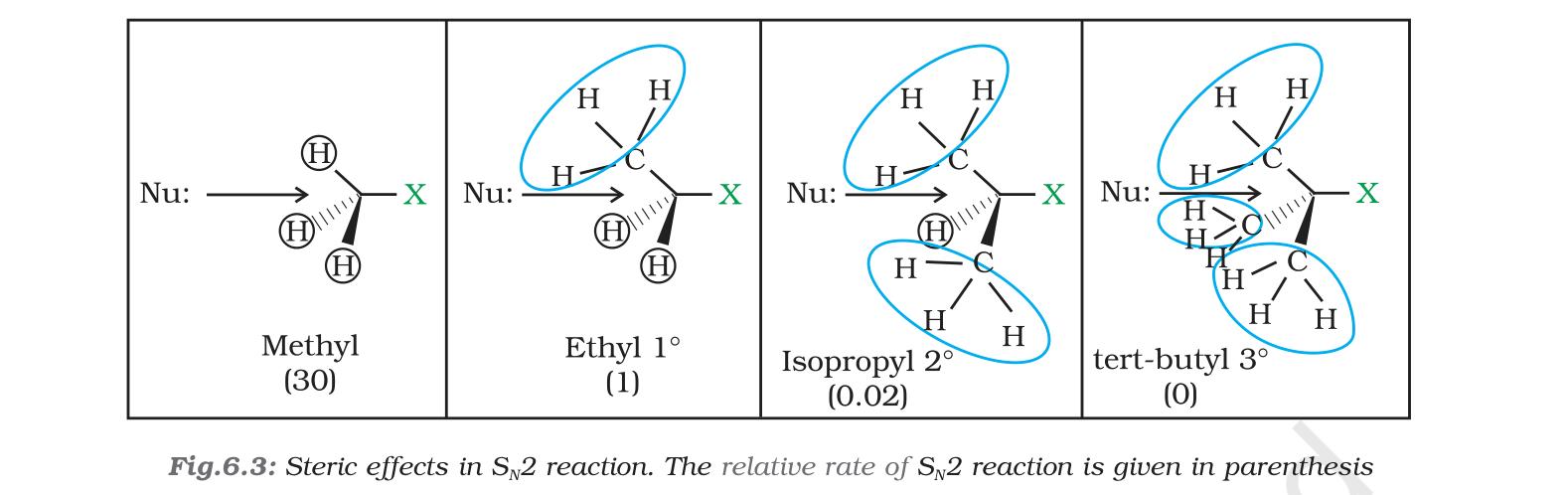
The rate depends on both partners, which is why the name is bimolecular. Steric crowding controls how fast the reaction goes. Methyl halides react fastest because the three small hydrogen atoms leave the carbon open. A tertiary halide is nearly crowded shut, and the rate falls sharply: methyl, then primary, then secondary, then tertiary. Anything that crowds the carbon or its neighbouring atoms slows the reaction, and a bulky nucleophile is slower still because it has to reach the back of the molecule.

3.4 SN1: two steps and a carbocation
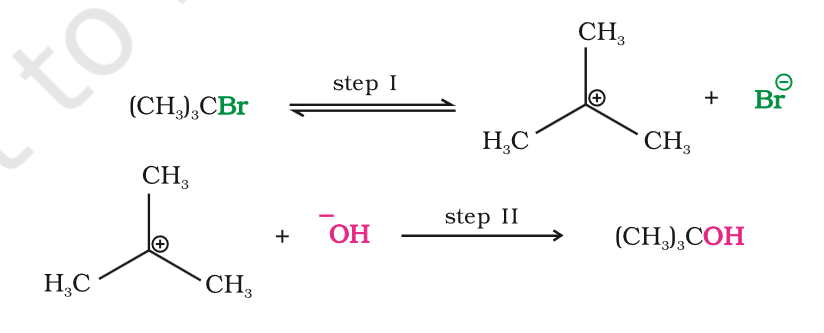
SN1 runs in two steps. In the slow first step the carbon halogen bond breaks on its own, helped by solvation of the halide by the protic solvent, and a carbocation plus a halide ion appear. In the second step the nucleophile joins the carbocation. The first step is reversible and slow, so it sets the rate, and the rate therefore contains only the concentration of the halide. That is first order, or unimolecular.
The carbocation is the star of this mechanism. The more stable the cation, the more easily it forms, so the reaction speeds up. A tertiary carbocation is stabilised by three alkyl groups through inductive donation and hyperconjugation, a secondary by two, and a primary by only one, which is why the SN1 order is the exact reverse of SN2: tertiary > secondary > primary > methyl. Allylic and benzylic halides also react quickly because their carbocations share the positive charge with a neighbouring double bond or ring through resonance.
Polar protic solvents such as water, alcohols and acetic acid help SN1 because they solvate the leaving halide and stabilise the cation. The solvent choice is one of the standard ways to push a reaction towards one mechanism: water with the halide favours SN1, while a dry polar aprotic solvent and a strong nucleophile favour SN2.
3.5 Elimination against substitution
A haloalkane with a hydrogen on the carbon next to the halogen faces two competing routes in base. Substitution replaces the halogen, while elimination removes the halogen and that hydrogen together to form an alkene. The reaction conditions tilt the competition. Aqueous KOH gives plenty of hydroxide as a nucleophile and plenty of water to solvate the halide, so substitution wins and an alcohol forms. Alcoholic KOH is a stronger base in a poorer ionising solvent, so elimination wins and an alkene forms. Bulky nucleophiles also act as bases because reaching the crowded carbon is harder than pulling a proton, and a primary halide tends to substitute by SN2 while a tertiary halide tends to ionise by SN1.
3.6 What the exam wants
A complete answer names the mechanism first, then the slow step, then the intermediate if there is one, then the stereochemical outcome. Say why the chosen mechanism fits the substrate: methyl and primary halides go SN2 because there is little hindrance, tertiary halides go SN1 because the carbocation is stable. Then add the evidence: SN2 gives inversion and obeys a second order rate law, SN1 gives racemisation and obeys a first order rate law.
Warning
Ranking charges without reasons loses marks. Write the stability order, then name the effect that causes it: three alkyl groups donate electron density, a phenyl ring spreads the charge by resonance, and crowding blocks the back side of the carbon in SN2.