

Concepts: Cross product, perpendicular directions and areas
Vector Algebra20 min readLesson 4 of 7
4.1 A product that gives a direction
The second product of two vectors gives a vector, not a number. Its magnitude measures how far the two vectors are from being parallel, and its direction is perpendicular to both of them. That combination is what makes the cross product the natural tool for areas and for normals to planes.
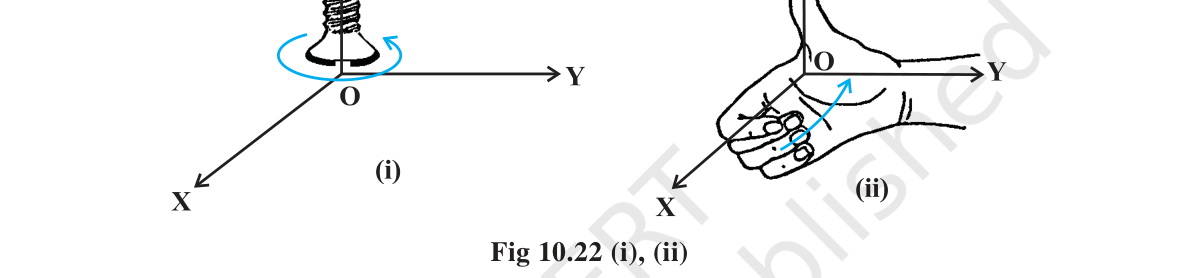
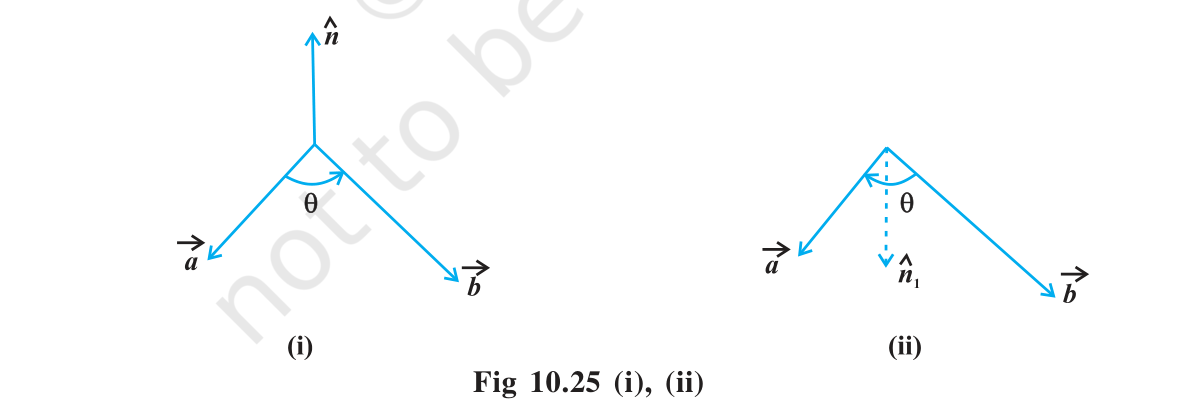
For nonzero vectors a and b with angle theta between them, the vector product is defined as the vector whose magnitude is the product of the lengths and the sine of the angle, directed along a unit vector n that is perpendicular to both. The triple a, b, n is taken in the right handed sense: if the fingers of the right hand curl from a to b, the thumb points along n. This is the right hand rule, and it fixes the sign of the answer.
4.2 Computing the cross product
The easiest way to compute a cross product is the determinant rule. Write i, j, k in the first row, the components of a in the second and the components of b in the third, then expand along the first row with alternating signs. The coefficient of i is a2b3 minus a3b2, the coefficient of j is a3b1 minus a1b3, and the coefficient of k is a1b2 minus a2b1.
Four algebraic properties get used in problems. The product is anti-commutative, because swapping the order reverses the perpendicular direction; the distributive property lets a cross product of a sum be split; a scalar can be moved outside; and the product of a vector with itself is the zero vector, since the angle is zero. Each of these follows from the definition with the sine and the right hand rule. Worked carelessly, the sign is the usual place to lose a mark, so write the vectors in the order given by the question and only then apply the formula. A second check is the dot product test: the answer must give zero with both original vectors.
A useful identity connects the two products. The square of the magnitude of the cross product plus the square of the dot product equals the product of the squared lengths. It is the vector version of the trigonometric identity that relates sine and cosine of the same angle, and it is the fastest route when a question gives the lengths and the dot product and asks for an area.
The magnitude of the cross product also gives the sine of the angle between the vectors, since the lengths are known. Combined with the dot product, which gives the cosine, it lets a question choose between the two routes. The sine route is useful when the angle is likely to be acute or when the answer must be positive.
4.3 Areas and perpendicular directions
If two vectors are the adjacent sides of a parallelogram drawn from a common point, the area of that parallelogram is the magnitude of their cross product. A triangle on the same two sides is half of that parallelogram, so its area is half the magnitude. This is the standard area formula for vectors, and it is often applied to triangles given by three points, by first forming two side vectors.
4.4 Worked examples
Example 1. Find a cross b for a = 2 i - j + 3 k and b = 3 i + 5 j - 2 k. The determinant gives i(2 - 15) minus j(-4 - 9) plus k(10 + 3), which is minus 13 i plus 13 j plus 13 k, and its magnitude is 13 root 3.
Example 2. Find a unit vector perpendicular to both a = i + j + k and b = i + 2 j + 3 k. The cross product is i minus 2 j plus k, whose magnitude is root 6, so the required unit vectors are plus or minus that vector divided by root 6.
Example 3. The triangle ABC has A(1, 1, 1), B(1, 2, 3) and C(2, 3, 1). Find its area. The sides from A are AB = j + 2 k and AC = i + 2 j, and their cross product is minus 4 i plus 2 j minus k. Its magnitude is root 21, so the area is half of root 21.
Example 4. A parallelogram is built on a = 3 i + j + 4 k and b = 5 i - 4 j + k. Find its area. The cross product is 17 i plus 17 j minus 17 k, whose magnitude is 17 root 3, so the area is 17 root 3 square units.
Example 5. Find the angle between a = i + j - k and b = i - j + k. The dot product is minus 1 and the cross product is 0 i minus 2 j minus 2 k with magnitude 2 root 2, so the sine is 2 root 2 divided by 3 and the cosine is minus one third. Both agree with an obtuse angle.
Exam
For an area question, write the two side vectors from one vertex, take the cross product, find its magnitude, then halve only for a triangle. For a perpendicular-direction question, the cross product is the answer before normalisation, and the unit vector needs a division by its magnitude. Keep the order of the vectors in the cross product consistent, because the direction flips otherwise.
Common mistake
Do not write the cross product as a number. It is a vector, and only its magnitude is a scalar. Do not forget the minus sign in the j component of the determinant expansion, and do not lose the half when the question is about a triangle. Also, a zero cross product does not mean the vectors are equal; it means they are parallel.