

Concepts: Vectors, their types and addition
Vector Algebra20 min readLesson 2 of 7
2.1 Why vectors need their own algebra
Some quantities are fully described by a number with a unit: a length of 1.6 metres, a mass of 10 kilograms, a time of 5 seconds. These are scalars. Other quantities need a direction as well. A force has a strength and a direction, a displacement says how far and which way, and a velocity adds a direction to a speed. These are vectors, and ordinary arithmetic is not enough for them.
The chapter builds a geometry and an algebra for vectors at the same time. The geometry comes from directed line segments, and the algebra comes from components, which you will meet on the next page. Both descriptions must agree, and most exam questions move between them.
Slideshow, slide 1 of 3. Use the left and right arrow keys to change slides and the space bar to play or pause.
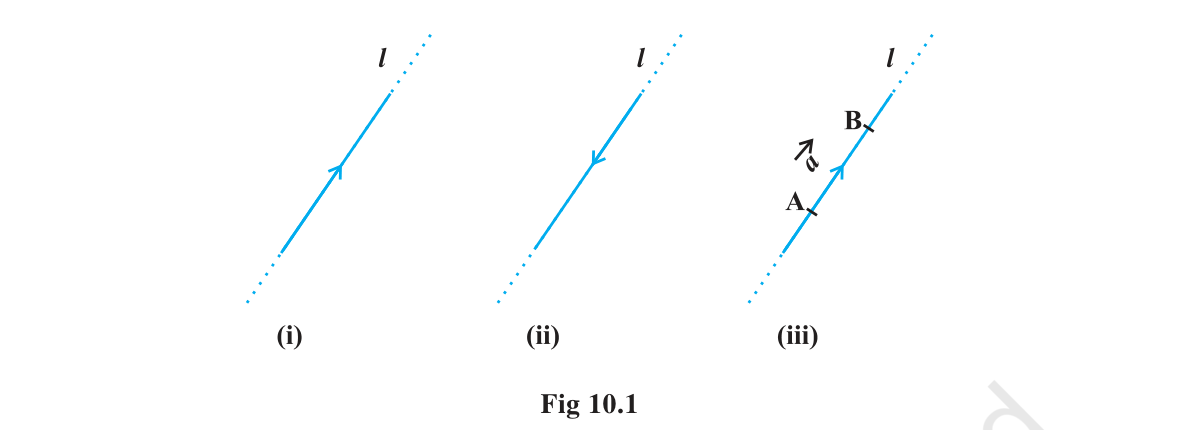
Three drawings of a line l with arrowheads: a directed line, the same line reversed, and the directed line segment AB.
2.2 Directed line segments
Take any straight line and put an arrowhead on one end. A line with a direction marked on it is a directed line. Cut a piece of that line between two points A and B and the piece carries both a length and a direction, so it is a directed line segment. Such a quantity, fixed by a length and a sense, is what the chapter calls a vector.
The point where the segment starts is the initial point, and the point where it ends is the terminal point. The distance between them is the magnitude, written with vertical bars. The arrow carries the direction. One warning follows immediately: a magnitude is a length, so it can never be negative, and a statement like the magnitude is less than zero has no meaning.
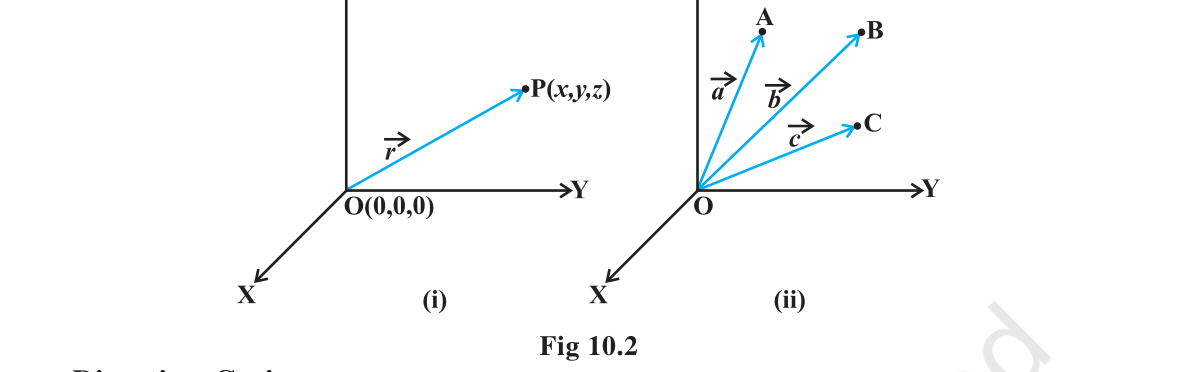
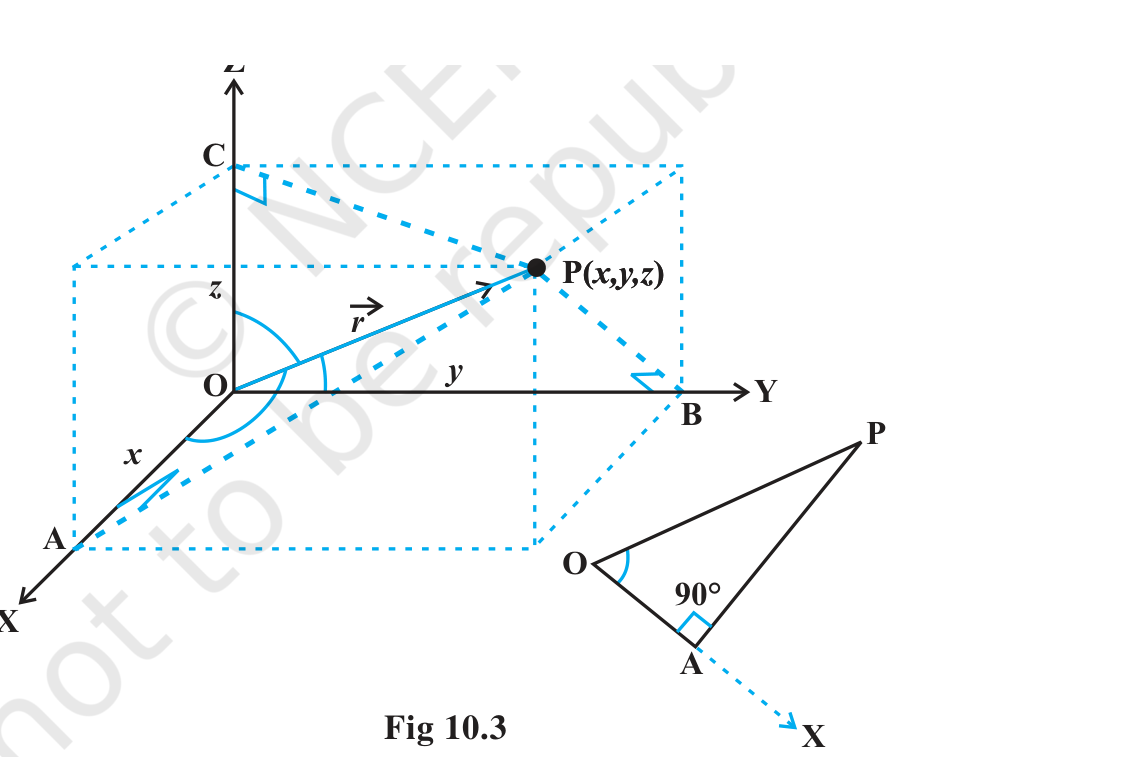
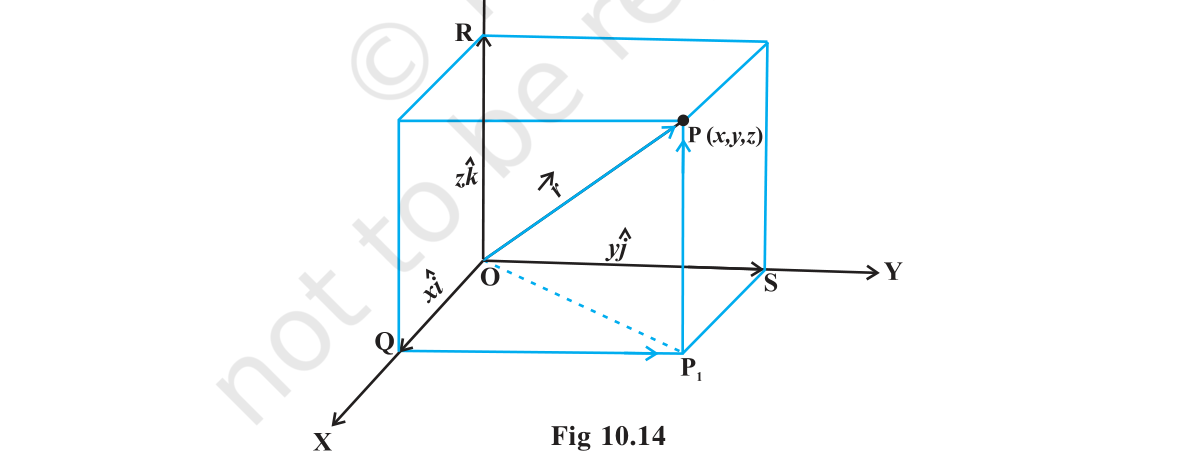
When the initial point of a vector is the origin O and the terminal point is P, the vector OP is called the position vector of P with respect to O. In three dimensional space with P at (x, y, z), the length of OP comes from the distance formula, which is the square root of x squared plus y squared plus z squared. The position vectors of points A, B and C are usually written a, b and c.
2.3 Types of vectors
Six named types appear in this chapter, and boards ask them as one-mark definitions.
When the start and the end of a vector are the same point, it is the zero vector, also called the null vector. It has zero magnitude and no fixed direction, and it acts as the additive identity. A vector of length one is a unit vector, written with a hat over the symbol. Two or more vectors with the same initial point are coinitial. Vectors are collinear when they are parallel to the same line, whatever their lengths and senses. Two vectors are equal when they have the same magnitude and the same direction, wherever they are drawn. The negative of a vector has the same magnitude but the opposite direction.
The last type explains why vector problems are simpler than they look. A vector is a free vector when it may be shifted parallel to itself without changing its length or direction, so only its components matter. Throughout this chapter, all vectors are treated as free vectors.
2.4 Adding and subtracting vectors
Picture a girl who walks from a point A to a point B and then from B to a point C. The single displacement that takes her from A to C is the same as doing the two walks one after the other. Written as vectors, the displacement AB plus the displacement BC equals the displacement AC. This is the triangle law of vector addition.
The triangle law works for any two vectors. Place the initial point of the second vector on the terminal point of the first, and the third side of the triangle, taken from the start of the first to the end of the second, is the sum. The same sum appears if the two vectors are drawn from a common point as adjacent sides of a parallelogram: the diagonal through the common point represents the sum. That is the parallelogram law, and the two laws are equivalent.
Reversing a vector and then adding it subtracts vectors. If b is the vector from A to B, the vector from B to A is negative b. The sum of the vector and its reverse is the zero vector, and subtracting b from a is the same as adding the negative of b to the vector a. In triangle language, if you walk around a closed triangle, the vector sum of the three sides taken in order is zero.
Addition has the two properties you would want. It is commutative, so a + b equals b + a, and it is associative, so a + (b + c) equals (a + b) + c. The associative property means the sum of three vectors can be written without brackets. The zero vector is the additive identity, since a + 0 = 0 + a = a.
2.5 Multiplying a vector by a scalar
A scalar times a vector is a new vector. If k is a scalar and a is a vector, then k a is collinear with a. Its length is |k| times the length of a, and its direction is the same as a when k is positive and opposite when k is negative. When k equals minus one, the result is the negative of a, which is the additive inverse.
Two consequences are used constantly. First, two nonzero vectors are collinear exactly when one is a scalar multiple of the other. Second, dividing a vector by its own magnitude gives a unit vector in its direction, since one over the length is a positive scalar. The scalar can be zero, in which case the product is the zero vector.
Exam
For a one-line answer, distinguish magnitude from direction, and remember the four tests that come up most: equal vectors need equal magnitude and direction; collinear vectors need a scalar relation; a unit vector needs length one; and the zero vector has no definite direction. Write tests as equations, not as sentences.
Common mistake
Do not treat a vector as a number. The magnitude of a + b is not the sum of the magnitudes in general, and the direction of b is not the same as the direction of a + b. Also, a vector drawn at a different place is still the same free vector, so moving a vector on the page changes nothing.