

Concepts: magnetic force and motion of a charged particle
Moving Charges and Magnetism22 min readLesson 2 of 6
2.1 The magnetic force
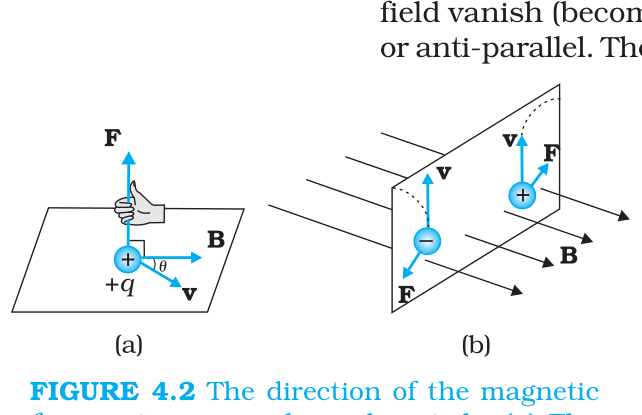
A charge at rest in a magnetic field feels no magnetic force. A charge moving parallel to the field also feels none. The maximum force appears when the velocity is perpendicular to the field, and in general the force is the charge times the cross product of velocity and field. The direction follows from the right hand rule for the cross product: point the fingers along the velocity, curl toward the field, and the thumb gives the force on a positive charge. For a negative charge the direction reverses.
The magnetic force is always perpendicular to the velocity, so it does no work on the charge. Kinetic energy stays constant and the speed stays constant. What changes is the direction of motion, so the magnetic field bends the path without speeding the charge up. This is a favourite conceptual question because it combines two ideas that look contradictory at first.
2.2 Motion in a uniform field
When the velocity is perpendicular to a uniform field, the magnetic force has a constant size and always points toward the centre of curvature, which is exactly the centripetal force needed for a circle. Set q v B equal to m v squared over r and the radius is m v over q B. The angular speed is q B over m and the time period is two pi m over q B.
The time period does not depend on the speed. A faster particle travels a bigger circle in the same time. This is why a cyclotron can keep accelerating particles with a fixed frequency, and it is the basis of the cyclotron frequency q B over two pi m. For a deuteron and an alpha particle with the same kinetic energy in the same field, the radii differ because the mass to charge ratio differs.
When the velocity makes an angle with the field, split it into a component along the field, which stays constant, and a component perpendicular to the field, which produces circular motion. The combined path is a helix whose axis is along the field. A charge projected exactly along the axis of a solenoid therefore feels no magnetic force and keeps its velocity.
2.3 Force on a current carrying conductor
A wire carrying current contains charges in steady motion, and each of them feels the magnetic force. Their sum is the force on the wire, and for a straight segment of length l in a uniform field the result is F = I l B sin theta, directed perpendicular to both the wire and the field. The direction again comes from the right hand rule, with the current direction replacing the velocity direction.
A current loop in a uniform field feels forces on its various segments. If the plane of the loop is parallel to the field, the forces on the two sides perpendicular to the field are opposite and produce a couple; the torque tends to turn the loop. If the plane is perpendicular to the field, the forces are radial and cancel without a torque. That is the origin of the torque expression in the next page, and of the mirror galvanometer scale: the torque depends on the angle between the loop normal and the field.
2.4 Common mistakes
Forget to reverse the direction for a negative charge and the whole answer flips. Use the field direction only, without the velocity, in the right hand rule and the direction is meaningless. Write r = m v / q B but substitute the component of speed perpendicular to the field, not the full speed in a helical case. And for a charge moving along the field, do not report a circular path: the force is zero there.
Warning
The magnetic force does no work, so any answer that says the kinetic energy changes is wrong. If the speed changes in a problem, some other force is present, such as an electric field.
2.5 Crossed electric and magnetic fields
When electric and magnetic fields act together, the total force on a moving charge is the sum of qE and q v × B. For a beam of charged particles moving in crossed fields, the two forces can be balanced by choosing E equal to v B. Particles with that speed pass straight through, while faster and slower particles are deflected to opposite sides. The device is a velocity selector, and it is the front end of a mass spectrometer, where the selected beam is later bent by a magnetic field alone so that the radius of curvature separates particles by mass.
A charge moving in a region where only the magnetic field varies cannot be treated with the constant radius formula. The radius changes locally as B changes, and the particle follows a curved path with a varying radius. Questions usually give the field at each point and ask for the direction of the force rather than the full trajectory.
2.6 Common mistakes
For a negative charge, reverse the direction that the right hand rule gives for a positive one. Do not add the magnetic force to the speed: it changes direction only. And check whether the field is uniform before using the circular path formula, because the spiral path of a field that increases along the axis is a different problem.